
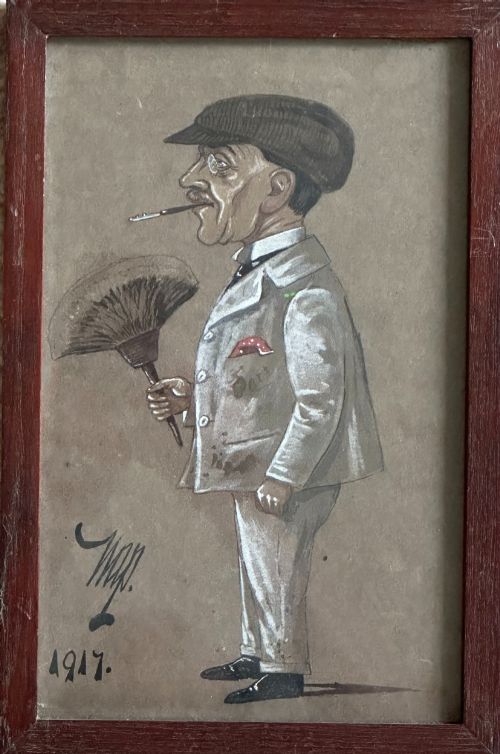
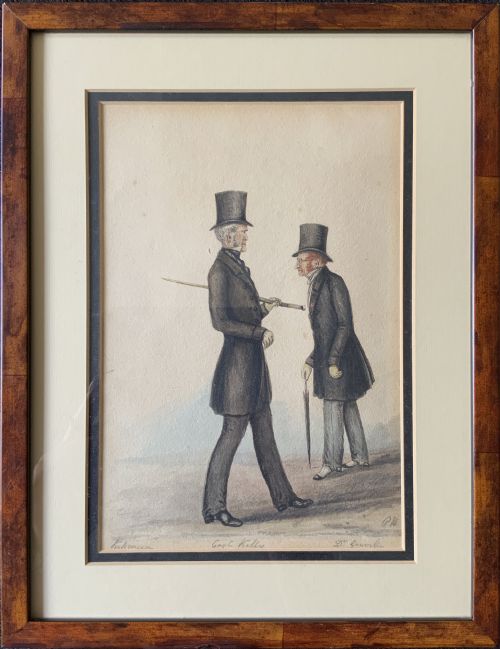
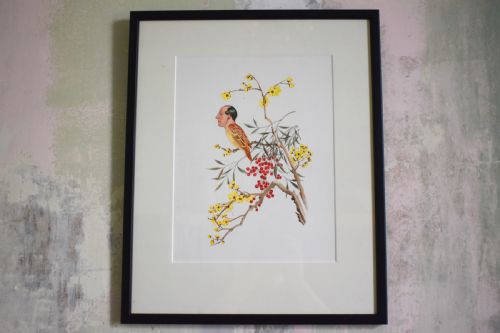
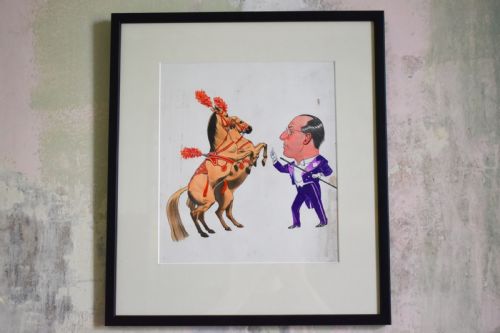


Framed Satirical Illustration
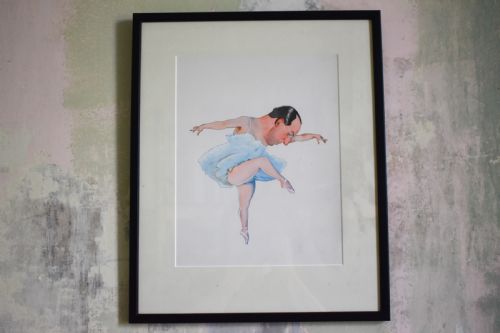
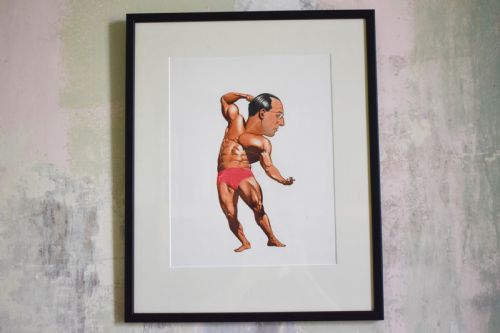
A framed satirical illustration delivers a sharp social comment through caricature, offering a witty focal point for any room.
Framed Satirical Illustration
A framed satirical illustration captures the humour and social commentary of past centuries through ink, paint, and print. These works range from George III period long engravings to early 20th century caricatures.
Buyers frequently encounter works executed in watercolour, ink, and gouache alongside chromolithographs and antique prints. Dating spans from the 18th century through the Victorian, Edwardian, and 1930s periods.
The assortment includes individual cartoon watercolours, political prints, and runs of caricatures depicting military figures or travel themes. Each piece arrives ready to hang within its original or period framing materials.
Materials and techniques
Artists employed watercolour pigments, gouache, and ink upon paper to produce these illustrative caricatures by hand. Chromolithography enabled vibrant multi-coloured reproduction for published satirical prints.
Framing typically incorporates traditional wood mouldings and protective glass to preserve the delicate paper beneath. Mount boards provide structural support and separation between the artwork and the glazing.
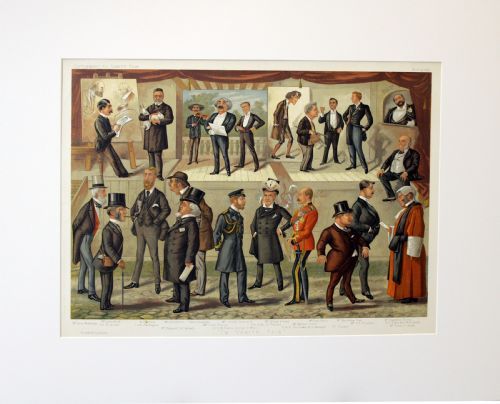
The selection includes individual cartoon watercolours, Vanity Fair chromolithographs, and runs of First World War German general caricatures.
Understanding quality
Quality rests upon the artist's draughtsmanship and the expressive precision of the caricature. Skilful brushwork in watercolour or ink distinguishes superior original paintings from standard printed material.
The preservation of the paper surface and the vibrancy of the pigments dictate overall desirability. Original period framing also contributes to the integrity of the piece.
Thomas Worth·Henry William Bunbury
The Framed Satirical Illustration Glossary
- Caricature
- A rendered image that exaggerates peculiarities or defects of persons or subjects for humorous effect. This forms the core of satirical illustration.
- Chromolithography
- A planographic colour printing technique used to produce multi-coloured lithographic prints. Vanity Fair utilised this method for its published plates.
- Gouache
- An opaque watercolour paint consisting of pigment, water, and a binding agent such as gum. It provides solid, flat areas of colour in illustrative works.
- Engraving
- A printmaking process where an artist cuts lines into a metal plate to hold ink. George III period examples demonstrate this traditional method.
Framed Satirical Illustration: Frequently Asked Questions
What periods do these illustrations cover?
The available works stretch from the 18th century through the Victorian and Edwardian eras into the 1930s. Each era brings distinct stylistic traits, from George III engravings to 1930s Art Deco illustration.
Buyers will find that 19th-century political prints and early 20th-century caricatures form the bulk of the selection. Dating is supported by explicit evidence within individual titles and dates.
Are these works original or prints?
The inventory encompasses both unique hand-painted watercolours in gouache and ink, and period printed matter. Items such as Vanity Fair chromolithographs and political prints represent mass-produced satirical media.
Conversely, items described as watercolour paintings or runs of caricatures represent hand-executed original works. Checking the listed medium clarifies whether a piece is painted or printed.
How should I hang these framed pieces?
Paper and watercolour works require placement away from direct sunlight to prevent pigment fading over time. Standard wall hanging fixtures suit the wood frames provided with the artworks.
Glass and mount boards protect the paper from ambient moisture and environmental dust. Ensure the hanging wall is structurally sound to support the weight of the wood and glass frame.
How do I identify a political print?
Political prints often feature specific historical figures, satirical commentary on events, and attribution to known artists such as Thomas Worth. Their imagery focuses on public affairs, elections, or social critique.
Such works frequently employ a narrative caption or title within the print border. The 19th-century American political print category exemplifies this style.