
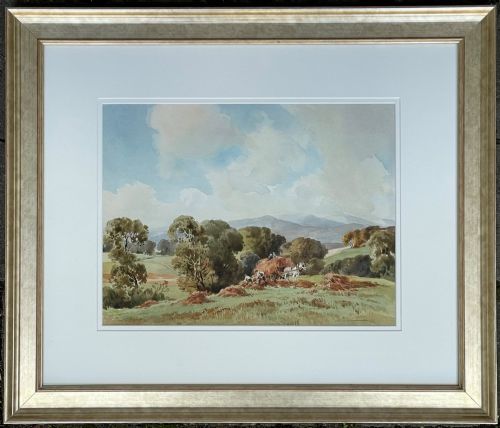
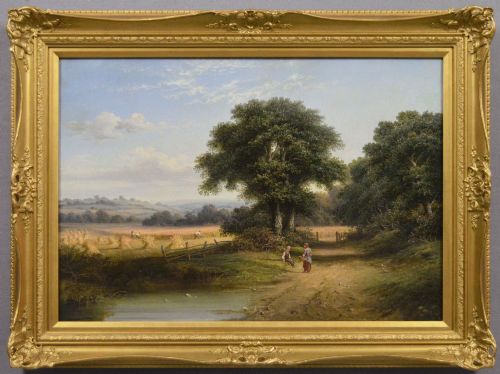
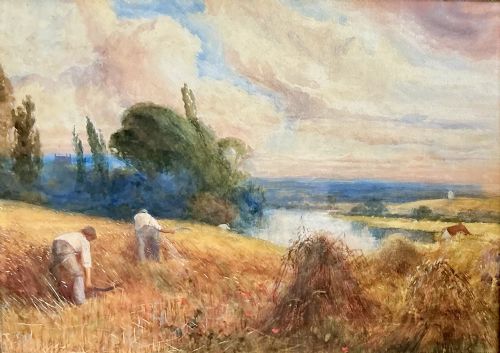


Framed Harvest Landscape Painting
A framed harvest landscape painting captures rural toil and golden fields across British pastoral scenes from the nineteenth and twentieth centuries.
Framed Harvest Landscape Painting
A framed harvest landscape painting depicts agricultural scenes such as hay cutting, wheat gathering, and farmworkers with horses in British countryside settings. These works span periods from the mid-nineteenth century through the mid-twentieth century, encompassing Victorian and Edwardian pastoral traditions.
Buyers will encounter both oil on canvas and watercolour works, often preserved behind glass within original giltwood frames. The subjects focus closely on rural labour, riverbanks, and cornfields during the seasonal harvest.
Artists record specific regional topography, including the Vale of Evesham, the river Kennet, Wharfedale, and Sussex, alongside unlocated rural vistas. The execution ranges from detailed realism to British Impressionism and naive school depictions.
Materials and Techniques
Artists built these works using oil paint on stretched canvas or applied watercolour and gouache pigments to paper. Canvases provide rich texture for depictions of cornfields and stormy skies, whilst paper supports fluid washes for river scenes and atmospheric dusks.
Makers housed the finished works in timber frames, frequently decorated with giltwood finishes and protected by glass in the case of watercolours. These frames complement the pastoral subject matter and secure the fragile media against environmental damage.
Regional styles represented include British Impressionism, Scottish Impressionism, and traditional British realism.
Quality Variations
The standard of a framed harvest landscape painting rests upon the artist's ability to render light, shadow, and movement within figures and livestock. Superior examples demonstrate confident brushwork and accurate anatomical proportions in working horses and farmworkers.
The integrity of the original wooden and giltwood frame contributes significantly to the piece, as period frames matching the creation date enhance the work's historical context. The depth of the colour palette and the preservation of the pigment without excessive fading separate accomplished works from simpler student pieces.
Walter Heath Williams·Henry H Parker·Herbert Royle·Arthur Walker Redgate·John Clayton Adams
The Framed Harvest Landscape Painting Glossary
- Oil on Canvas
- Pigment mixed with drying oil applied to a woven fabric support. This medium allows for thick impasto application and deep colour saturation.
- Watercolour
- Pigments suspended in a water-soluble vehicle applied to paper. It creates transparent washes of colour suited to delicate landscape lighting.
- Giltwood
- Timber coated with a thin layer of gold leaf or gilt finish. It provides ornate framing for traditional and impressionist paintings.
- Gouache
- An opaque water-based paint containing pigment and a binding agent. It offers heavier coverage than traditional watercolour.
- Pastoral
- Artistic work depicting rural life and agricultural scenes in an idealized or realistic manner. It forms the primary genre for harvest paintings.
Framed Harvest Landscape Painting: Frequently Asked Questions
What periods do these paintings date from?
The available works date primarily from the nineteenth and twentieth centuries, spanning the Victorian and Edwardian eras up to the nineteen-fifties. Painters recorded rural scenes continuously through these decades.
Earlier pieces often reflect nineteenth-century realism, whilst later examples embrace impressionist techniques and naive school interpretations.
How should I hang a framed harvest painting?
Display these works away from direct sunlight and excessive moisture to protect oil on canvas surfaces and delicate watercolours on paper. Stable indoor temperatures prevent warping in the timber frames.
Ensure wall fixings match the weight of the wooden and giltwood frames, particularly for larger canvases.
Are watercolours always framed behind glass?
Works on paper require glass protection to shield the pigment from dust, moisture, and physical contact. Most period watercolours retain their original glass and framing.
Oil paintings on canvas generally remain unglazed to allow the textured paint surface to breathe.
How do I identify the subject location?
Many titles or artist signatures note specific British locations such as the Vale of Evesham, Wharfedale, or Arundel Castle. Local topographical details often appear within the composition.
Unsigned or untitled pieces rely on stylistic clues and regional agricultural attire to suggest a general British countryside origin.