
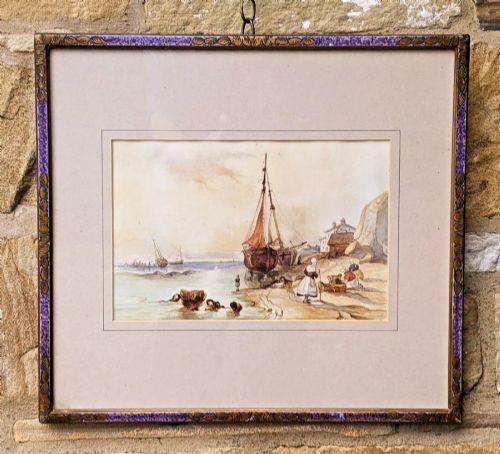


Framed Fish Print
These framed fish print pieces bring nineteenth-century natural history and marine subjects into the home, prized for their traditional engraving work and watercolour detail.
Framed Fish Print
When you search for a framed fish print, you encounter nineteenth-century natural history subjects, antique engravings, and watercolour paintings. These items capture marine life and angling themes through historical illustration.
The pieces on this page lean heavily towards Victorian and nineteenth-century works, often presented in wood frames under glass. You will find individual plates, sets of prints, and hand-painted coastal scenes.
Originating from British sporting art and natural history traditions, these works document aquatic species and fishing culture. They offer a direct window into historical scientific illustration and decorative art.
How they were made
Maker techniques rely on traditional paper media, utilising ink, watercolour pigment, and gouache to render marine subjects. Engraving methods deliver precise anatomical lines for scientific and decorative plates.
Unusual supports appear in the selection, including pith paper for delicate Chinese export gouache paintings. Framing materials typically involve wood and oak, paired with protective glass to preserve the paper surfaces.
Listings feature paper, oak, wood, and glass alongside watercolour, ink, and pith paper across the nineteenth and twentieth centuries.
What varies in quality
Quality rests on the precision of the engraving work and the finesse of any hand-applied watercolour pigment. Early nineteenth-century plates by known illustrators exhibit superior line definition compared to later decorative copies.
The integrity of the paper and the original framing elements dictate the overall grade of the piece. Clean margins, vibrant pigments without fading, and period-appropriate oak or wood frames elevate the standing of the work.
Jonathan Couch·Thomas Bush Hardy·Snaffles
The Framed Fish Print Glossary
- Engraving
- A printmaking technique where an artist carves an image into a metal plate to hold ink. This method produces sharp, permanent lines suited for detailed fish illustration.
- Pith paper
- A delicate material cut from the pith of the rice paper plant, used in nineteenth-century Chinese export paintings. It accepts gouache and watercolour with a characteristic luminous depth.
- Gouache
- An opaque watercolour paint that provides heavier coverage and brighter colour saturation than traditional transparent washes. It is frequently found on botanical and zoological export works.
- Watercolour pigment
- Finely ground colour suspended in a water-soluble binder, applied to paper for subtle tonal shifts. It brings naturalistic colour to nineteenth-century marine and coastal scenes.
Framed Fish Print: Frequently Asked Questions
What is a framed fish print?
A framed fish print is a historical illustration, engraving, or watercolour depicting marine life or angling, preserved behind glass within a wood frame.
These pieces originate predominantly from the nineteenth century, reflecting the era's fascination with natural history and coastal sports.
How old are these framed fish prints?
The pieces span the nineteenth century and the early twentieth century, with examples dating from around eighteen hundred through to nineteen thirty.
Victorian natural history publishing and sporting art represent the primary chronological periods for these works.
How were these marine prints displayed?
Historically, natural history plates and sporting prints were bound in volumes, kept in portfolios, or framed for display in studies and libraries.
Today, they are mounted under glass in wood or oak frames to protect the antique paper from environmental damage.
Are these prints hand painted?
Some pieces are original hand-painted watercolours or gouache works on paper, while others are engraved plates that may feature subtle hand-colouring.
Techniques vary from precise black and white engravings to fully pigmented studies of fish and coastal scenes.