

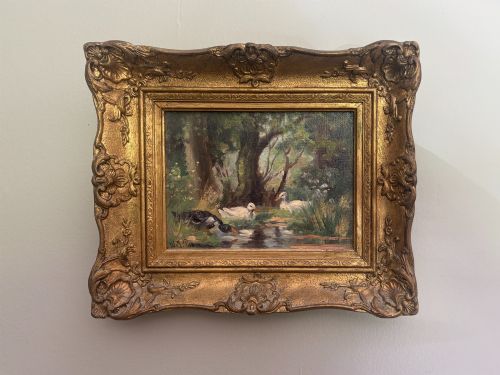
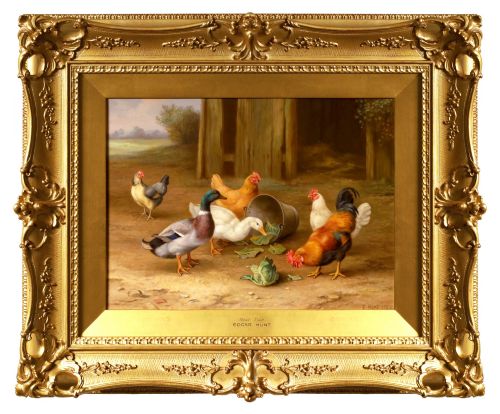


Framed Duck Canvas Artwork
These framed duck canvas artwork pieces bring pastoral and sporting life into rooms through oil paint on canvas.
Framed Duck Canvas Artwork
Framed duck canvas artwork centres on oil paintings depicting birds, farmyards, and river landscapes across several historic periods. The selection runs from the eighteenth century through the Victorian era and into the early twentieth century.
Buyers meet works from continental and British schools, often housed in giltwood frames with plaster elements. These paintings capture rural scenes, sporting subjects, and naturalism.
The subjects range from domestic ducklings with mothers to flying birds and waterside wildlife. Each piece represents a specific historic artistic interpretation of animalier and pastoral life.
Materials and Technique
Artists painted these works using oil on canvas, applying pigment to textile supports to build depth and texture. The resulting surfaces hold the brushwork of nineteenth century realism and pastoral styles.
Surrounding the canvases are giltwood frames, frequently incorporating moulded plaster details to ornament the borders. These frames protect the edges of the canvas while providing a polished display format.
Framed Duck Canvas Artwork Retail Price Guide 2026
Typical asking prices for framed duck canvas artwork among the pieces listed under this phrase on Sellingantiques today, from the lower quarter to the upper quarter. They describe what is for sale here now, not the wider market.
Materials across this selection include oil paint, canvas, giltwood, and plaster, spanning the eighteenth to early twentieth centuries.
Gradations in Quality
The standard of a piece rests in the precision of the brushwork and the anatomical accuracy of the wildlife depicted. Master painters capture feather texture and river light with greater nuance than lesser contemporaries.
Frame construction also dictates the standing of an item, with carved giltwood and intact plaster enrichment holding more distinction than plain or heavily restored surrounds.
Edgar Hunt·Philipp Ferdinand de Hamilton·Percival Glenfern·John Frederick Herring·Claude Cardon·Arthur Walker Redgate·Alfred Banner·Thomas Blinks·Constant Ludovic Artz
The Framed Duck Canvas Artwork Glossary
- Canvas
- A heavy woven fabric used as a surface for oil painting. It provides the tensile strength needed for large historical works.
- Giltwood
- Wood carved and covered with a thin layer of gold leaf. This material defines the ornate frames typical of the period.
- Animalier
- Art focusing on the realistic portrayal of animals. The term applies widely to nineteenth century sporting and farmyard paintings.
- Plaster
- A workable mixture used to create moulded ornamentation on frames. It hardens to form decorative relief patterns around the artwork.
Framed Duck Canvas Artwork: Frequently Asked Questions
How old are these paintings?
The works span from the eighteenth century through the Victorian period and into the early twentieth century. Each era brings distinct characteristics in framing and subject matter.
Dates are established through stylistic analysis of the brushwork, canvas preparation, and the framing techniques employed by the period makers.
What is animalier art?
Animalier art refers to the realistic and detailed depiction of animals within fine art painting and sculpture. This genre gained prominence during the nineteenth century across British and continental schools.
Artists in this tradition focused closely on the natural behaviour and anatomy of ducks, wildlife, and farm animals in their native environments.
How should I hang them?
These framed pieces require sturdy wall fixings due to the weight of the traditional canvas, stretcher bars, and giltwood frames. Position them away from direct sunlight to protect the oil pigments.
Maintain stable indoor humidity levels to prevent movement in the timber stretcher frames and the plaster elements of the giltwood surrounds.