




Framed Cottage Landscape Watercolour
A framed cottage landscape watercolour captures the charm of rural life through delicate pigment on paper.
Framed Cottage Landscape Watercolour
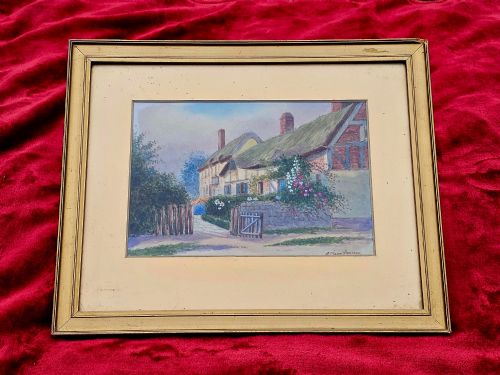
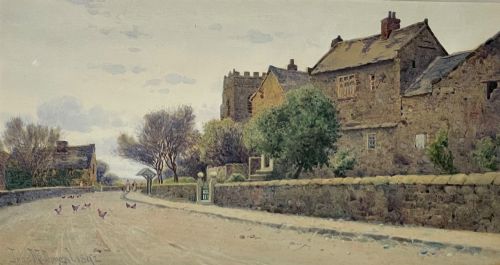
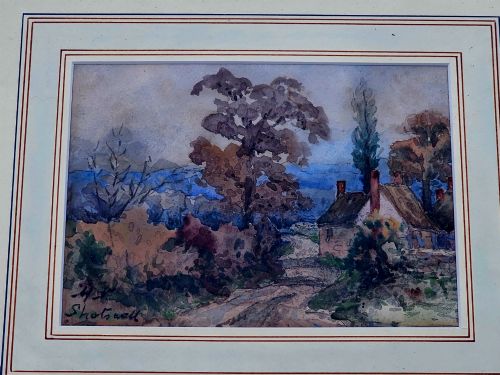
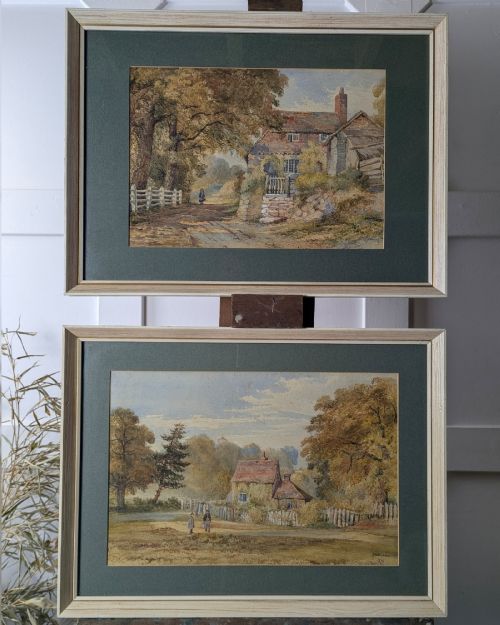
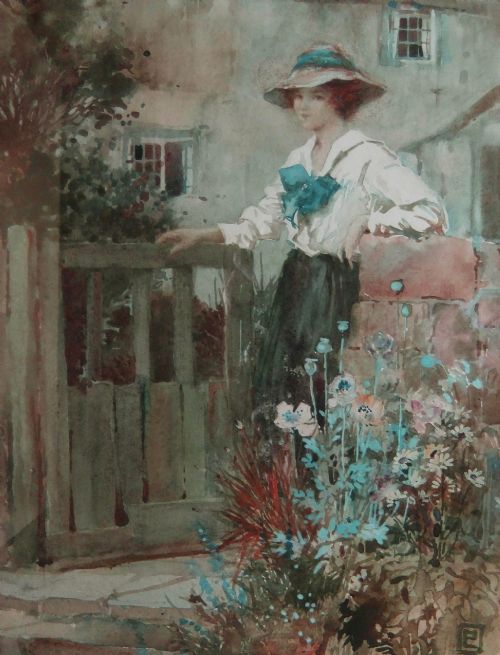
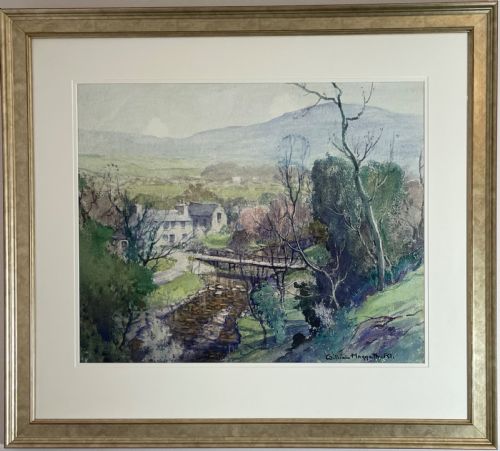
A framed cottage landscape watercolour is a work of art on paper, depicting rural dwellings, gardens, and village scenes across the nineteenth and twentieth centuries. These paintings reflect pastoral interests through distinct regional depictions ranging from Victorian rural genre to Edwardian pastoral styles.
The versions most commonly met on this page date from the Victorian era through to the mid-twentieth century. They combine traditional watercolour pigment on paper with period wooden and gilt frames, capturing the English countryside as seen by artists working in local villages and coastal settlements.
How they were made
Artists applied watercolour pigment onto paper using washes and fine brushwork to build depth and atmospheric light. Many works rely on the white of the unpainted paper to create highlights in clouds, whitewashed walls, and sunlit paths.
Finished works were mounted behind glass within wooden frames, frequently finished in gilt to complement the delicate tones of the painting. These protective enclosures preserved the water-soluble pigments from moisture and fading over decades.
The listings include watercolours produced across the Victorian, Edwardian, and mid-century periods, utilising paper, glass, and gilt wood.
What varies in quality
Quality rests upon the artist's ability to handle light, shadow, and architectural perspective within a watercolour medium. Stronger examples display confident brushwork and balanced composition, capturing movement in figures and animals rather than relying on stiff formulae.
The preservation of the pigment and the original framing also influence the standard of a piece. Works retaining fresh, un-faded colour and secure period frames sit at the upper end of the range.
A. Marie Parsons·John McDougal·Robert A. Nottingham·Percy Lancaster·Fred Lawson·J S Ainley·William Hoggatt·James Hardy Junior·Theresa Stannard·Helena Maguire·Owen Bowen·Lilian Stannard·Henry Sylvester Stannard·Henry Charles Fox·Will Anderson·Thomas James Lloyd·B. Kaufmann·David Woodlock·Joseph Kirkpatrick·J.V.R.Parsons·Arthur Claude Strachan·John Abernethy Lynas-Gray·Walter Henry Sweet·Thomas Nicholson Tyndale·Jane Utley
The Framed Cottage Landscape Watercolour Glossary
- Watercolour pigment
- Finely ground colour mixed with a water-soluble binder, applied in translucent layers on paper. This medium allows artists to achieve luminous effects through washes that let the underlying paper show through.
- Gilt wood
- Wood coated with a thin layer of gold leaf or metallic paint. It provides a reflective border that frames and enhances the tonal range of the painting.
- Victorian rural genre
- A nineteenth-century style focusing on everyday country life, labour, and domestic scenes. These works often depict figures engaged in cottage tasks, farm work, or village gatherings.
- Edwardian pastoral
- An artistic movement from the early twentieth century celebrating an idealized English countryside. The style emphasises harmonious village scenes, cultivated gardens, and quiet rural lanes.
Framed Cottage Landscape Watercolour: Frequently Asked Questions
Where were these watercolours painted?
Artists travelled across British counties to record specific villages, coastal towns, and rural cottages. Locations span from Devon and Somerset to Yorkshire and the Isle of Man.
Many works capture identifiable local architecture, village greens, and coastal homes, providing a visual record of regional English life during the nineteenth and early twentieth centuries.
How should I hang them at home?
Watercolours are sensitive to bright natural light and benefit from placement away from direct sunlight. Hang them on interior walls where illumination can be controlled to prevent the pigments from fading.
Pairing these paintings with traditional wooden or gilt frames helps them integrate naturally into classic or contemporary room schemes.
Are these paintings original works?
The listings consist of unique, hand-painted works created directly by the artist rather than mass-produced prints. Each piece displays the individual brush marks and tonal choices of its creator.
Signatures, dates, and inscriptions found on the paintings or mounts often provide direct links to the individual artists who recorded these rural scenes.
What subjects appear in these scenes?
Common subjects include thatched cottages, walled gardens, village lanes, and coastal houses. Figures often appear tending gardens, feeding hens, or working outside rural dwellings.
These compositions reflect a strong contemporary interest in traditional English country life and pastoral tranquillity.