


Framed Cottage Landscape Canvas
A framed cottage landscape canvas brings the quiet pastoral scenes of past centuries directly onto the wall.
Framed Cottage Landscape Canvas
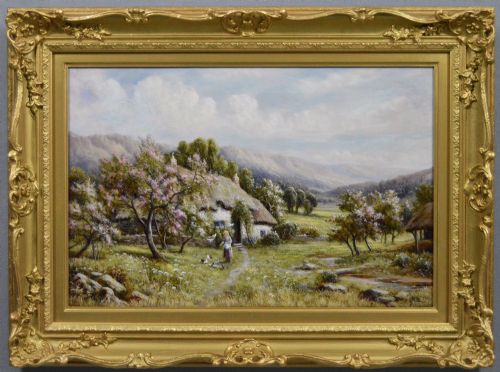
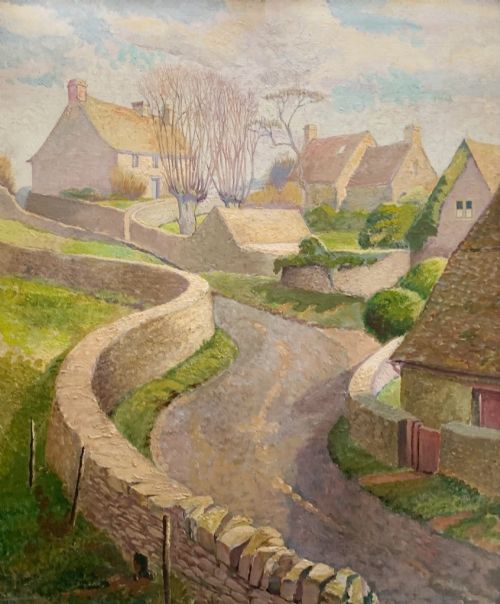
A framed cottage landscape canvas depicts rural dwellings, farmsteads, and country rivers through oil paint applied to stretched fabric. These works capture domestic rural life, often featuring figures outside thatched cottages, farm animals, or quiet waterways.
The pieces on this page span from the nineteenth century through the mid-twentieth century, including Victorian works and later Impressionist interpretations. British and continental European schools provide the majority of these pastoral subjects.
Buyers encounter both signed canvases by known painters and unsigned works from regional English or European schools. Domestic scenes such as gardens, farmyards, and riverbanks dominate the available compositions.
Materials and Construction
Artists painted these works using oil paint on canvas, a combination that allowed for rich texture and gradual blending of colour. Canvases were typically stretched over wooden frames to maintain tautness and stability before being mounted within decorative surrounds.
Moulded gesso and gilt wood frequently form the frames that house these paintings, adding weight and reflective surface depth. The framing materials often reflect the aesthetic preferences of the period in which the canvas was produced.
Several cottages hiding in these woods come complete with wandering geese and grazing sheep.
Evaluating Quality
The strength of a framed cottage landscape canvas rests on the confidence of the brushwork and the harmony of the palette. Skill in rendering natural light, atmospheric depth, and structural details marks the distinction between routine regional output and superior artistic execution.
Condition plays a part in the standing of a piece, particularly the preservation of the original paint surface and the structural integrity of the stretcher and frame. Original matching frames that complement the age of the canvas elevate the integrity of the whole object.
Robert John Hammond·Mario Pinetti·Frederick James Knowles·William Greaves·Charles Vickers·Donald McIntyre·Robert Finley McIntyre·Ernest Higgins Rigg·Lorenzo Headley·Helmut Reuter·John Falconar Slater·Robert Gemmell Hutchinson·Harry Pennell·Ernest Walbourn·George Cole·Herbert Royle·James William Stamper·James Ward·George Morland·Robert Gallon·Thomas Thomas·Stuart Lloyd
The Framed Cottage Landscape Canvas Glossary
- Oil on Canvas
- Pigment suspended in a drying oil medium applied to a woven fabric support. This combination permits deep tonal variation and durable longevity.
- Gesso
- A plaster-like mixture applied to wooden frames as a base for moulding and gilding. It provides a smooth surface for ornamental detail.
- Impressionism
- An artistic style focusing on accurate depiction of light and its shifting qualities rather than minute detail. Works in this manner often display visible brushstrokes.
- Bothy
- A small rustic cottage or shelter used traditionally by farm labourers in Scotland. These stone structures frequently appear in northern rural landscapes.
- Barbizon Style
- A French school of landscape painting characterised by naturalistic scenes and atmospheric rendering of rural environments. It influenced many later nineteenth-century painters.
Framed Cottage Landscape Canvas: Frequently Asked Questions
How do I date a cottage landscape canvas?
Dating relies on stylistic clues, framing materials, and stretcher construction. Canvas types and stretcher wedges often shift across decades.
Signatures, artist records, and regional painting styles provide more precise chronological anchors when documentation survives.
Where should I hang these paintings?
These works suit traditional living spaces, studies, or dining rooms where domestic rural themes complement interior furnishings. Placing them away from direct sunlight protects the oil pigments.
Allowing adequate wall space lets the heavy gilt or wood frames define their own boundaries without crowding.
How do I clean an oil painting canvas?
Surface dust should be removed gently with a soft, dry brush by a professional conservator. Household cleaners or moisture can damage fragile paint layers.
Crackle patterns and aged varnish require expert attention to prevent permanent harm to the pigment.
What is the difference between Victorian and mid-century landscapes?
Victorian landscapes generally favour detailed realism, narrative elements, and muted natural tones. Brushwork is tightly controlled to describe foliage and architecture precisely.
Mid-century works often embrace impressionistic techniques with looser application of paint and brighter, more expressive palettes.