


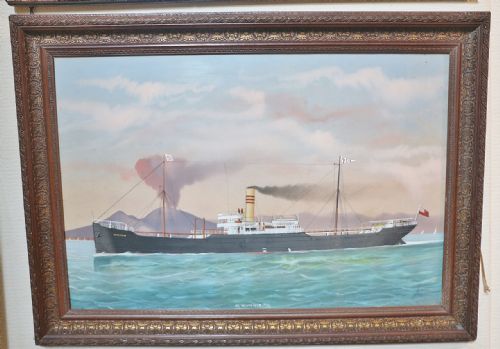


Framed Coastal Wall Decor
These framed coastal wall decor pieces bring maritime history, harbour scenes and open water into a room through traditional paintings and maps.
Framed Coastal Wall Decor
When you search for framed coastal wall decor, you encounter marine paintings, harbour views and coastal watercolours dating from the nineteenth century through to the mid-twentieth century. The selection spans traditional maritime subjects, British Impressionism and mid-century interpretations of the sea.
The most common pieces on this page are oil paintings on canvas or panel depicting harbours, ships and coastal inlets from periods such as the Victorian era and the nineteen-sixties. Watercolours and antique maps also appear alongside these oils, offering varied depictions of ports and shorelines.
Subjects range from quiet Cornish fishing ports and estuary views to warship portraits and transatlantic liners. Buyers select these artworks to anchor a nautical theme within a room or to collect specific regional marine schools.
Materials and Techniques
These works rely on traditional artist materials such as oil paint on canvas, board or wood panels, alongside watercolour applied to paper. Frames are predominantly wood, frequently gilded or finished to complement the maritime subject matter.
Techniques vary from detailed realist marine painting and impasto application to loose impressionistic brushwork and fine watercolour washes. Map works utilise engraved paper formats preserved from historical publications.
Listings feature works created across multiple eras, ranging from nineteenth-century marine pieces to mid-century modern oil paintings.
Assessing Quality and Execution
Quality in these coastal works rests upon the confidence of the brushwork and the accuracy of maritime detail, such as rigging, vessel architecture and coastal topography. Stronger pieces demonstrate a secure handling of light upon water and atmosphere.
The relationship between the artwork and its original or period frame contributes significantly to the overall integrity of the piece. Finer examples maintain harmony between the visual weight of the frame and the painted surface.
Edward Matthew Elliott·Helen Layfield Bradley·Sir David Murray RA·Frank Wood·H. Hadfield Cubley·Charles Cameron Baillie·James Kinnear·Paul-Louis Barruel·Thomas Bush Hardy·Arthur Joseph Meadows
The Framed Coastal Wall Decor Glossary
- Impasto
- Paint applied thickly to a canvas or panel, standing out from the surface so that texture remains visible. This technique adds tactile depth to water and sky elements.
- Panel
- A rigid flat surface, often wood, used as a support for oil paintings instead of stretched canvas. Panels offer a stable ground for detailed marine subjects.
- Watercolour
- A painting method where water-soluble pigments are suspended in a water-based solution on paper. It creates transparent washes well suited to atmospheric coastal views.
- Maritime Realism
- An artistic approach focused on the precise representation of ships, coastal scenes and naval architecture. Works in this style record historical vessels with exactness.
Framed Coastal Wall Decor: Frequently Asked Questions
What periods do these coastal artworks come from?
The listings span from the nineteenth century through Edwardian times up to mid-century modern examples dated around nineteen-sixty. Pieces include Victorian and Edwardian works alongside later twentieth-century interpretations.
This range allows collectors to choose between tightly rendered nineteenth-century marine scenes and freer mid-century depictions of harbours and estuaries.
What materials are used in these wall decorations?
Works incorporate oil paint on canvas, board or panel, as well as watercolour on paper and printed paper maps. Frames are constructed from wood, with several featuring gilded finishes.
These materials reflect traditional studio practices across the nineteenth and twentieth centuries.
How should I hang framed coastal art at home?
Consider placing these pieces in rooms that benefit from natural light, keeping them away from direct sunlight to protect painted surfaces and paper. Match the scale of the frame to the wall space available.
Grouping smaller watercolours or pairing oval oil views can create a balanced arrangement in a hallway or living space.
How do I distinguish between an oil painting and a watercolour?
Oil paintings feature a textured paint layer on canvas, board or wood panel, often displaying visible brush marks or impasto. Watercolours utilise paper beneath translucent washes of pigment, usually protected behind glass.
Examining the surface under good light reveals whether the medium sits proud of the support or absorbs directly into paper.