

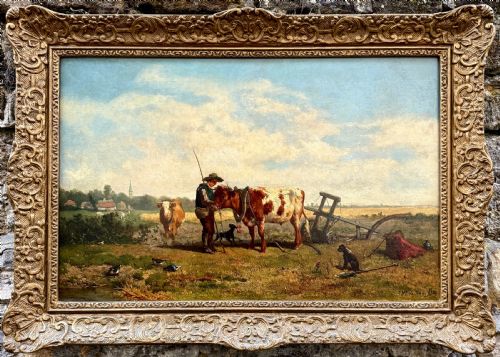


Framed Cattle Art
Framed cattle art gathers pastoral scenes and rural portraits from the nineteenth and early twentieth centuries, bringing historic agricultural life into a modern interior.
Framed Cattle Art
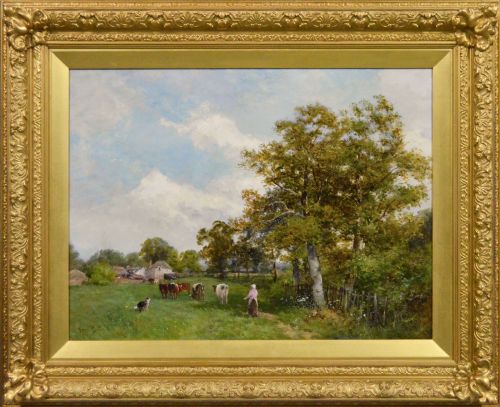
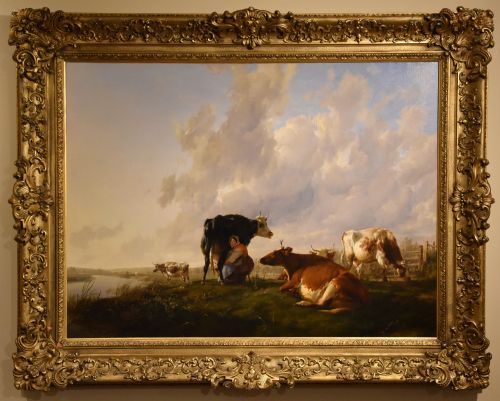
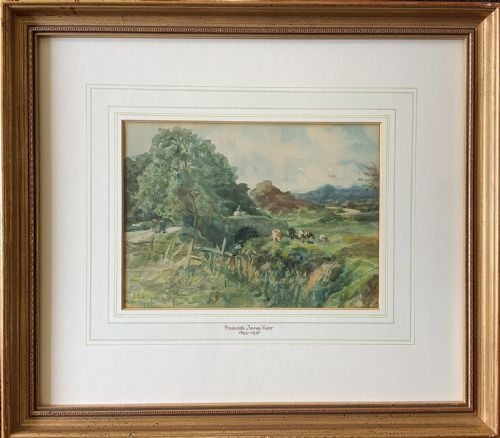
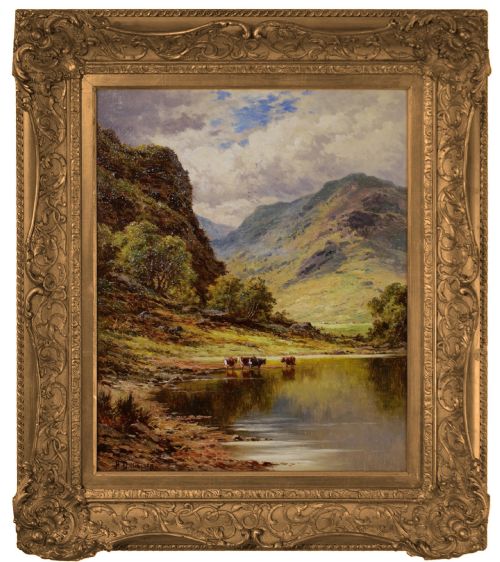
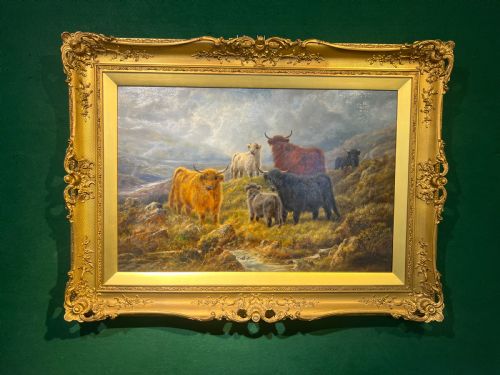
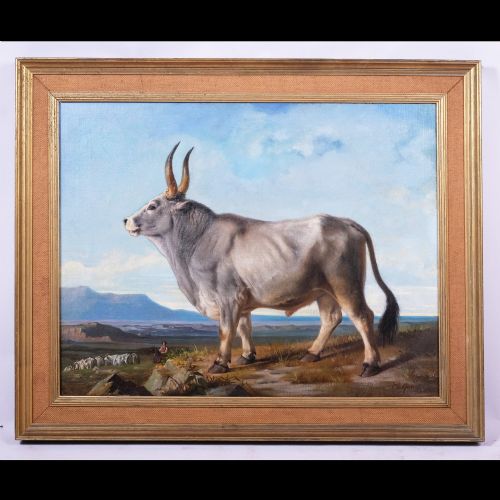
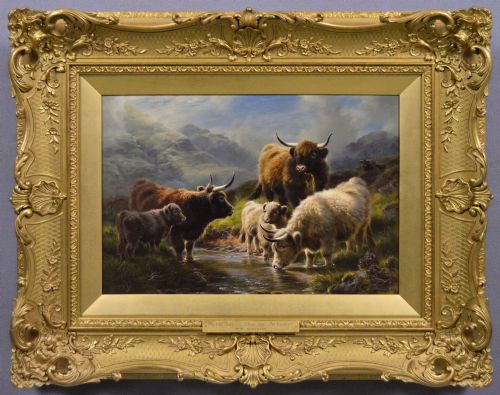
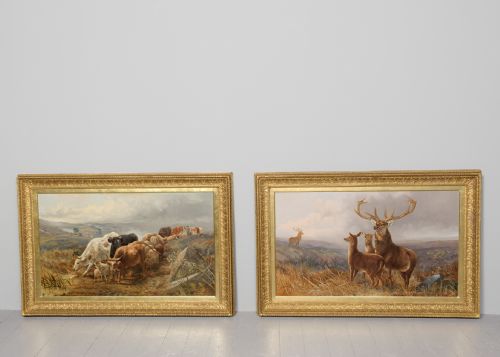
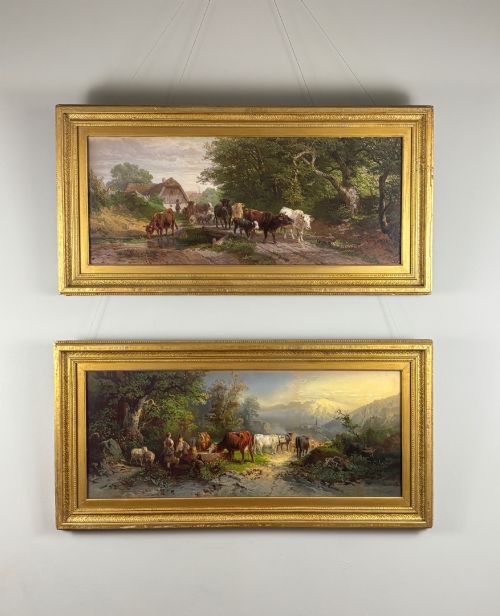
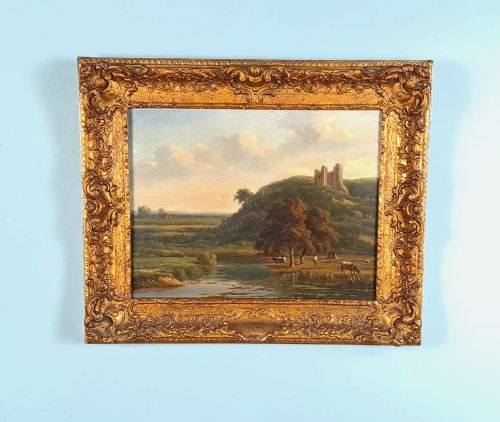
When you search for framed cattle art, you encounter oil paintings and watercolour paintings depicting cows, bulls, and calves within British, Scottish, and continental landscapes. These works span the Victorian and Edwardian periods, capturing rural farming scenes, river valleys, and highland settings.
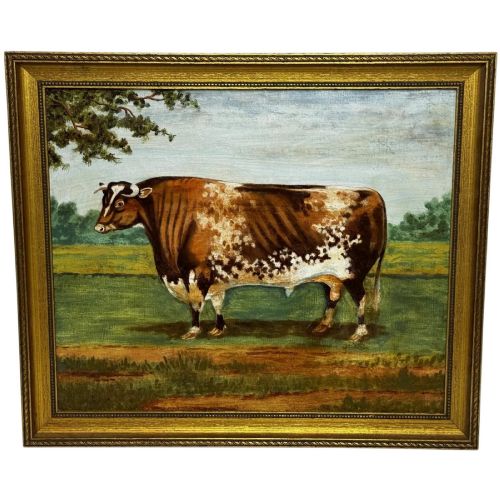
The most common pieces on this page are mid-to-late nineteenth-century oil paintings on canvas and paper-mounted watercolours. They range from intimate animal portraits of prized shorthorn bulls to sweeping pastoral vistas featuring herds resting near streams.
Artists of the British school dominate these selections, often framing their subjects against recognisable topographical backgrounds such as Welsh mountains or Scottish lochs. Such works reflect a period when pastoral imagery held a central place in domestic art collections.
Materials and technique
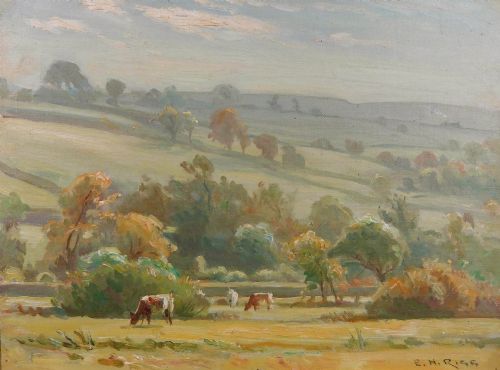
These works rely primarily on oil paint applied to canvas or wood boards, alongside watercolours worked on paper. Canvas supports permit layered brushwork and deep colour saturation, while watercolours rely on fluid washes to capture atmospheric light in open countryside.
Framing is an integral component of the construction, utilising period giltwood and gesso mouldings. Many pieces retain their original frames, which complement the tonal balance of the painted surface through decorative plasterwork and gilded finishes.
The listings span the Victorian and Edwardian eras, utilising oil on canvas, watercolour, and giltwood frames.
What sets the best pieces apart
Quality rests in the anatomical accuracy of the animals and the handling of natural light across the landscape. Superior works capture the weight and texture of a beast's coat alongside convincing atmospheric depth in the surrounding skies and pastures.
The relationship between the animal and its environment distinguishes finer examples from standard decorative work. Master hands integrate cattle into the composition so that the landscape and the livestock function as a single unified vision.
William H Myers·David Bates·Thomas Sidney Cooper·Ernest Higgins Rigg·Frederick James Kerr·Henry H Parker·Robert Watson·William Watson Jnr·Robert Cleminson·Johann Friedrich Voltz·T C Hofland·Johannes de Haas·A M Gauci·Oswald Garside·Henry Robinson Hall·J C Grey·Frederick Septimus Lewis·Ernest Pile Bucknall·Samuel Joseph Clark·William Sydney Cooper·Thomas Hunn·George Vicat Cole·Andre de Moller·Sidney Richard Percy·Frederick James Knowles
The Framed Cattle Art Glossary
- Giltwood
- Wood carved and covered with a thin layer of gold leaf. This material forms the traditional reflective border for nineteenth-century oil paintings.
- Gesso
- A plaster-like mixture applied to wooden frames before gilding. It provides a smooth base for intricate moulded decorative details.
- Pastoral
- A genre of art depicting rural life and domesticated animals. These scenes emphasise a calm, idealized view of agricultural landscapes.
- Watercolour
- A paint consisting of pigment suspended in a water-based solution. Applied to paper, it creates translucent washes favoured by landscape painters.
Framed Cattle Art: Frequently Asked Questions
How do I care for antique cattle art?
Keep oil and watercolour paintings away from direct sunlight to prevent fading of pigments and degradation of paper or canvas supports.
Maintain stable room temperatures and avoid hanging pieces in damp environments to protect both the artwork and its original wooden frame.
Are these paintings signed by the artists?
Many examples feature artist signatures or monograms inscribed directly onto the canvas or paper during creation.
Attributions are also supported by period documentation, gallery inscriptions, and stylistic comparisons with known works by British and European painters.
What framing comes with these pieces?
Most works are preserved in their period frames, typically constructed from wood finished with gesso and gold leaf.
These surrounds often date from the same decade as the painting itself, completing the historic presentation of the rural scene.
Where were these pastoral scenes painted?
The settings draw from actual rural locations across Britain, Ireland, and continental Europe, including Welsh river valleys and Scottish lochs.
Artists travelled into the countryside to sketch herds in their working agricultural environments before completing the finished canvases in their studios.