


Framed Castle Watercolour
A framed castle watercolour brings historic architecture and landscape into a room through delicate pigment on paper.
Framed Castle Watercolour
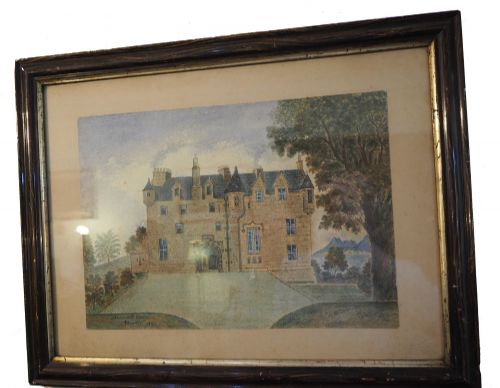
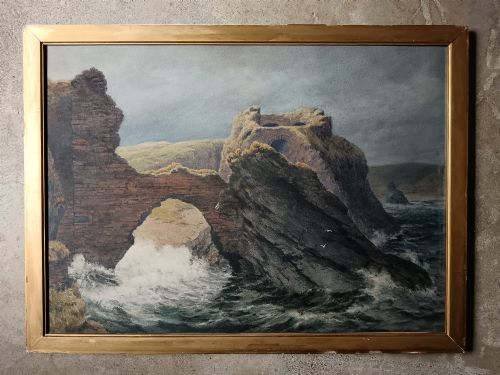
A framed castle watercolour depicts historic fortresses, coastal ruins and royal strongholds across Britain, captured by artists working from the Victorian era into the twentieth century. These works range in style from nineteenth century romanticism and British impressionism to traditional landscape recording.
Buyers encounter depictions of specific Northern and Welsh strongholds such as Bolton, Bamburgh, Conwy and Windsor castles, executed on paper and housed behind glass within wood and gilt frames.
The selection spans Victorian precursors through to twentieth century British works, showing how artists recorded these stone fortifications across changing seasons and rural settings.
How they were made
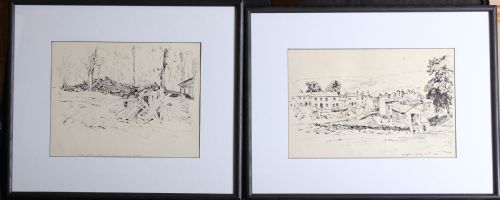
Artists painted these scenes using watercolour pigment and ink applied to paper sheets, sometimes drawing preliminary outlines in pen before washing colour across the surface. The support paper rests beneath protective glass within traditional wood frames, which often incorporate gilt detailing.
The technique relies on the transparency of watercolour paint to build light and shadow across stone walls, water and sky, capturing atmospheric conditions from bright coastal bays to wintry Yorkshire dales.
Some castle views include winter snowfalls, proving that British artists braved the freezing dales just to paint cold masonry.
What varies in quality
Quality rests in the sureness of the brushwork and the artist's command of light, tone and atmospheric perspective across the stone architecture and surrounding landscape. Stronger examples display confident handling of ink and pigment that brings depth to the subject without overworking the paper.
The preservation of the paper and the integrity of the original frame and glass also influence the overall character of the piece, as well as how clearly the hand of the artist or the specific location is documented.
Fred Lawson·F A Roylance·John Moxon·Thomas Cooper Moore·George Graham·James Orrock·David Cox Jnr·Frank Wood·R P Noble·Alfred Robert Quinton·Willie Stephenson·Frederick Tully Lott·Sonia Lawson·Frank Wasley·Carleton Grant·J D Walker·Owen Bowen·Fred Stead·Joseph William Carey
The Framed Castle Watercolour Glossary
- Watercolour paint
- A medium consisting of colour pigments suspended in a water-soluble vehicle, applied to paper to create transparent washes of tone.
- Gilt frame
- A wooden picture surround covered with a thin layer of gold leaf or metallic gilt, commonly used to finish and protect nineteenth and early twentieth century works.
- British School
- A term used to classify artists trained or working within Britain, sharing stylistic traditions in landscape and topographical painting.
- Sepia
- A brown pigment derived from the ink sac of the cuttlefish, frequently utilised for monochromatic or tonal landscape drawings.
Framed Castle Watercolour: Frequently Asked Questions
How should I hang a watercolour?
Keep framed watercolours away from direct sunlight to prevent the pigments and paper from fading over time. Ensure the wall space remains stable in temperature and humidity to protect the paper and frame.
Position the painting at eye level where the fine details of the castle architecture and wash techniques can be clearly observed.
Are these works signed?
Many examples bear the artist's signature, often inscribed directly onto the lower corner of the paper. Signatures help confirm attribution to specific nineteenth and twentieth century painters.
Unsigned works are frequently attributed through stylistic comparison, exhibition records or contemporary inscriptions on the reverse of the frame.
What periods do these paintings cover?
The selection spans from the Victorian era through Edwardian times and into the mid-twentieth century. Earlier works reflect nineteenth century romanticism, while later pieces capture twentieth century British landscape styles.
Each period brings distinct framing choices and paper characteristics that help date the artwork.
What subjects appear besides castles?
Alongside the primary fortress walls, artists frequently included surrounding elements such as coastal bays, rivers, bridges and rural valleys. Scenes often incorporate figures, boats or local livestock to establish scale and atmosphere.
These surrounding landscape details provide context about the topography and daily life near the historic sites.