
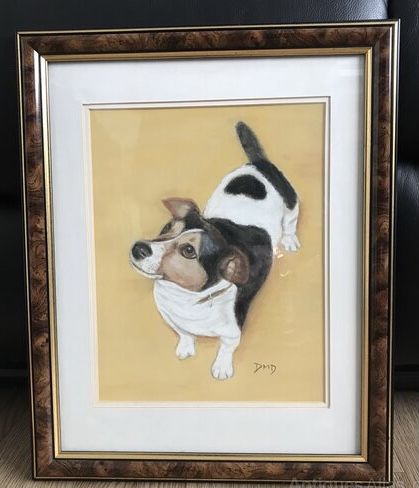


Framed Canine Wall Picture
These framed canine wall picture examples capture breeds from working terriers to spaniels in oils, watercolours and etchings.
Framed Canine Wall Picture
A framed canine wall picture brings historical depictions of dogs into domestic spaces, ranging from intimate pastel studies to large oil portraits. Buyers seeking a framed canine wall picture encounter various mediums including oil on canvas, etchings, watercolours and silhouette paper works.
The selection on this page spans the nineteenth century through to the mid-twentieth century, capturing subjects like Jack Russells, retrievers and spaniels. Victorian sporting art and English country house styles dominate the aesthetic, reflecting long-standing British traditions of canine portraiture.
How they were made
Works are executed in oil, watercolour, pastel or ink on canvas and paper supports, often mounted under protective glass. Frames frequently incorporate wood and gold leaf or gilt finishes to complement the artwork.
Printmakers employed techniques like engraving and etching to produce detailed multiples, whilst painters built up subjects using traditional oil mediums on canvas.
Listings span from the nineteenth century to the 1960s, featuring oil, canvas, paper, wood, glass, gold leaf and gilt materials.
What varies in quality
Quality differentiates through the anatomical accuracy and expressive capability of the animal depiction, alongside the handling of the medium. Finer works show careful attention to coat texture and gaze.
The integrity of the original framing, including gold leaf application and glass preservation, contributes to the overall standard of the piece.
C W Tuck·Herbert Dicksee·Augustin Edouart·Sir Edwin Landseer·M.E.Hankinson·John Emms·Samuel Fulton
The Framed Canine Wall Picture Glossary
- Etchings & Prints
- Impressions pulled from metal plates or blocks. These reproductive works allowed popular paintings to reach wider audiences.
- Oil on Canvas
- Pigment mixed with drying oil applied to stretched fabric. This medium offers rich colour depth and longevity.
- Gold Leaf
- Gold beaten into extremely thin sheets used for gilding frames. It provides a warm, reflective border to the artwork.
- Silhouette
- A solid shape of a subject filled in with a single colour, usually black. Cut paper silhouettes offer a minimalist profile representation.
Framed Canine Wall Picture: Frequently Asked Questions
How do I date a framed dog painting?
Dating relies upon stylistic markers, clothing or interior clues in the background, and framing materials. Victorian works often display specific gilt framing styles.
Maker signatures and inscriptions on the reverse of the canvas or paper provide further chronological reference points.
Are these works original paintings?
The selection includes both unique hand-painted oils and watercolours alongside period engravings and prints. Each listing specifies the exact medium used.
Original oils feature visible brushwork whilst prints show fine inked lines under close inspection.
How should I hang these pictures?
Consider eye-level placement where the detail of the animal portrait can be appreciated. Adequate wall space allows gilt frames to stand out.
Keep pieces away from direct sunlight to protect watercolours, paper, and canvas pigments from fading.
What breeds are most common?
Terriers, spaniels, retrievers and mastiffs appear frequently across the nineteenth and twentieth-century selections. Sporting dogs reflect historical popularity in British art.
Specific breeds like the King Charles spaniel and bulldog also feature prominently in wartime and Victorian periods.