
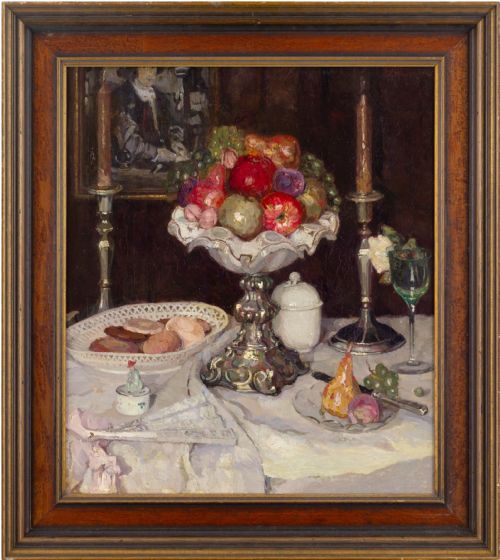
Framed Art for Dining Room
These framed art for dining room selections bring historical oil paintings and still life fruit scenes directly to your walls.
Framed Art for Dining Room
When you search for framed art for dining room, you encounter oil paintings predominantly centred on still life fruit and domestic interior subjects. The selection spans periods from the Victorian era and Edwardian years through to the mid-twentieth century, including works dated from eighteen fifty up to nineteen sixty.
The objects take the form of canvas works and wall art housed within wood and gilt frames. Subject matter frequently includes fruit, baskets, jugs, and candlesticks, alongside occasional cottage interior scenes that suit a traditional dining space.
Makers and artists represented include named painters such as Else Preußner and John Exley, alongside signed works by artists like T. Vincent. These pieces offer established historical character for domestic wall display without relying on modern reproductions.
How they were made
The physical construction relies on oil paint applied to canvas supports, often stretched over wooden frames or secured within protective wood and gilded surrounds. These materials provide the rich pigment depth and surface texture characteristic of traditional painting methods from the nineteenth and twentieth centuries.
Framing typically employs carved or moulded wood, occasionally enhanced with gilt finishes to accentuate the visual weight of the artwork. The combination of oil on canvas and substantial wooden framing ensures structural durability and a classic appearance suited to period interiors.
Listings span multiple decades from the Victorian era to nineteen sixty, utilising oil paint, canvas, and gilded wood frames.
What varies in quality
Quality differences manifest in the handling of brushwork and the precision of the composition, where accomplished artists render light and shadow with greater subtlety. The presence of a clear signature or attribution to a listed painter distinguishes higher tier works from anonymous studio pieces.
The condition and period integrity of the accompanying frame also influence the overall standard of the piece. Original gilded wood frames that match the age of the canvas elevate the presentation compared to later replacements.
Else Preußner·John Exley·T. Vincent
The Framed Art for Dining Room Glossary
- Still life
- A painting featuring inanimate subject matter, typically everyday objects such as fruit, food, or tableware. This genre forms the core of the available dining room selections.
- Oil on canvas
- A technique involving pigment suspended in drying oils applied to a woven fabric support. This combination creates durable surfaces with rich colour saturation.
- Gilt
- A thin layer of gold leaf or gilt paint applied to wood frames. This finish adds reflective brilliance and historical ornamentation to the artwork presentation.
- Post-Impressionism
- An art style developing subsequent to Impressionism that emphasises symbolic content and expressive use of paint. Works from this tradition appear within the twentieth-century selections.
Framed Art for Dining Room: Frequently Asked Questions
How do I date an oil painting?
Dating involves examining the canvas type, stretcher construction, pigment characteristics, and frame style alongside any visible signatures or dates inscribed by the artist. Comparing the stylistic approach to known periods helps narrow down the decade of creation.
Archival records and artist signatures, such as those by Else Preußner or John Exley, offer precise reference points for specific works.
Are these paintings original works?
The inventory consists of original hand-painted works created using oil paint on canvas supports. Each piece represents a unique artistic creation rather than a modern print or reproduction.
Signed examples and period pieces from the nineteenth and twentieth centuries carry individual brushwork and distinct material ageing.
How should I hang heavy frames?
Substantial wood and gilt frames require secure wall fixings suited to the weight of the canvas and the construction of your walls. Using appropriate picture hooks and wall anchors ensures the artwork remains safely supported over time.
Positioning the painting at eye level within the dining space maximises visual impact and protects the frame from accidental knocks.