


Framed Alphabet Needlework
Framed alphabet needlework pieces are domestic schoolroom exercises and decorative panels that preserve centuries of personal handiwork behind glass.
Framed Alphabet Needlework
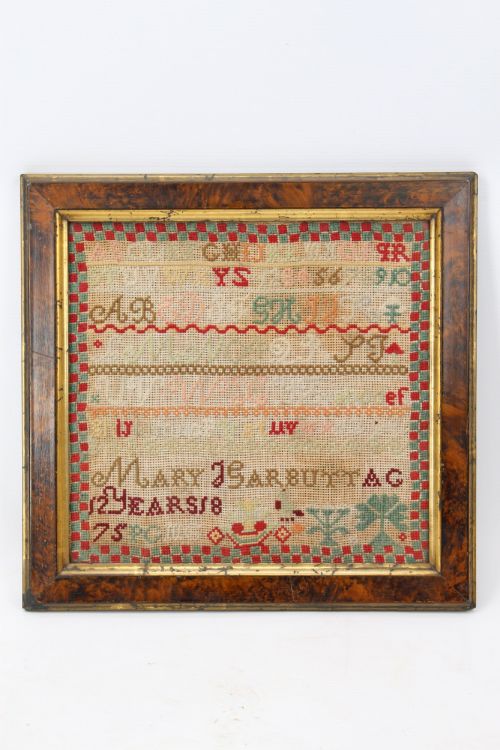
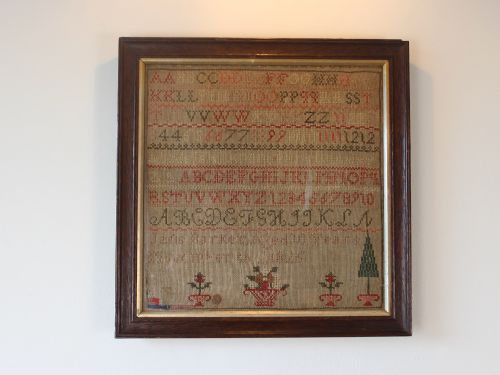
When you examine framed alphabet needlework, you are looking at stitched letters, numbers and verses worked by young girls, often signed with an age and date. These textile panels span from the late seventeenth century through the Georgian and Victorian periods, reflecting the domestic education of their makers.
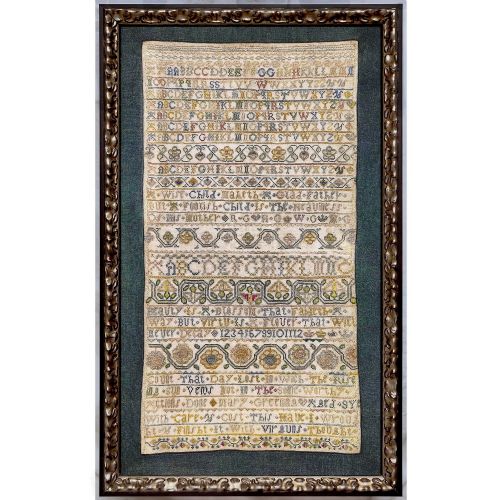
You will most commonly encounter nineteenth-century examples on this page, alongside earlier Georgian and late seventeenth-century band samplers. These works typically combine rows of lettering with numerals, pious verses, and motifs such as birds, flora or small figures.
The survival of these textiles relies heavily on their protection behind glass in period wood frames. They record not only literacy and needle skills of past generations, but also specific schools, dates and family names.
How they were made
Maker execution relied on linen grounds stitched with wool, silk thread or standard thread. These materials were chosen for durability and fine weave, allowing children and young women to plot precise cross-stitches and alphabet rows.
Works were finished by mounting the embroidered panel into wood frames, frequently protected behind glass to shield the fragile threads from dust and light over the centuries.
One determined Victorian maker left behind a visible stitch error alongside her name and age.
What varies in quality
The standard of these textiles rests on the regularity of the stitching and the complexity of the composition. Denser alphabets, varied stitch types, and detailed pictorial motifs indicate higher skill than simple, repetitive lettering.
Condition and legibility also define the piece. Clear lettering, stable linen grounds, and original wood frames preserve the historical integrity of the work far better than heavy fading or frayed textile edges.
The Framed Alphabet Needlework Glossary
- Band sampler
- An early horizontal format where rows of distinct pattern bands, alphabets and motifs are stacked vertically. This layout allowed makers to practice various embroidery stitches on a single strip of linen.
- Cross-stitch
- A popular embroidery technique forming an X shape, used extensively for creating uniform letters and numbers on samplers. It provides structural clarity to the stitched alphabets.
- Linen ground
- The woven fabric base made from flax fibres that receives the needlework. Its thread count determines the fineness of the finished stitches.
- Needlepoint
- Embroidery stitched over a stiff canvas or linen grid rather than counting threads freely. It produces a dense, durable surface common in later nineteenth-century panels.
Framed Alphabet Needlework: Frequently Asked Questions
How old are these needlework pieces?
The pieces span from the late seventeenth century through the Georgian and Victorian eras, with the majority originating in the nineteenth century.
Dates are frequently stitched directly into the textile alongside the maker's name and age, offering clear chronological markers.
Who made these samplers?
Young girls and pupils in domestic settings or schools worked these samplers as part of their education in literacy and needlecraft.
Many examples record the maker's name, age - often around eleven or twelve years old - and occasionally the specific school attended.
Are the frames original?
Some pieces retain their period wood frames and original glass, which help protect the fragile linen and thread inside.
Other panels have been reframed later to ensure continued protection and display stability.
What motifs appear besides letters?
Alongside alphabet rows and numerals, makers stitched religious verses, the Lord's Prayer, and moral sentiments.
Pictorial elements such as birds, floral borders, and small figures frequently accompany the text.