

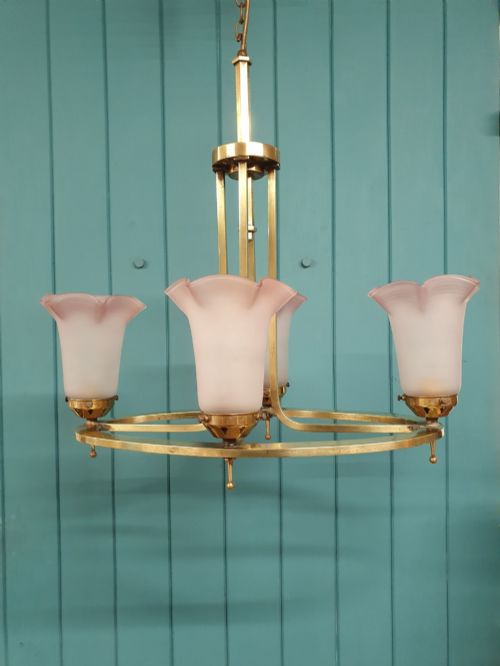


Fluted Glass Ceiling Light
These fluted glass ceiling light fixtures bring period character and diffuse illumination to a room, ranging from simple Victorian shades to grander Art Deco chandeliers.
Fluted Glass Ceiling Light
A fluted glass ceiling light brings both period character and soft, diffused illumination to a room, drawing on designs from the Victorian, Edwardian, and Art Deco eras. You will encounter various forms on this page, including single pendant lights, multi-bulb chandeliers, and individual ceiling pendant shades designed to hang from above.
The materials and styles span several decades, featuring English and French origins in formats such as pharmacy pendants and industrial shades. Early twentieth-century examples sit alongside nineteenth-century brass leaf designs and silver plated fixtures, offering multiple ways to light a space.
How they were made
The construction of these pieces relies on moulded and cut glass combined with metal components like brass, chrome, and silver plating. Shades take distinct forms in moonstone, opal, ruby, and frosted glass, often paired with metal galleries that secure the glass to the suspension.
Techniques range from the precision cutting seen in Edwardian crystal to the specialised prismatic moulding used for Holophane shades. Metalwork components such as brass leaf frames and chrome fittings provide the structural support required for ceiling suspension.
Fluted Glass Ceiling Light Retail Price Guide 2026
Typical asking prices for fluted glass ceiling light among the pieces listed under this phrase on Sellingantiques today, from the lower quarter to the upper quarter. They describe what is for sale here now, not the wider market.
Period styles represented on this page span Victorian, Edwardian, Art Deco, French Country, and industrial designs.
What varies in quality
Quality in these fixtures is defined by the weight and clarity of the glass, the complexity of its moulding or cutting, and the integrity of the original metal hardware. Pieces featuring specialised glass types such as moonstone or ruby glass, or substantial brass and silver-plated frames, represent the higher end of the range.
The distinction also lies in the completeness of original elements, such as matched shades on multi-light chandeliers and authentic galleries. Simpler single-shade pendants from industrial or domestic contexts sit lower on the scale of decorative complexity.
The Fluted Glass Ceiling Light Glossary
- Holophane shade
- A type of glass shade moulded with prismatic ribs designed to direct and diffuse light efficiently while reducing glare. These were widely used in early twentieth-century industrial and commercial settings.
- Moonstone glass
- An opalescent white glass that glows softly when illuminated, resembling the appearance of the moon. It was frequently utilised in early twentieth-century lighting.
- Gallery
- The metal collar or ring at the top of a pendant light shade that holds it securely to the suspension fitting. Galleries are often cast in brass or finished in chrome.
- Ruby glass
- A deep red coloured glass produced by adding gold or copper to the batch during manufacturing. It is characteristic of nineteenth-century decorative lighting.
- Pendant light
- A hanging light fixture suspended from the ceiling by a cord, chain, or metal rod. These fixtures are common across Victorian and Edwardian interiors.
Fluted Glass Ceiling Light: Frequently Asked Questions
What periods do these ceiling lights come from?
The listings span the Victorian and Edwardian eras, the 1920s, and the 1930s Art Deco period. Each era brings distinct decorative choices in the glass and metalwork.
Designs range from ornate nineteenth-century brass leaf fittings to industrial Holophane shades and streamlined twentieth-century chandeliers.
How do I hang a pendant light?
Pendant lights suspend from the ceiling using a cord, chain, or metal rod attached to a gallery that grips the top of the glass shade. Most require professional installation to ensure secure fixing and correct wiring.
Consider the ceiling height of your room when deciding on the drop length, particularly for multi-light chandeliers.
What is the difference between opal and moonstone glass?
Opal glass is a dense, milky white material that diffuses light evenly across its surface. Moonstone glass offers a softer, more translucent opalescence that creates a gentle glow.
Both materials were popular in early twentieth-century lighting to soften the harsh glare of early electric bulbs.
Where were these lights originally used?
These fixtures served in various settings, from grand Victorian homes to Edwardian parlours and industrial spaces like English pharmacies. Industrial variants often utilised prismatic glass for maximum illumination in commercial interiors.
Domestic versions prioritized decorative appeal through coloured glass, brass ornamentation, and cut crystal.