

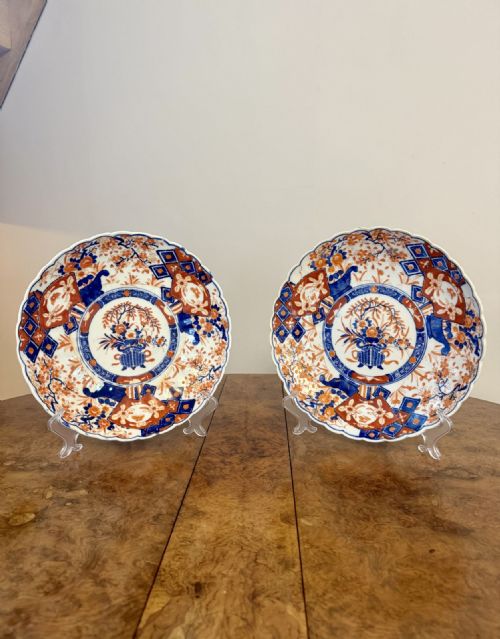


Floral Motif Plate
These floral motif plate examples bring hand-painted botanicals and traditional Eastern patterns directly to your table or wall.
Floral Motif Plate
A floral motif plate encompasses everything from traditional blue and white Imari wares to vibrant majolica pottery decorated with sunflowers and birds. Buyers seeking a floral motif plate will encounter pieces spanning the eighteenth century through to the early twentieth century, originating from Japanese kilns, European potteries, and Chinese export workshops.
Materials and methods
Potters utilised ceramic, porcelain, and glazed earthenware as the primary base materials for these items. Skilled artisans applied detailed enamel pigments and glaze finishes by hand to achieve the characteristic botanical and ornamental surface designs.
Certain pieces integrate copper and brass or incorporate gold leaf accents alongside traditional underglaze painting techniques. Ironstone and stone china provided durable alternatives for heavier domestic serveware whilst maintaining refined decorative qualities.
Floral Motif Plate Retail Price Guide 2026
Typical asking prices for floral motif plate among the pieces listed under this phrase on Sellingantiques today, from the lower quarter to the upper quarter. They describe what is for sale here now, not the wider market.
Listings span the eighteenth century, the nineteenth century, and early twentieth-century periods up to nineteen-twenty.
Assessing quality and finish
Superior examples demonstrate exceptional control over hand-painted brushwork and pigment saturation, particularly within complex Imari palettes and majolica relief moulding. The crispness of the painted floral details and the uniformity of the glaze application distinguish finer pieces from standard production wares.
Purity of the ceramic body and the precision of the forming process, whether shaped with scalloped edges or standard circular profiles, dictate the overall refinement of the object. Age-appropriate condition and the preservation of delicate enamel or metallic highlights also contribute significantly to the standing of an individual piece.
Mason's Ironstone·Davenport
The Floral Motif Plate Glossary
- Imari
- A style of Japanese export porcelain characterised by a palette of underglaze blue, iron red, and gilt highlights. The designs typically incorporate intricate floral and brocade patterns.
- Majolica
- A type of earthenware coated with an opaque tin-lead glaze and painted with bright metal oxide colours. This technique allows for rich relief decoration depicting natural subjects such as birds and sunflowers.
- Ironstone
- A heavy, durable type of ceramic patented in the nineteenth century as a tougher alternative to porcelain. It frequently bears oriental-inspired floral transfer prints or hand-applied enamels.
- Charger
- A large decorative plate or dish traditionally utilised for ceremonial display rather than daily dining. These substantial pieces provide an expanded surface area for elaborate floral motifs.
- Cloisonne
- A metalwork technique where enamel paste is applied within compartments created by soldered wire strips on a copper base. Floral designs rendered in this method offer vivid texture and colour.
Floral Motif Plate: Frequently Asked Questions
How should I display antique decorative plates?
These decorative plates suit wall mounting using appropriate wire hangers or display upon dedicated plate stands on flat surfaces.
Position them away from direct sunlight and moisture to protect the glaze and enamel details over time.
Are these antique dishes suitable for daily use?
Most antique ceramics and earthenware function best as display items or decorative serveware rather than for regular dining.
Hand washing with mild soap preserves the historical glazes and painted floral surfaces.
How do I identify Japanese Imari pottery?
Japanese Imari traditionally displays a distinct colour combination featuring cobalt blue and burnt orange alongside gilt detailing.
The motifs frequently combine floral arrangements with geometric or brocade borders characteristic of the Edo and Meiji periods.
What distinguishes majolica from standard porcelain?
Majolica utilises a porous earthenware body covered in an opaque tin glaze, often featuring bold relief moulding and vibrant botanical colours.
Porcelain relies on a vitrified, non-porous white body fired at higher temperatures with smoother surface painting.