
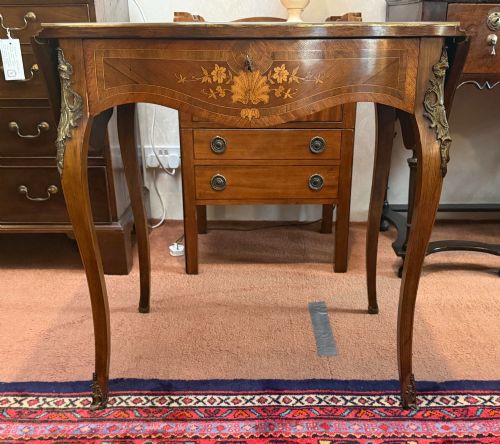
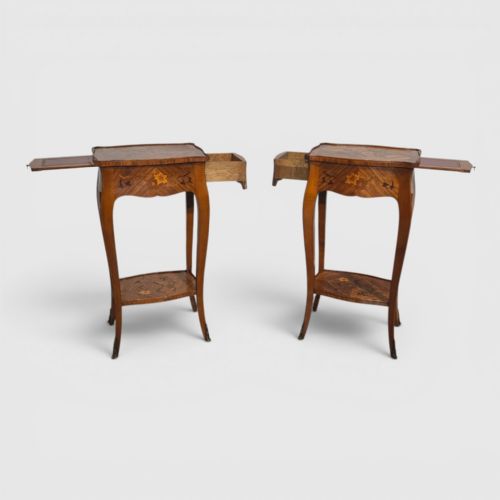


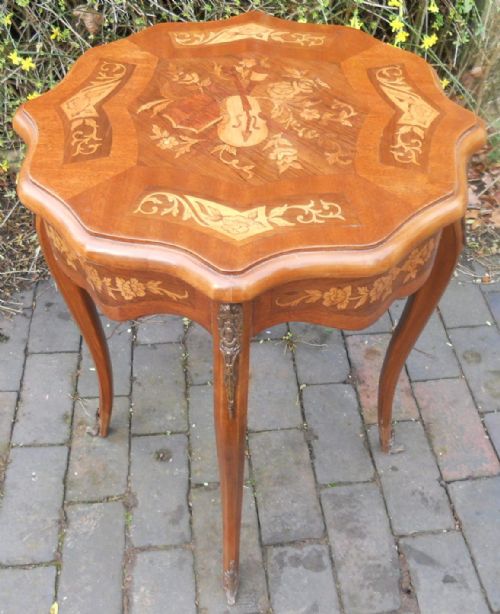
Floral Marquetry End Table
These floral marquetry end table examples combine botanical wood-inlay with compact proportions, offering decorative utility beside seating.

Floral Marquetry End Table
A floral marquetry end table appears in forms such as side tables, occasional tables, bedside tables, and nests of tables spanning the Victorian, Edwardian, and late nineteenth to early twentieth centuries.
The material palette of these pieces draws upon walnut, rosewood, satinwood, kingwood, mahogany, and fruitwood, occasionally accented with brass and ormolu.
Stylistic influences range widely across French Louis XV style, French provincial, Napoleon III, Victorian Rococo Revival, and Edwardian taste.
How they were made
Cabinet makers utilised foundational timbers like walnut, mahogany, and rosewood to construct the structural carcasses of these small tables.
Fine veneers of satinwood, kingwood, and fruitwood were precisely cut and assembled to create intricate floral inlay patterns across the top surfaces.
Listings span periods from the mid nineteenth century through the Edwardian era, predominantly featuring walnut, rosewood, and mahogany.
What varies in quality
The refinement of the botanical inlay work distinguishes simpler geometric parquetry from elaborate floral marquetry compositions.
The choice of secondary cabinet woods, such as the use of kingwood and satinwood alongside walnut or rosewood, separates standard examples from more ambitious productions.
The Floral Marquetry End Table Glossary
- Marquetry
- Decorative veneer work cut and fitted together to form pictures or designs on wood surfaces. It differs from plain parquetry through its pictorial floral motifs.
- Kingwood
- A dense, heavily figured timber prized for fine cabinet making. This exotic wood provides rich contrast within patterned table tops.
- Ormolu
- Gilded bronze mounts applied to furniture edges and legs. This decorative hardware appears frequently on pieces finished in the French taste.
- Kidney shape
- A curved tabletop profile designed for compact placement. Such serpentine forms suit bedside and lamp table functions.
Floral Marquetry End Table: Frequently Asked Questions
Where should I place a floral marquetry end table?
These compact tables suit living rooms as lamp tables or beside armchairs where their inlaid tops remain visible.
Bedside positions also work well for smaller occasional and bedside formats.
How do I care for the wood surface?
Keep inlaid tables away from direct sunlight and strong heat sources to protect the delicate fruitwood and satinwood veneers from fading or drying.
Apply traditional wax polish sparingly to maintain the natural lustre of the walnut and rosewood.
Are these tables sturdy enough for daily use?
Most examples function effectively as lamp or occasional tables supporting modest weights.
Avoid overloading them, as delicate legs and historical joints require careful handling.
How do I distinguish French styles from Victorian pieces?
French pieces often incorporate ormolu mounts, kingwood veneers, and Louis XV or Napoleon III stylistic references.
Victorian and Edwardian British examples tend to favour mahogany or rosewood with distinct kidney shapes and local cabinet-making traditions.