

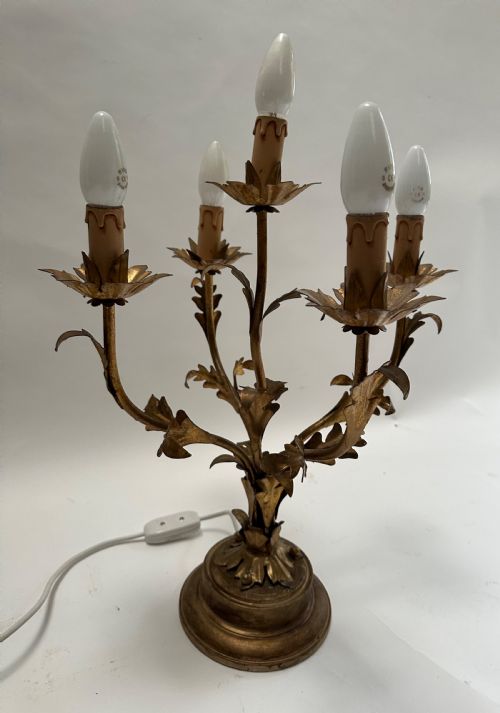
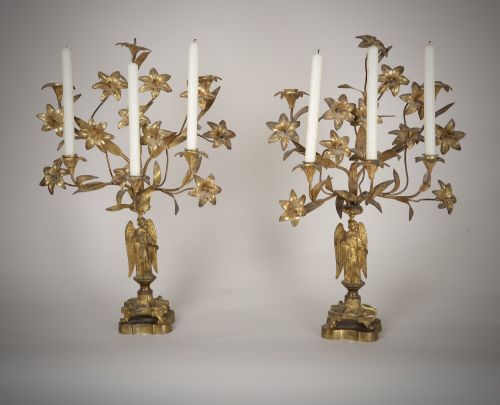


Floral Gilt Candelabra
These floral gilt candelabra bring 18th-century and 19th-century French and German craftsmanship into your room with polished metal and porcelain detail.
Floral Gilt Candelabra
Floral gilt candelabra span the eighteenth and nineteenth centuries, taking the form of paired lights designed for tables and mantelpieces. You will frequently encounter nineteenth-century French and German examples on this page, drawing upon Louis XVI style, Rococo revival, and Gothic revival designs.
The objects themselves range from three-light to five-light configurations, often incorporating figurative elements such as cherubs, putti, birds, and musicians alongside branching arms. Materials such as marble, enamel, and hard-paste porcelain frequently appear paired with the metalwork to form the bodies and bases.
How they were made
Maker's workshops cast metal in bronze and brass, employing fire-gilding and ormolu techniques to achieve the characteristic gilt surface finish. Patinated bronze is often set alongside the bright gilding to create contrast across the figural components.
Porcelain elements from factories such as Meissen were hand-modelled and painted before being mounted into the metal frames. Marble bases were cut and polished to support the heavy metalwork and branches of the candelabra.
Floral Gilt Candelabra Retail Price Guide 2026
Typical asking prices for floral gilt candelabra among the pieces listed under this phrase on Sellingantiques today, from the lower quarter to the upper quarter. They describe what is for sale here now, not the wider market.
Listings feature hard-paste porcelain alongside gilt bronze, patinated bronze, marble, and enamel across nineteenth-century and eighteenth-century objects.
What varies in quality
The integration of porcelain components also defines the tier of the piece, with detailed modelling and fine hand-painting marking out the superior examples. The balance between the marble, porcelain, and metal parts dictates the overall visual harmony of the candelabra.
The Floral Gilt Candelabra Glossary
- Ormolu
- Gilt bronze produced by applying a mercury and gold amalgam to a bronze object and heating it to vaporise the mercury. This technique creates a durable golden finish seen on nineteenth-century French pieces.
- Hard-paste porcelain
- A type of ceramic fired at high temperatures using kaolin and petuntse. It provides a dense, durable body utilised in German and French figurative candelabra.
- Patinated bronze
- Metal that has undergone chemical treatment or natural ageing to alter its surface colour. It provides dark contrast against bright gilt components.
- Louis XVI style
- A neoclassical design movement characterised by straight lines, symmetry, and classical motifs. Pieces in this style often incorporate marble and formal floral ornament.
- Rococo revival
- A nineteenth-century design style drawing on earlier eighteenth-century ornamentation with asymmetric scrolls, naturalistic foliage, and shell motifs.
Floral Gilt Candelabra: Frequently Asked Questions
What periods do these candelabra come from?
The pieces span the eighteenth and nineteenth centuries, with dates extending into the early twentieth century.
Nineteenth-century pieces dominate the selection, heavily influenced by Louis XVI and Rococo revival styles.
How were porcelain elements incorporated into metal frames?
Priced porcelain figures, such as birds or musicians from Meissen, were modelled separately and then secured within custom-cast ormolu mounts.
This combination of ceramic and metal required specialised assembly to ensure stability.
What is the difference between gilt bronze and ormolu?
Ormolu specifically refers to gilt bronze created through historical mercury gilding processes on bronze substrates.
Gilt brass and general gilt bronze terms may encompass alternative base metals or modern finishing methods.
Where were these decorative candelabra originally placed?
They served as functional lighting on dining tables, sideboards, and mantelpieces within nineteenth-century drawing rooms and chateaux.
Pairs were typically arranged symmetrically to balance the room decor.