


Flemish Master Style Painting
These flemish master style painting works capture the rich atmosphere of seventeenth-century village life and portraiture.
Flemish Master Style Painting
When you search for flemish master style painting, you encounter works spanning from the seventeenth century through to the mid-twentieth century. These pieces encompass tavern interiors, village fetes, portraits of gentlemen, and still lifes of flowers and fruit.
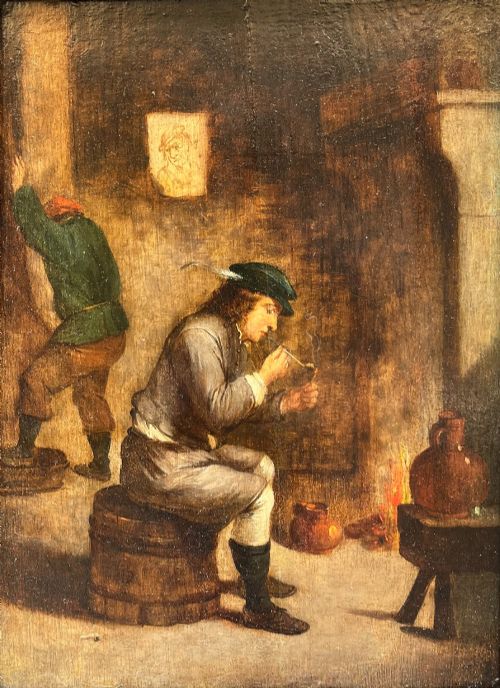
You are most likely to meet canvases in the manner or tradition of David Teniers and Peter Paul Rubens on this page. The subjects range from musicians and smokers on barrels to mythological scenes like Perseus freeing Andromeda.
The selection includes original seventeenth-century works alongside later nineteenth-century interpretations and mid-twentieth-century adaptations. Dutch and Flemish stylistic influences dominate the selection across wood panels and canvas supports.
Materials and technique
These works are executed in oil paint on canvas or wood supports. The application of oil medium allows for deep tonal gradations and the characteristic luminosity seen in seventeenth-century and later interpretations.
Many of these paintings are framed in gilt wood or giltwood surrounds that complement the traditional realism of the compositions. The technique relies on layered oil pigments to build rich textures in fabrics, foliage, and skin tones.
A smoking barrel and exotic birds share the same stylistic universe in seventeenth-century taverns.
What varies in quality
The distinction between works lies in the handling of light, shadow, and figurative detail within the composition. Pieces associated closely with an Antwerp workshop or created nearer to the active period of the primary artists display greater nuance in expression and drapery.
The sophistication of the oil medium application determines the visual depth of the scene, particularly in complex genre gatherings and still life arrangements. Framing in period-appropriate gilt wood also influences the overall integrity of the piece.
David Teniers·Peter Paul Rubens·Bartholomeus Van der Helst·Marmaduke Cradock·Jacob Bogdani
The Flemish Master Style Painting Glossary
- Flemish Baroque
- A style of art originating in Flanders during the seventeenth century, characterised by energy, robust figures, and dramatic use of colour. It forms the foundation for many traditional realists.
- Dutch Golden Age
- A period in Dutch history spanning the seventeenth century when painting flourished with genre scenes, landscapes, and portraits. Works from this time set the standard for subsequent European art.
- Genre painting
- The pictorial representation of scenes from everyday life, such as tavern interiors or village fetes. These works depict ordinary people engaged in common activities.
- Manner of
- A term used when a work is executed in the style of a specific artist without being by their hand. It indicates an artist working under the strong stylistic influence of a master.
- Still life
- A painting featuring an arrangement of inanimate objects, such as flowers, fruit, or dead game. These compositions often showcase meticulous detail and varied textures.
Flemish Master Style Painting: Frequently Asked Questions
What is a flemish master style painting?
It is an oil painting created in the tradition of seventeenth-century Flemish and Dutch artists. These works often depict genre scenes, portraits, or still lifes.
The style emphasises realistic detail, rich colour palettes, and dramatic lighting reminiscent of the Baroque period.
How were these paintings displayed?
Historically, such works hung in domestic interiors, merchant houses, and reception rooms to demonstrate taste and culture.
They were typically housed in ornate gilt wood frames that enhanced the depth and warmth of the oil canvas.
How do I identify a period piece?
Dating relies on examining the canvas support, pigment composition, and stylistic execution relative to known seventeenth-century or nineteenth-century standards.
Attributions often reference the circle, manner, or followers of specific historical masters.
What subjects are most common?
Tavern interiors, village fetes, musicians, and portraits of gentlemen recur frequently among these historical scenes.
Still lifes featuring flowers, fruit, and exotic birds also appear across the centuries.