
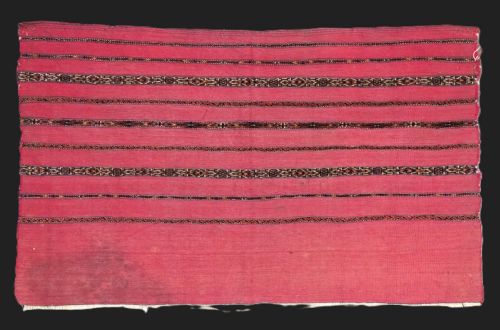


Flatweave Tribal Rug Panel
These flatweave tribal rug panel examples bring authentic nomadic textile art into a room, offering bold geometric patterns and rich historical character.
Flatweave Tribal Rug Panel
When you search for a flatweave tribal rug panel, you encounter textiles originating from nomadic and village traditions across Central Asia, the Caucasus, and Persia. These pieces often begin their lives as functional storage containers, including mafrash panels, chuval faces, torbas, and saddlebags, which are later preserved or repurposed as flat panels and wall hangings.
The selection on this page dates predominantly from the nineteenth century into the early twentieth century, spanning periods from eighteen fifty to nineteen twenty. You find specific tribal attributions such as Tekke Turkmen, Yomut, Shahsavan, Uzbek, Kurdish, and Qashqai, each carrying distinct regional motifs and weaving structures.
Most items represent fragments or complete faces of larger utilitarian objects rather than standard floor carpets. Collectors value them for their graphic strength, authentic field use, and direct connection to tribal weaving traditions that predate industrial production.
What varies in quality
Quality rests primarily in the fineness of the weave and the clarity of the graphic design. Tightly packed warps and wefts produce crisp geometric lines, whereas looser structures yield softer outlines.
The integrity of the natural dyes and the preservation of original borders or complete bag faces also dictate the standing of a piece. Finer examples retain their original structural panels and display balanced colour saturation across the entire surface.
Some nineteenth-century nomadic weavers hid tiny animal figures and protective symbols inside complex geometric borders to ward off bad luck.
The Flatweave Tribal Rug Panel Glossary
- Chuval
- A large tent storage bag produced by Turkmen tribes. These pieces typically feature characteristic guls and tribal iconography.
- Mafrash
- A rectangular storage chest or bedding bag face from Caucasian or Shahsavan weavers. They are frequently constructed in soumak flatweave technique.
- Soumak
- A wrap-wefting technique that produces a durable surface with raised pattern details resembling embroidery on the front and loose floats on the back.
- Jajim
- A lightweight flatwoven textile typically constructed in narrow strips and joined together. Silk and wool examples are common.
- Torba
- A smaller storage bag used within nomadic tents for holding personal items. They mirror the broader design vocabulary of larger chuvals.
Flatweave Tribal Rug Panel: Frequently Asked Questions
What is a flatweave tribal rug panel?
A flatweave tribal rug panel is a textile fragment or complete face originating from nomadic storage items like saddlebags and tent chests. These pieces display traditional geometric patterns without a pile.
Weavers in regions such as the Caucasus, Persia, and Central Asia produced them using hand-spun wool and natural dyes for utilitarian purposes within nomadic camps.
How do I display a panel at home?
These panels mount easily onto walls as textile art to showcase their bold graphic designs and rich colours. Many collectors use custom mounting to support the historic fabric safely.
Placing them away from direct sunlight preserves the natural vegetable dyes and protects the delicate hand-spun wool and silk fibres from fading.
How do I identify different tribal origins?
Attribution relies on specific structural techniques, colour palettes, and characteristic geometric motifs unique to each region. Turkmen pieces often display distinct guls, while Shahsavan and Caucasian panels frequently utilise soumak techniques.
Examining the weave density and material composition helps distinguish between Uzbek, Kurdish, and Qashqai work from the nineteenth century.
What is the difference between a chuval and a mafrash?
A chuval is a large tent bag made by Turkmen tribes, generally featuring rows of repeating guls on the face. A mafrash is a rectangular bedding storage container associated with Shahsavan and Caucasian weavers.
Both items yield flat panels when older pieces are separated from their original backs and side gussets for preservation.