

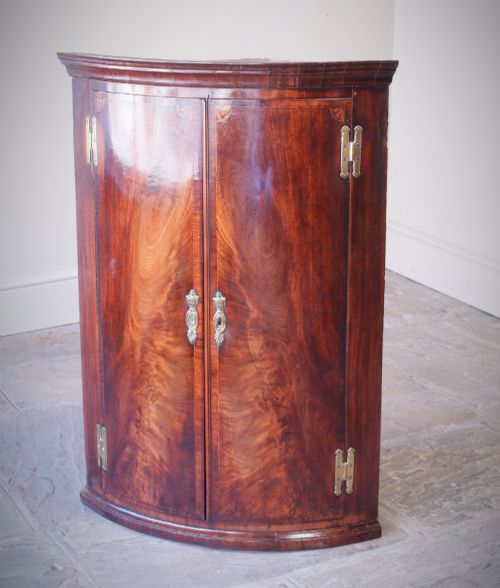
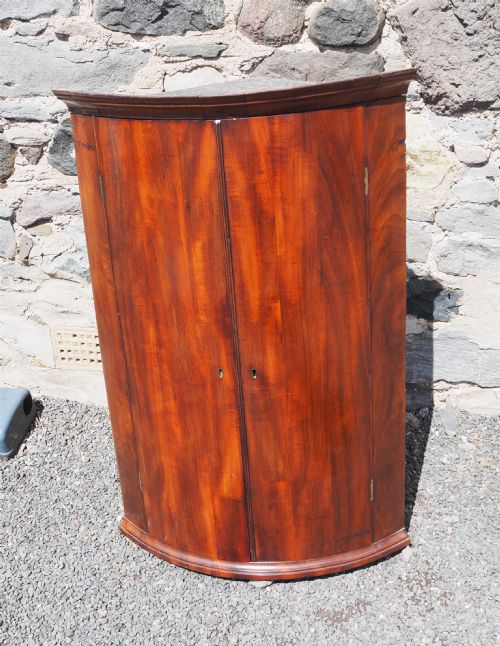


Flame Mahogany Wall Cabinet
A flame mahogany wall cabinet brings striking grain patterns and clever corner placement to traditional rooms, offering both display and concealed storage.
Flame Mahogany Wall Cabinet
Flame mahogany wall cabinets are primarily represented in this selection by hanging corner cupboards and corner cabinets dating from the Georgian period through to the nineteenth century. These pieces utilise distinctive timber grains and compact proportions designed to fit neatly into room junctions, maximising interior space while providing a commanding visual presence.
The dominant forms seen here include bow front corner cupboards featuring single doors, alongside occasional variations such as late Georgian examples with continental Empire influence or mid nineteenth century Danish Empire combinations incorporating mirrors. Most pieces originate from the eighteenth and nineteenth centuries, spanning eras from seventeen fifty onwards.
Buyers seeking a flame mahogany wall cabinet will find that English Georgian pieces dominate the inventory, often displaying curved bow fronts and fitted shelving within. The selection focuses heavily on wall hanging formats and corner cupboards rather than freestanding furniture, aligning with period domestic requirements for upper room storage.
Materials and construction
Construction relies upon solid mahogany and striking flame mahogany veneers applied to structural carcasses, complemented by contrasting details in satinwood inlay and boxwood inlay. Cabinetmakers selected timbers for their dramatic figuring, arranging veneer leaves symmetrically to create the distinctive flame effect across the door panels.
Hardware such as brass hinges and escutcheons completes the construction of these hanging cupboards, while internal woodwork often includes shaped wooden shelving. Joinery techniques from the Georgian and nineteenth century periods ensure sturdy wall mounting through integrated brackets or structural cornices.
Flame Mahogany Wall Cabinet Retail Price Guide 2026
Typical asking prices for flame mahogany wall cabinet among the pieces listed under this phrase on Sellingantiques today, from the lower quarter to the upper quarter. They describe what is for sale here now, not the wider market.
Some corner cupboards feature secret internal compartments designed to keep small valuables hidden behind the main shelving.
Assessing quality
Quality in these wall cabinets is determined by the vibrancy and bookmatching of the flame mahogany veneer, where superior examples exhibit deep, undulating grain patterns across the primary surfaces. Finer pieces also incorporate precise satinwood or boxwood inlay work that remains crisp and intact.
Structural refinement sets apart the better examples, visible in well proportioned broken arch pediments, harmonious bow front curves, and original brass fittings that complement the period timber. The handling of secondary woods and the neatness of internal shelving further distinguish workshop origins.
The Flame Mahogany Wall Cabinet Glossary
- Flame mahogany
- A figure in mahogany timber produced by cutting across the branch junctions or growth forks, yielding a feather-like, flickering grain pattern prized for cabinet doors.
- Bow front
- A convex, outwardly curved front facade common on eighteenth century and nineteenth century corner cupboards, adding softness to rectangular room angles.
- Corner cupboard
- A specialised cabinet built with a triangular cross-section specifically to fit into the ninety-degree angle of a room.
- Satinwood inlay
- Contrasting light-coloured wood inserted into recesses in the mahogany surface to create decorative borders, geometric lines, or floral motifs.
- Broken arch pediment
- A decorative architectural gable top interrupted at the apex, frequently housing an urn or finial in higher-status Georgian furniture.
Flame Mahogany Wall Cabinet: Frequently Asked Questions
How do I hang a wall cabinet?
These historical cupboards are heavy due to solid timber construction and require secure attachment to wall studs or masonry using appropriate heavy-duty fixings matched to the weight of the piece.
Professional installation is recommended to ensure the internal brackets or structural hanging points support the cabinet safely without straining the antique joinery.
What is flame mahogany?
Flame mahogany refers to wood cut from specific parts of the mahogany tree, usually near branch forks, which produces a distinctive, fiery ripple pattern.
Cabinetmakers sliced this timber into thin veneers and applied it symmetrically to door fronts to create striking visual displays.
Where were corner cupboards placed?
Corner cupboards were designed to utilise awkward wall junctions in dining rooms, parlours, and hallways, providing accessible storage without taking up floor space.
Their triangular footprint allowed them to tuck neatly into room corners while displaying valued ceramics or storing provisions.
How do I date a Georgian cabinet?
Dating relies on examining construction methods, timber types, handle styles, and decorative details such as stringing or pediments characteristic of the eighteenth century.
Cabinet work from seventeen fifty to the early nineteenth century exhibits specific stylistic transitions from simple fielded panels to elaborate veneered bow fronts.