
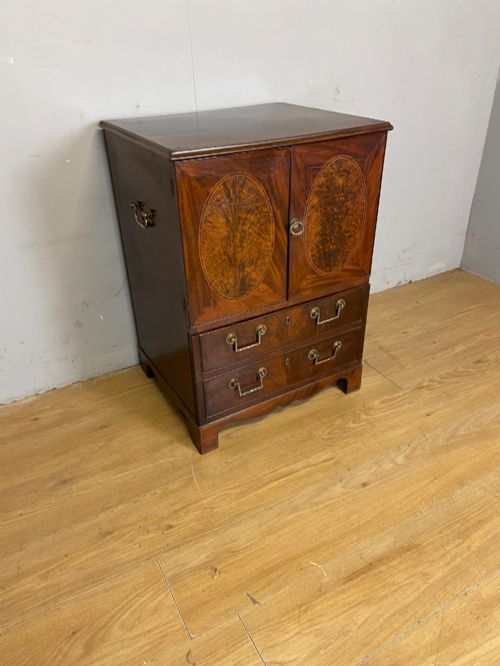


Flame Mahogany Side Chest
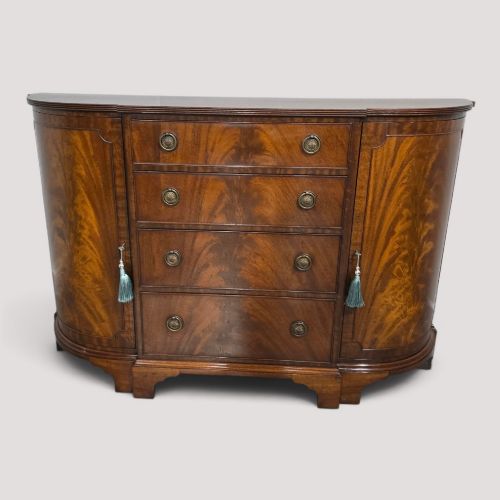
A flame mahogany side chest brings rich timber grain and compact storage to a room, offering practical surface space alongside striking figured surfaces.
Flame Mahogany Side Chest
A flame mahogany side chest groups together compact case furniture designed for bedside or side placement, drawing on 19th Century, Georgian, Victorian, Edwardian, and 1920s periods.
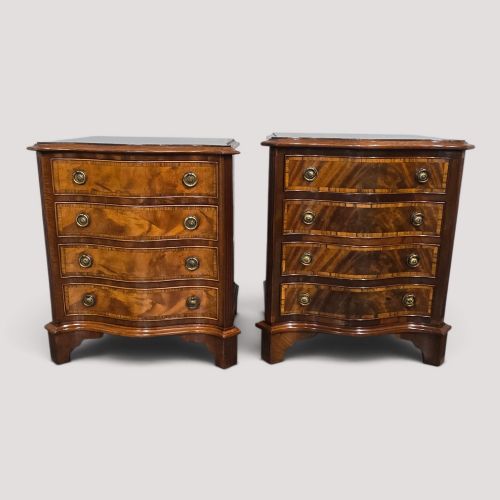
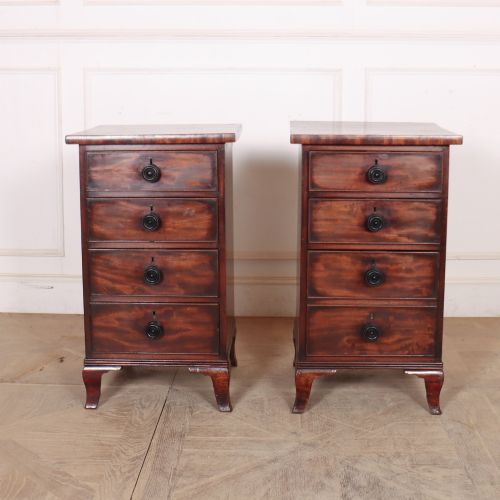
The selections span bedside tables, side cabinets, chests of drawers, commodes, and library cupboards, with a strong presence of matching pairs designed for bedroom symmetry.
Makers and workshops across these periods utilised mahogany, flame mahogany veneer, oak, and brass hardware, incorporating satinwood inlay and serpentine or bowed fronts.
How they were made
Cabinet makers applied thin sheets of flame mahogany veneer over solid secondary timbers such as oak, aligning the swirling grain patterns to create dramatic visual movement across drawer fronts and cabinet doors.
Construction techniques involve dovetail joints on drawers and detailed brass handles or key escutcheons, alongside intricate inlay work utilising contrasting timbers like satinwood.
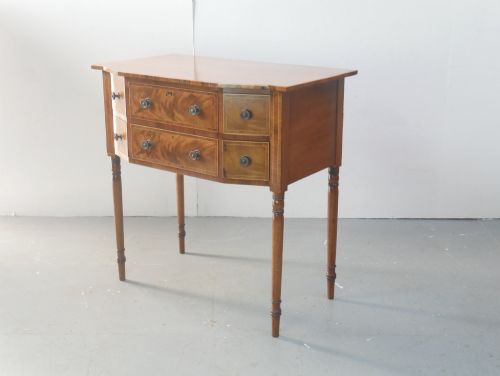
Form variations include bedside tables, Wellington chests, library cupboards, cutlery chests, and serpentine commodes.
What varies in quality
The intensity and symmetry of the flame mahogany veneer figure dictate the visual impact of the piece, with matched grain patterns across multiple drawers marking superior craftsmanship.
Structural refinement shows in the precision of serpentine or bowed curves, the tightness of drawer joints, and the integrity of secondary woods like oak beneath the veneer.
Walker and Hall Sheffield·Whytock and Reid
The Flame Mahogany Side Chest Glossary
- Flame mahogany veneer
- A thin slice of mahogany timber cut from the fork of the tree where branches meet, producing a characteristic swirling, flame-like grain pattern. This decorative surface defines the appearance of the best cabinet work.
- Serpentine front
- A furniture front curved with a convex centre flanked by concave ends, creating a fluid, undulating line. This shape demands high skill from the cabinet maker.
- Bowfront
- A convex, outwardly curved front elevation typical of many side chests and cabinets. It softens the geometric lines of case furniture.
- Wellington chest
- A tall, slender chest of drawers secured by a hinged locking side flap that fastens with a key. This form typically holds seven drawers.
- Commode
- A low cabinet or chest of drawers, frequently fitted with doors or a lift-up lid. These pieces originated for domestic storage and bedside use.
- Satinwood inlay
- Contrasting light-coloured wood inserted into the primary timber surface to form decorative borders or motifs. It provides a sharp visual boundary against dark mahogany.
Flame Mahogany Side Chest: Frequently Asked Questions
What is a flame mahogany side chest?
A flame mahogany side chest is a compact storage piece featuring decorative wood veneer with a characteristic swirling grain pattern. These items function as bedside tables, small cabinets, or commodes.
They combine practical drawer or cupboard space with decorative front elevations suited for smaller rooms or flanking a bed.
How do I style a side chest?
These pieces fit easily beside a bed, in a hallway, or as an accent cabinet in a living space. Their compact footprints allow them to hold lamps or small objects while providing enclosed storage.
Pairing matching chests creates symmetry, while single examples work well as standalone accent tables against plain walls.
How do I date a mahogany chest?
Dating relies on construction methods, hardware styles, and overall form, spanning Georgian designs through Victorian and early 20th century revivals. Examining the drawer joints and secondary timbers helps clarify the period.
Earlier pieces often exhibit hand-cut dovetailing and specific brass pulls, whereas later 19th and 20th century examples incorporate machine assistance or revival aesthetics.
Why buy a pair of bedside chests?
Matching pairs provide balanced arrangement options for larger bedrooms and guest spaces. They offer identical proportions and coordinated grain patterns across both sides of a bed.
Pairs appear frequently among Victorian and Edwardian flame mahogany designs, reflecting the period preference for bedroom suites.