
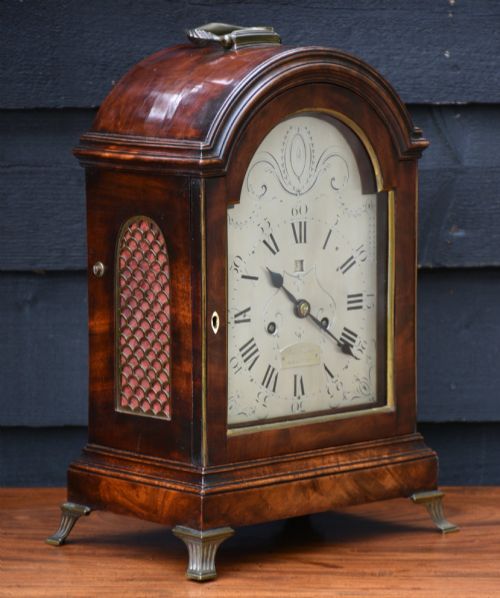
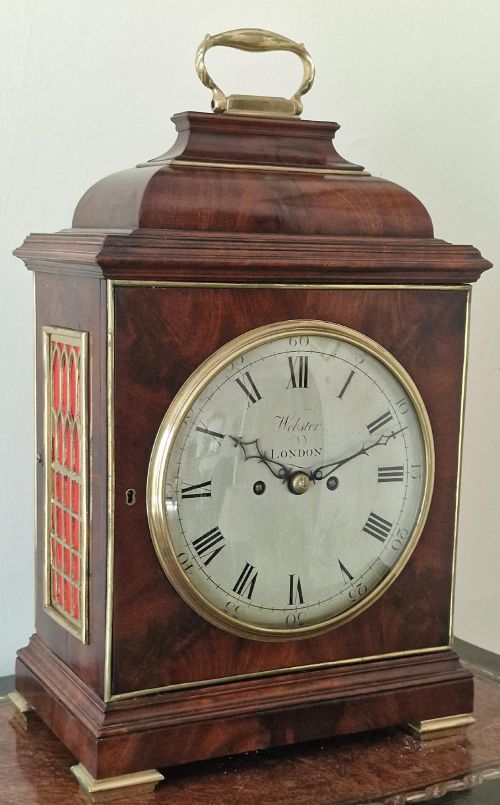


Flame Mahogany Bracket Clock
A flame mahogany bracket clock brings rich timber figure and precise timekeeping to a room, driven by fusee movements housed in mahogany cases.
Flame Mahogany Bracket Clock
A flame mahogany bracket clock is a portable timepiece designed to sit on a table, bracket, or mantel, featuring the distinctive swirling wood grain known as flame mahogany. These pieces span the Georgian, Regency, and nineteenth-century periods, with forms ranging from bell top and chamfer top to lancet designs.
Most examples encountered on this page date from the Georgian and Regency eras, constructed as mantel clocks or table clocks. Makers sign many of these pieces on brass or silvered dials, placing London and provincial horology directly within domestic settings.
How they were made
Cases utilise solid mahogany and applied mahogany veneers selected for dramatic flame figures, combined with cast brass mounts, fretwork sound grilles, and glazed doors. Movements rely on brass gear trains, often driven by fusee mechanisms to maintain even tension on the line or chain as the mainspring unwinds.
Dials employ painted enamel, engraved brass, or silvered metal with Roman and Arabic numerals, framed by bevelled or curved glass bezels. Top sections feature architectural bell tops, chamfered gables, or lancet curves constructed by skilled cabinetmakers.
Early clockmakers occasionally hid their signatures on internal plates, ensuring their handiwork endured long after the paper dial labels faded.
What varies in quality
Quality rests in the intensity and symmetry of the mahogany veneer figure across the front door and case sides, alongside the crispness of the brass sound frets and feet. Finer examples retain well-proportioned architectural cases with original bracket feet or brass carrying handles.
The sophistication of the movement and the signature on the dial separate standard timepieces from higher grade work. Signed dials by known makers and complex striking or chiming trains elevate the standing of a clock.
Webster London·Hyde of Salisbury·Hampson And Son·Watson London·Ganthony Of London·John Ellicott·Barraud And Lund·Vulliamy·Hunter Of London·Elliott
The Flame Mahogany Bracket Clock Glossary
- Fusee
- A conical pulley used in clock movements to equalise the power of the mainspring as it winds down. This ensures steady force reaches the escapement for accurate timekeeping.
- Flame mahogany
- A veneer cut from the fork of the mahogany tree where the branch meets the trunk, producing a rippling, flame-like pattern. Cabinetmakers reserved this timber for the primary facades of superior furniture and clock cases.
- Bell top
- A rounded, stepped architectural roof style typical of late eighteenth-century and early nineteenth-century bracket clocks. It often houses a striking bell and carries a brass handle.
- Silvered metal
- A brass dial plate treated with a silver solution to create a matte white metallic surface. Engraved numerals and maker signatures are then filled with black wax for legibility.
- Lancet top
- A pointed, arched clock case profile resembling a Gothic lancet window, popular during the Regency period. This silhouette provides a clean, vertical line to mantel and table clocks.
Flame Mahogany Bracket Clock: Frequently Asked Questions
What is a flame mahogany bracket clock?
A flame mahogany bracket clock is a portable mechanical timepiece enclosed in a wood case displaying prominent, undulating veneer patterns. These clocks were originally designed to sit on wall brackets or tables in principal rooms.
They combine cabinetmaking with precision gear trains, often featuring striking mechanisms and signed metal dials. The form evolved through the Georgian and Regency periods into distinct architectural shapes.
How do fusee movements work?
A fusee movement uses a conical pulley connected to the mainspring by a fine chain or cord. As the spring uncoils and loses strength, the chain moves to a wider part of the cone to maintain consistent torque.
This mechanical arrangement ensures the clock maintains steady timekeeping as the power reserve diminishes between windings.
Where were bracket clocks placed?
Bracket clocks earned their name from the wooden wall brackets that supported them, allowing sound to project effectively through side frets. Later, owners placed them directly on mantelpieces, tables, and chests of drawers.
Their portable nature meant households could move them between rooms as daily routines required.
How to tell Georgian from Regency clocks?
Georgian bracket clocks often feature robust bell top cases with elaborate brass mounts and classical dial layouts. Makers during this era favoured substantial proportions and architectural presence.
Regency examples frequently adopt simpler architectural outlines such as lancet or chamfer tops, reflecting a shift toward cleaner classical lines influenced by the Greek Revival.