


Figural Watercolour Art
Figural watercolour art brings people and narrative to paper through water-soluble pigments, capturing figures from Regency gentlefolk to Victorian rustic workers.
Figural Watercolour Art
Figural watercolour art comprises works on paper centring on human subjects, spanning 19th Century, Victorian, Regency, 1890, 1870, and 1930 periods. Buyers encounter framed paintings and unframed works depicting scenes from daily life, rural settings, and international subjects.
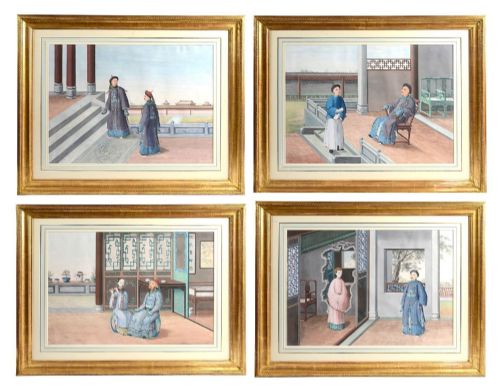
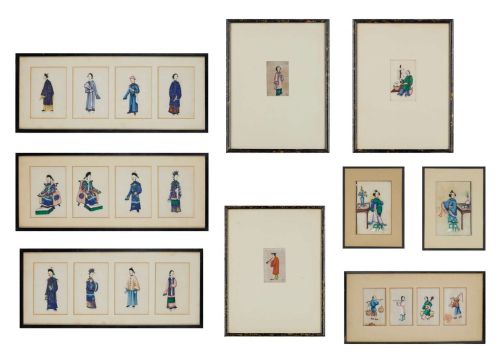
Chinese Export and Qing Dynasty pith paper paintings sit alongside British and American works by named artists like Philip Richard Morris and James Hardy Junior. The common thread is the human figure rendered in watercolour pigment, gouache, and sometimes ink on paper or pith.
Most pieces date to the Victorian era and the 19th century, featuring subjects such as shepherdesses, fisherwomen, and children. Styles range from Pre-Raphaelite realism to Chinese Canton export art and Japanese watercolours.
How they were made
Artists applied watercolour pigment and gouache suspended in water onto paper supports, including delicate pith paper derived from plant pith. Detail work required fine sable brushes, while washes created atmospheric backgrounds and soft light.
Many works survive in period frames of wood and gilt wood, protected behind glass to shield the paper from moisture and light damage. Chinese pith paintings frequently retain their original mounting or leaf-book formats.
Fisherwomen, potato peelers, and ducks feature heavily, proving that 19th-century artists found high drama in everyday chores.
What varies in quality
Quality rests in the precision of the brushwork and the expressiveness of the human face and hands. Master works capture personality and texture in fabric and skin with minimal pigment, whereas lesser examples rely on stiff outlines and flat washes.
The condition of the paper and the vibrancy of the pigments dictate value. Unfaded watercolours with crisp detail command attention over sheets suffering from foxing, damp staining, or heavy light fading.
Philip Richard Morris·James Hardy Junior·Madeline Hughes·John R Houston·Charles Edward Wilson·Muriel Metcalfe
The Figural Watercolour Art Glossary
- Pith paper
- A delicate, spongy material cut from the pith of the Tetrapanax papyrifer plant, used in 19th-century China for vibrant gouache and watercolour paintings. It absorbs pigment deeply, creating a velvety surface.
- Gouache
- An opaque water-soluble paint consisting of pigment, water, and a binding agent such as gum, often used alongside transparent watercolour to add highlights. It provides solid blocks of colour.
- Foxing
- Brown spots and patches that appear on old paper caused by chemical reactions in the pulp or mould growth from damp environments. It is common in 19th-century watercolours.
- Pre-Raphaelite
- An artistic movement from the mid-19th century characterised by detailed observation, bright colours, and complex literary or moral subjects. Artists in this circle depicted figures with intense realism.
- Regency
- The period in British history from 1811 to 1820, noted for specific neoclassical design traits and early export art. Works from this time often show distinct costume and palette.
Figural Watercolour Art: Frequently Asked Questions
How should I display watercolour art safely?
Keep watercolours away from direct sunlight to prevent the pigments from fading and the paper from yellowing. Framing them behind glass with UV-filtering properties offers essential protection.
Position the pieces in rooms with stable humidity and temperature levels. Avoid hanging them on damp exterior walls or near heat sources that could warp the paper and frame.
What is pith paper?
Pith paper comes from the stem of a Chinese shrub and has a soft, velvety texture that absorbs watercolour and gouache brilliantly. Artists in the 19th century used it extensively for export paintings.
Because the material is fragile, pith paintings require careful handling and protective framing behind glass. They are distinct from Western paper due to their spongy, cushion-like body.
How do I date a 19th-century watercolour?
Examine the costume, hairstyle, and framing materials for clues. Victorian and Regency clothing styles offer precise brackets for when the subject was painted.
Look for signatures, dates inscribed by the artist, and paper watermarks. Backing boards and old gallery labels also help establish a timeline for the artwork.
What is the difference between watercolour and gouache?
Watercolour is translucent, allowing the white of the paper to shine through the washes of pigment. It relies on layering transparent tones to build depth and light.
Gouache is opaque because it includes a white pigment filler, creating solid, flat areas of colour. Artists often combined both mediums in figural art to highlight details like lace or water.