


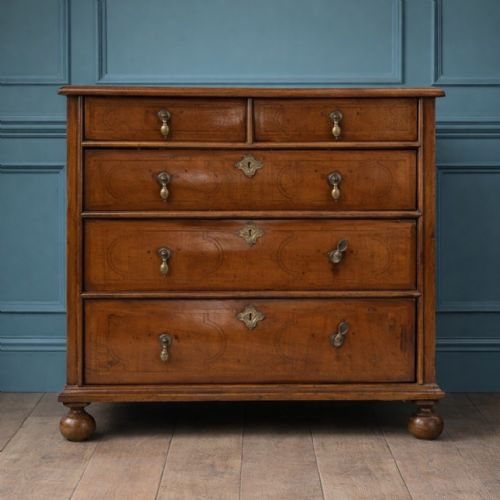


Feather Inlaid Chest
A feather inlaid chest brings rich walnut grain and delicate banding into a room, offering both historic character and practical storage.
Feather Inlaid Chest
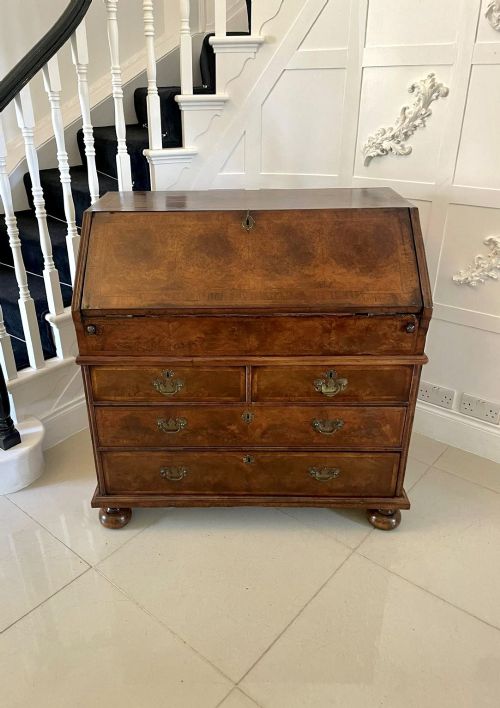
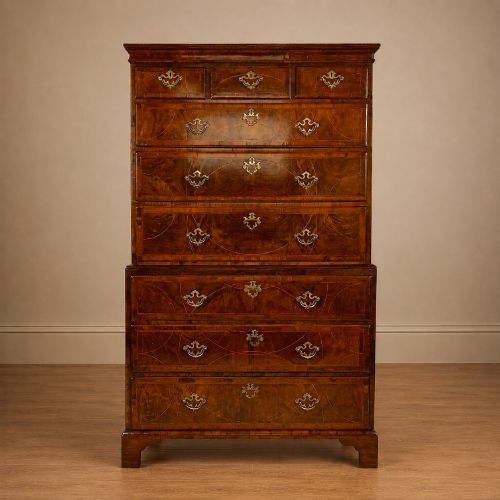
A feather inlaid chest is a storage piece constructed in walnut, appearing across periods from the late seventeenth century through the Georgian era. These items take the form of chests of drawers, taller chests on chests, and tallboys designed to hold garments.
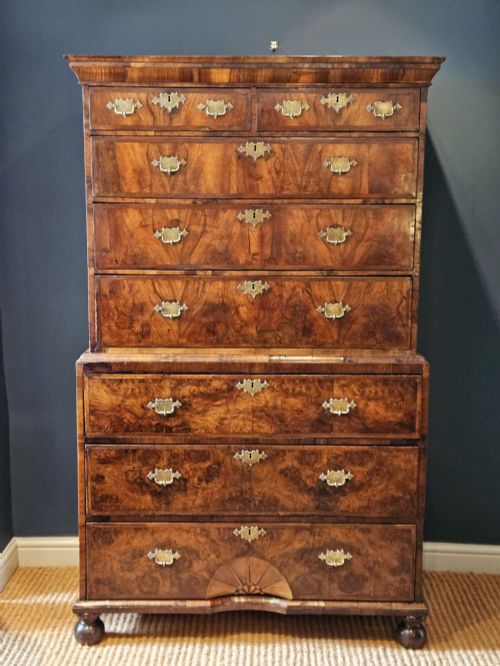
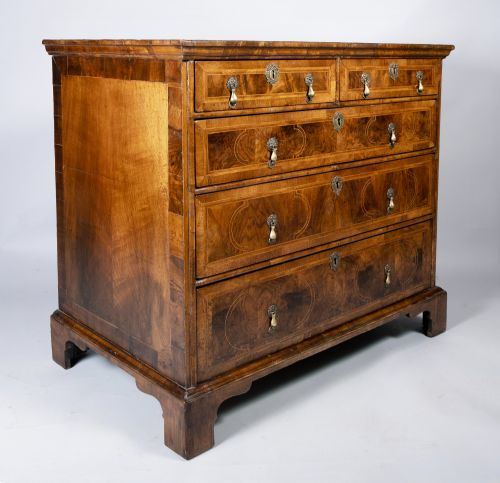
The version most commonly met on this page is the walnut chest of drawers or chest on chest from the George I, George II, and Queen Anne periods. Such examples frequently display distinct feather-banded or line-inlaid borders framing the drawer fronts.
How they were made
Cabinetmakers utilised walnut and burr walnut veneers applied to secondary woods like oak, securing structural stability while presenting striking figurative grain patterns on the exterior surfaces. Brass hardware, including handles and escutcheons, was fitted to the drawer fronts to complete the construction.
Intricate banding techniques involved cutting thin strips of veneer diagonally to create the herringbone or feather effect seen around the borders. These decorative elements were meticulously inlaid into the primary timber surfaces by hand.
Listings feature walnut, burr walnut, oak, and brass across seventeenth and eighteenth-century periods including Queen Anne, William and Mary, and Georgian.
What varies in quality
The choice and matching of the walnut veneer dictate much of the visual appeal, with highly figured burr timber placed symmetrically across the drawers marking out the finer pieces. Lesser examples rely on plain timber surfaces with simpler, less rhythmic grain patterns.
The precision of the inlay work and the retention of original brass hardware elevate certain items above others. Subtle details such as dished sunburst motifs or well-executed cross-banding demonstrate superior cabinetmaking skill.
The Feather Inlaid Chest Glossary
- Feather-banding
- A decorative inlay technique using two strips of veneer cut diagonally to form a herringbone pattern resembling a bird feather. This detail frames the drawer fronts of finer pieces.
- Tallboy
- A tall chest of drawers, often constructed as a chest on chest where a smaller upper section sits atop a larger base. These pieces maximise vertical storage space.
- Cross-banding
- A border of veneer where the grain runs at right angles to the surrounding wood. It creates a neat framing effect on table tops and drawer faces.
- Escutcheon
- A protective brass plate surrounding a keyhole. These fittings prevent the wood from wearing around the lock.
Feather Inlaid Chest: Frequently Asked Questions
How do I date a walnut chest?
Dating relies on stylistic markers, construction methods, and the specific proportions of the piece. Pieces from the late seventeenth century often display William and Mary or Queen Anne characteristics.
Later eighteenth-century examples shift towards Georgian proportions and different bracket foot designs. Examining the secondary woods like oak inside the drawers also assists in determining the period.
Where should I place one?
These chests suit traditional bedrooms, studies, or hallways where their warm timber tones can be appreciated. Their practical drawer space makes them useful for everyday storage.
Keeping them away from direct sunlight and radiators protects the antique walnut veneer from drying out and splitting over time.
What is a tallboy?
A tallboy is a variation of the chest of drawers built vertically to provide substantial storage within a compact floor footprint. Many examples on this page take the form of a chest on chest.
They combine an upper set of smaller drawers with a larger chest base. This stacked design was popular throughout the Georgian era.