


Feather Banded Bureau
A feather banded bureau is a writing cabinet defined by delicate decorative borders, offering both fitted interior drawers and rich figured timber.
Feather Banded Bureau
A feather banded bureau combines a sloping fall-front writing flap with internal pigeonholes and small drawers, resting atop a chest of larger drawers. When searching for a feather banded bureau, buyers encounter sophisticated writing furniture produced during the late seventeenth and eighteenth centuries, spanning the Queen Anne, George I, and George II periods.
The pieces appearing on this page originate predominantly from the 18th century and the 1700s, often attributed to the Georgian era. Walnut and burr walnut dominate the construction, accompanied by oak used for secondary framing and drawer linings.
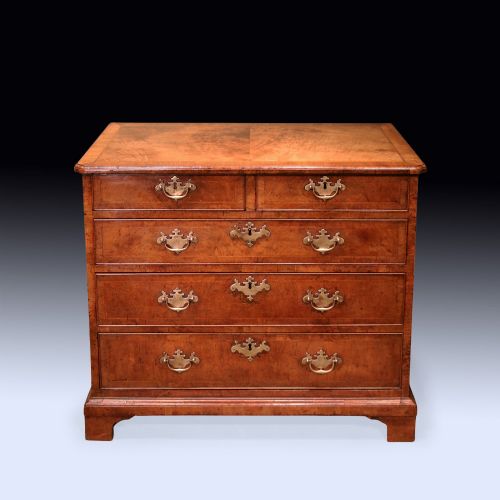
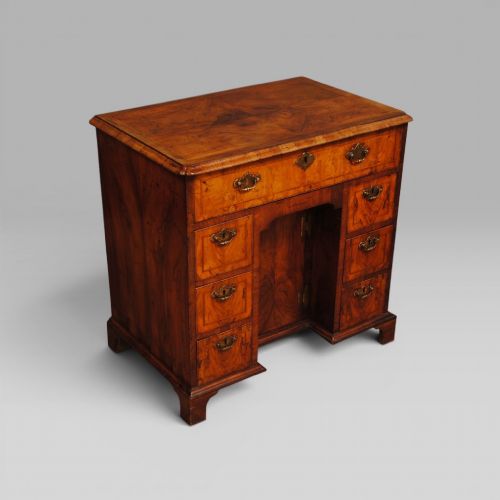
Beyond the standard bureau form, related writing pieces such as escritoires, secretaire cabinets, and kneehole desks appear frequently in the selection. These variations retain the characteristic decorative borders while offering alternative internal storage arrangements and writing surfaces.
Materials and construction methods
Cabinetmakers utilised walnut and burr walnut veneers applied to solid oak or softwood carcases, creating rich figure and depth on the primary surfaces. Crossbanding and feather banding were then inlaid around the drawer edges and fall fronts using meticulously cut veneers.
Brass handles and escutcheons, often cast in drop or batwing designs, provide the operational hardware for the drawers and fall fronts. These metal mounts are secured with original pins or wires where untouched examples survive.
Internal components feature secret compartments, small drawers, and pigeonholes constructed from secondary timbers like oak and pine. Dovetail joints join the drawer construction, reflecting the prevailing standards of early eighteenth-century joinery.
Listings feature walnut, burr walnut, oak, and brass across 18th-century Queen Anne, George I, and George II periods.
Variations in quality
The figure of the walnut veneer dictates much of the visual hierarchy, with highly figured burr timber commanding greater regard than plain straight-grained surfaces. The crispness and symmetry of the feather banding further distinguish finer examples from simpler provincial work.
Proportion and scale play a crucial role, as smaller bureau formats and kneehole configurations demonstrate greater cabinetmaking ambition. The survival of original brass hardware and untouched surface patination enhances the integrity of any piece.
The Feather Banded Bureau Glossary
- Feather banding
- A decorative inlay technique using two strips of veneer cut diagonally and laid to meet at a central angle, resembling a bird feather. This border frames drawer fronts and fall fronts on walnut furniture.
- Crossbanding
- A strip of veneer laid perpendicular to the grain of the surrounding surface, often bordering the outer edges of a bureau flap. It creates a contrasting frame that highlights the main panel.
- Escritoire
- A writing cabinet featuring a fall-front desk compartment enclosed by a large upper door or fall flap. These tall case pieces offer extensive internal storage.
- Burr walnut
- Wood taken from the wart-like growths on walnut trees, yielding highly swirling and turbulent grain patterns. Cabinetmakers prized this timber for high-status furniture surfaces.
- Kneehole desk
- A compact writing table featuring a central recessed space for the user's knees, flanked by small banks of drawers. They date primarily from the Queen Anne and Georgian periods.
Feather Banded Bureau: Frequently Asked Questions
What is a feather banded bureau?
A feather banded bureau is an eighteenth-century writing desk featuring a sloping fall-front lid that opens to reveal internal compartments and drawers. The exterior surfaces are typically decorated with delicate diagonal wood veneers arranged to resemble bird feathers.
These pieces combine practical workspace with concealed storage, standing upon drawer bases or bracket feet. They represent a pinnacle of early walnut cabinetmaking.
How do I date an early walnut bureau?
Dating relies on examining construction traits, timber choices, and hardware styles across the Queen Anne and Georgian eras. Early pieces from around 1700 to 1720 often feature herring-bone or feather banding, bracket feet, and solid walnut or burr walnut veneers.
Secondary woods like oak in the drawer linings and original brass drop handles provide further chronological markers. Cabinet proportions also shifted from taller formats toward smaller, neat proportions as the eighteenth century progressed.
Where were these bureaus placed in a home?
In eighteenth-century homes, these desks served as private writing spaces in parlours, bedrooms, or dedicated studies. Their compact footprints made them suitable for rooms where space remained at a premium.
The lockable fall-front flap allowed owners to secure correspondence, account books, and valuables safely away from household staff.
How do I care for antique walnut furniture?
Antique walnut requires stable indoor humidity and protection from direct sunlight to prevent timber shrinkage and veneer lifting. Regular dusting with a soft, dry cloth preserves the polished surface without introducing moisture.
Abrasive cleaners and modern silicone polishes should be avoided to maintain the natural patination built up over centuries.