

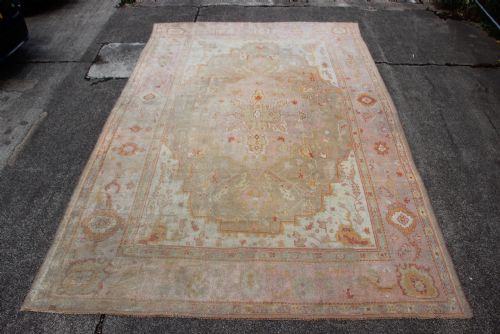
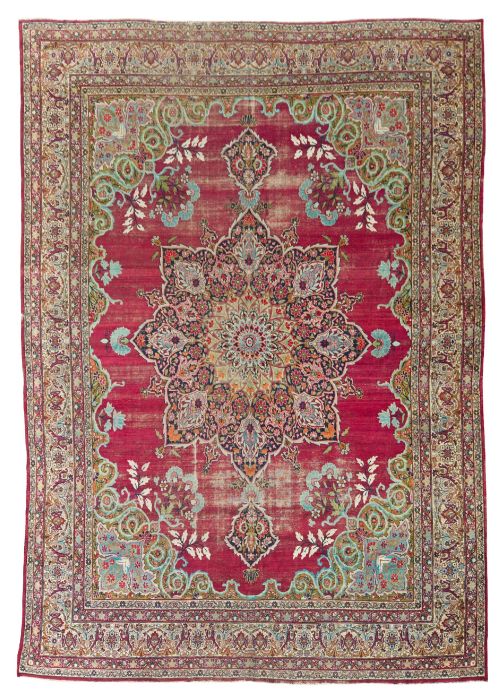



Faded Floral Carpet
A faded floral carpet brings muted botanical warmth to a floor, offering softly weathered motifs shaped by generations of domestic wear.
Faded Floral Carpet
A faded floral carpet brings together traditional rug weaving traditions from regions such as Turkey and Persia, spanning the nineteenth and early twentieth centuries. When searching for a faded floral carpet, buyers encounter large carpets, room-size runners, and smaller area rugs originating from centres like Ushak, Tabriz, Kirman, Bandirma, Sarouk, and Kashan. These floor coverings employ classic Ottoman, Turkish, Anatolian, and Persian design vocabulary, adapted into grand room formats or narrower runner proportions.
The pieces available on this page demonstrate the enduring appeal of floral patterns subdued by time, utilising wool pile on cotton foundations. Dating primarily from the 1880s, 1890s, 1900s, 1920s, and the broader nineteenth century, these woven works range from expansive oversized dimensions exceeding four or five metres to more modest domestic formats. Each piece displays the distinct characteristics of its weaving origin, whether structured Ziegler designs or sweeping Anatolian floral arrangements.
How they were made
These carpets and rugs are constructed using wool for the surface pile, providing both resilience and a soft tactile quality underfoot. The foundational structure beneath the pile relies on cotton warp and weft threads, offering stability and structural integrity to large room-size formats.
Weavers knotted the wool pile by hand onto the cotton foundation, translating traditional Ottoman, Persian, and Anatolian botanical motifs into enduring textile art. The application of natural dyes over wool created the characteristic palette that eventually mellowed into the muted tones seen today.
Faded Floral Carpet Retail Price Guide 2026
Typical asking prices for faded floral carpet among the pieces listed under this phrase on Sellingantiques today, from the lower quarter to the upper quarter. They describe what is for sale here now, not the wider market.
Listings feature pieces from the 1880s, 1890s, 1900s, 1920s, and the wider 19th century, constructed from wool and cotton.
What varies in quality
The distinction between tiers of quality rests upon the finesse of the knotting and the spatial balance of the floral composition. Finer examples exhibit a precise relationship between the wool pile and the underlying cotton structure, allowing the botanical design to retain clarity despite centuries of softening.
Proportion and scale dictate the visual success of larger formats, where room-size and oversized pieces require harmonious borders and central fields. The depth of the wool and the organic way the colours have faded over time further separate standard utility weaves from superior artistic achievements.
The Faded Floral Carpet Glossary
- Pile
- The upright loops or cut ends of yarn that form the usable surface of a carpet. This wool layer absorbs daily friction and softens in colour over time.
- Foundation
- The underlying grid of warp and weft threads that supports the knotted wool pile. Cotton is typically utilised for this structural framework.
- Runner
- A long, narrow carpet format designed specifically for hallways, corridors, or alongside furniture. These pieces maintain proportional balance over extended lengths.
- Oversize
- A descriptive term for particularly large carpets that exceed standard room dimensions. These substantial formats anchor expansive floor spaces.
Faded Floral Carpet: Frequently Asked Questions
How do I clean an old carpet?
Gentle surface vacuuming without the rotating brush active removes daily dust and prevents fibre abrasion. Professional specialist cleaning remains essential for deep maintenance.
Harsh chemical washing must be avoided to preserve the delicate wool pile and the historic natural dyes. Specialist textile conservators understand how to handle nineteenth-century foundations safely.
Can I place these in hallways?
Long runner formats function naturally in corridors, narrow entryways, and gallery spaces. Their proportions suit linear architectural layouts.
High foot traffic areas require a breathable underlay to cushion the cotton foundation against hard floors. This simple addition reduces direct friction and extends the functional life of the wool pile.
How do I distinguish regional styles?
Turkish and Anatolian pieces, such as those from Ushak or Bandirma, often display looser floral arrangements and distinctive warm palettes. Persian examples from Tabriz, Kirman, Sarouk, or Kashan frequently feature tighter knotting and intricate medallion schemes.
Examining the handling of the wool and the structure of the cotton foundation helps confirm the origin. Each weaving centre maintained specific technical habits that identify its geographic source.
What underlay should I use?
A specialist non-slip mesh underlay protects the cotton foundation from gripping directly onto wooden or stone floorboards. This layer prevents slipping and cushions the textile.
Selecting a breathable material ensures trapped moisture does not affect the wool pile or foundation threads. Proper airflow safeguards the textile structure over decades of domestic placement.