
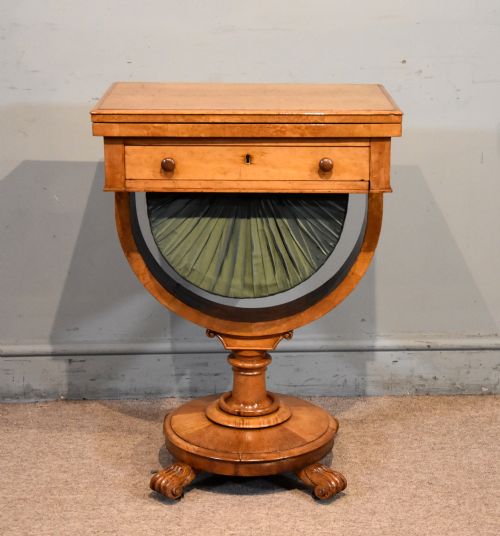

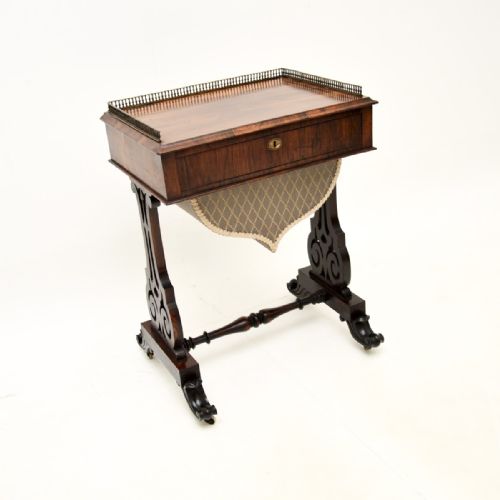


Fabric Basket Sewing Table
A fabric basket sewing table brings together refined woodwork and practical needlework storage, offering a charming piece of period furniture for daily use.
Fabric Basket Sewing Table
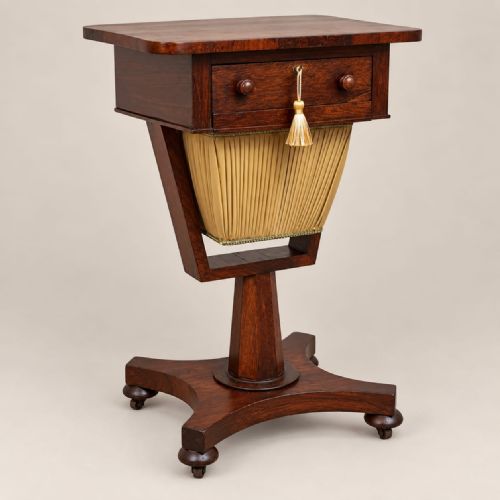
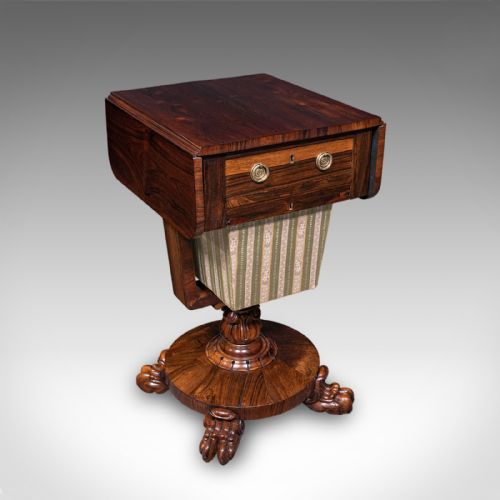
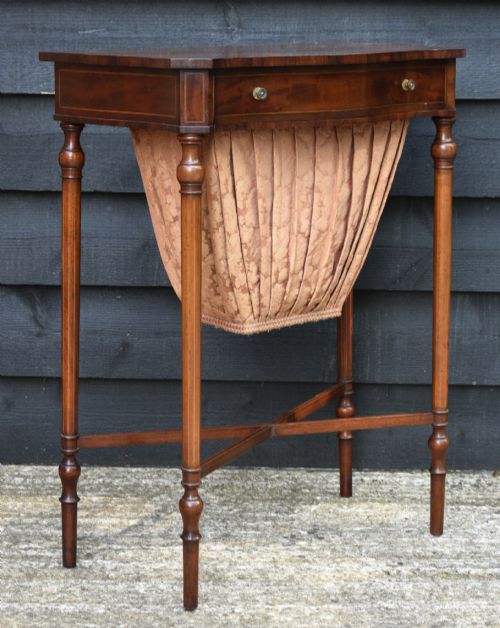
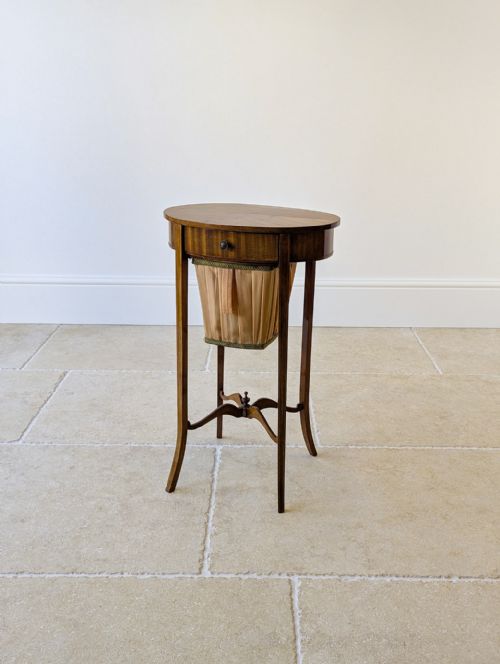
When you search for a fabric basket sewing table, you are looking at specialised occasional furniture designed to hold sewing, needlework, and hobby materials within reach. These pieces function as both practical work tables and decorative side tables for the parlour or sitting room.
The versions you are most likely to meet on this page date from the Georgian, Regency, William IV, and Victorian periods, extending through to Edwardian examples around nineteen-ten. They appear most frequently in mahogany and rosewood, often featuring drop leaves or fitted compartments above an attached cloth bag.
Makers designed these items specifically for ladies' pursuits, combining the utility of a work box with the graceful proportions of a side or lamp table. The inclusion of a suspended fabric bag distinguishes them from standard occasional tables, providing a soft receptacle for yarn, silk, and cloth.
What varies in quality
The standard of timber selection and cabinet work largely determines the quality of a piece, with finely figured veneers and solid secondary woods marking out superior examples. Attention to detail in the turning of the legs and the neatness of the drop-leaf mechanism also separates standard items from finer productions.
The preservation of the original fabric components and interior fitments plays a significant role in the overall integrity of the piece. Tables that retain sophisticated internal compartment layouts or well-executed inlay demonstrate a higher grade of craftsmanship.
Listings feature mahogany, rosewood, satinwood, and burr walnut across Georgian, Regency, Victorian, and Edwardian periods.
Gillows
The Fabric Basket Sewing Table Glossary
- Drop Leaf
- A table top with hinged flaps that can be folded down to save space or raised to expand the surface area.
- Work Table
- A small piece of furniture designed to hold sewing equipment, patterns, and materials.
- Satinwood
- A pale, hard timber with a lustrous sheen, frequently utilised for fine Edwardian inlay and decorative veneering.
- Lyre-Ended
- A form of table support shaped like an ancient Greek lyre, commonly found on Regency examples.
- Burr Walnut
- A highly prized wood featuring swirling knot formations, used to create decorative surfaces on Victorian furniture.
Fabric Basket Sewing Table: Frequently Asked Questions
What is a fabric basket sewing table?
A fabric basket sewing table is a compact occasional table equipped with a suspended cloth bag or pouch designed to hold needlework supplies. These pieces combine a wooden top and frame with soft textile storage.
Cabinet makers produced them primarily during the nineteenth and early twentieth centuries for domestic use in parlours and sitting rooms.
How were sewing tables used originally?
Gentlewomen used these tables to organise sewing, embroidery, and knitting projects while keeping materials tidy and close at hand. The tops served as a steady surface for handwork or holding a lamp.
Many versions included internal compartments for spools and pins, alongside the drop leaves which provided extra workspace when needed.
How do I date a sewing table?
Dating relies on identifying the prevailing timber choices, stylistic motifs, and structural forms characteristic of specific eras. Regency pieces often feature maple, rosewood, or lyre supports, while Edwardian examples frequently showcase inlaid satinwood and lighter proportions.
Victorian models tend to utilise heavy rosewood or burr walnut with robust turnings, whereas Georgian pieces display simpler, classical lines.
Can I use an antique sewing table today?
These tables adapt readily to modern interiors as side tables, bedside stands, or lamp tables in living spaces. The fabric basket provides convenient storage for magazines, yarn, or small everyday items.
Their compact proportions allow them to fit easily into smaller rooms while adding historical character to a modern scheme.