

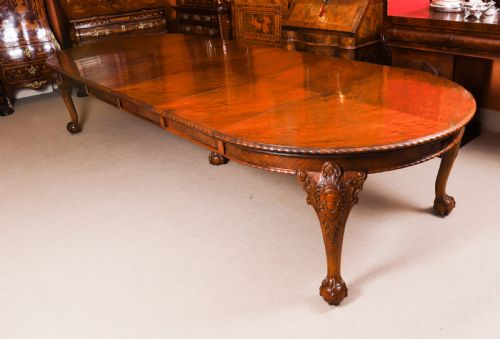
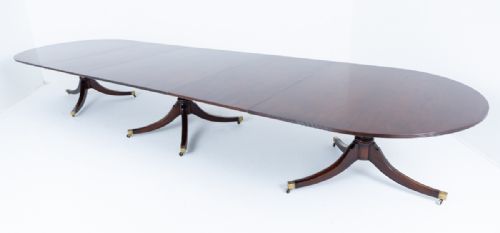
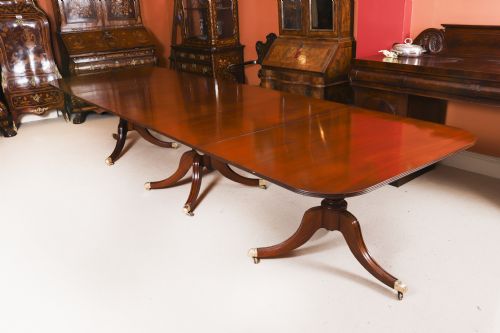
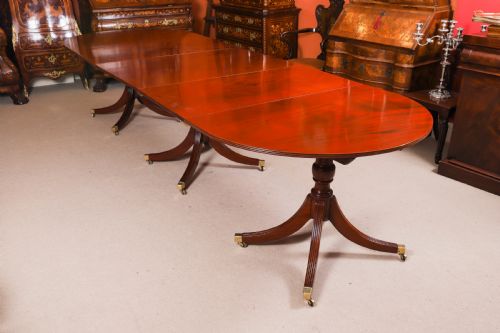
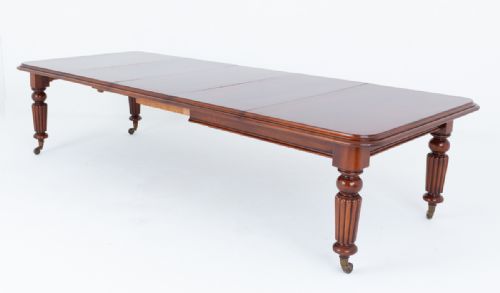

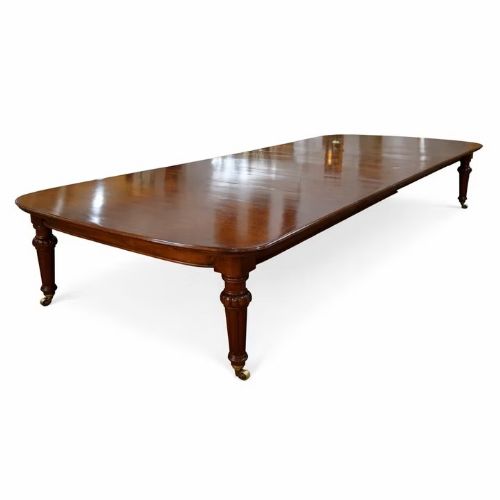
Extendable Banquet Table
An extendable banquet table handles large company gracefully, expanding through clever leaves and pillars to seat twenty or more guests.
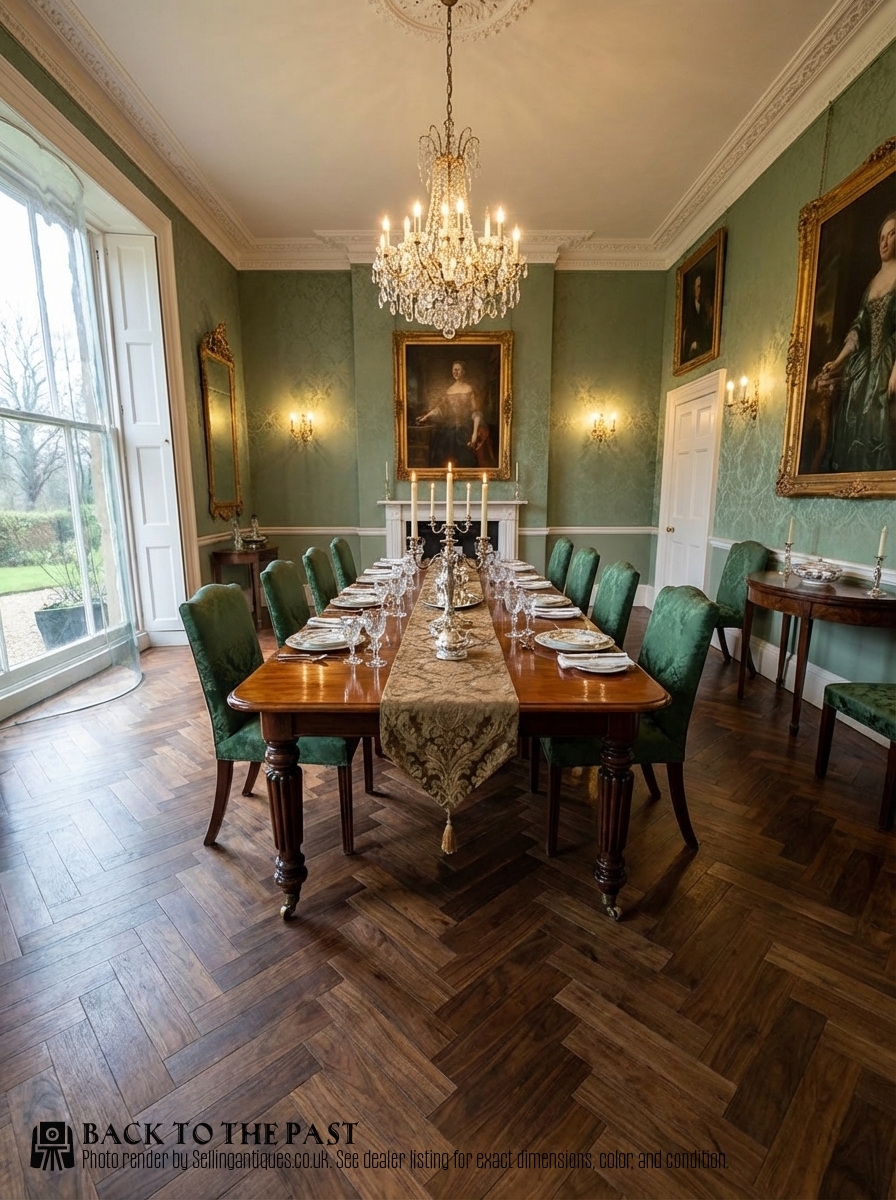
Extendable Banquet Table
An extendable banquet table provides substantial dining capacity through multi-pillar frames and removable leaves, spanning lengths from eight to over twenty feet. These dining tables appear primarily in mahogany, walnut, and oak across Georgian, Regency, Victorian, and Edwardian periods.
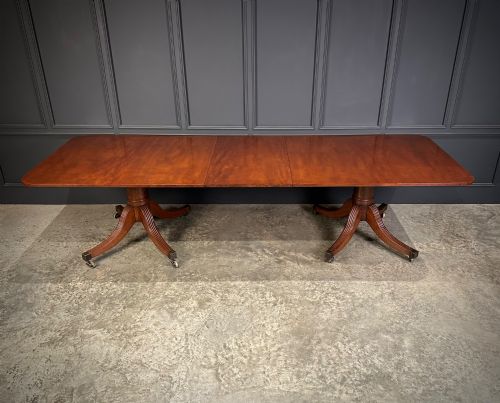
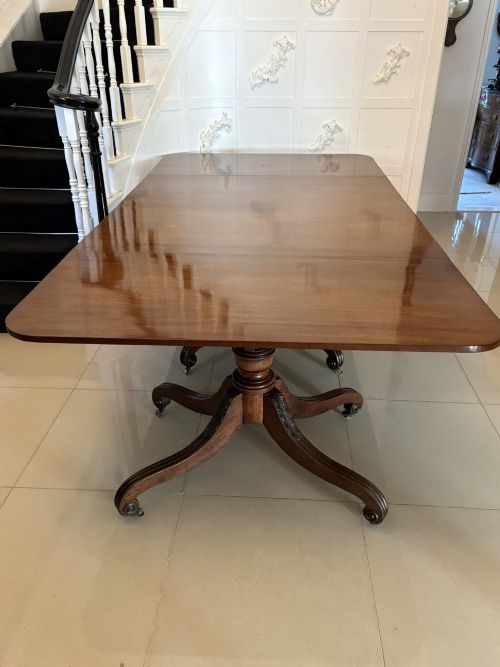
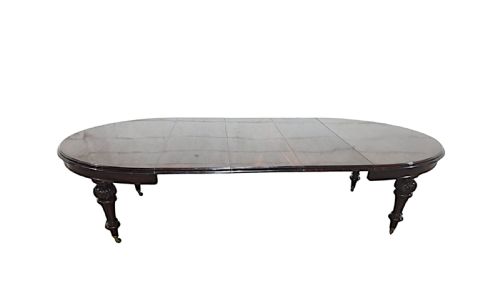
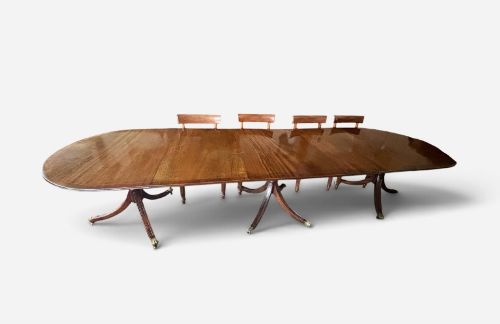
The version most commonly met on this page is the multi-pillar mahogany dining table dating from the nineteenth century. These pieces employ twin, triple, or four-pedestal bases fitted with brass castors to support lengthy timber tops.
Makers and workshops constructed these tables to adapt from intimate family meals to large gatherings by inserting additional leaves into the centre. The mechanisms range from traditional wind-out systems to draw-leaf designs and drop-in leaf configurations.
Distinctions in Quality and Make
Quality rests heavily on the selection of timber figures, such as Cuban flame mahogany or plum pudding mahogany, matched evenly across multiple inserted leaves. Inferior examples show mismatched grain direction or secondary timbers on primary visual surfaces.
The engineering of the extending mechanism dictates the upper tier of execution, where smooth-running brass screws and stable pillar housings keep long tops level under heavy loads. Lesser tables exhibit sag across extended joints or wobble on uneven floor surfaces due to poorly seated pedestals.
The listings span the Georgian, Regency, William IV, Victorian, and Edwardian periods, constructed primarily in mahogany, oak, and walnut.
Gillows·Maple and Co·Wylie and Lochead·Whytock and Reid·William and Gibton
The Extendable Banquet Table Glossary
- Wind-out table
- A dining table utilising an internal metal screw mechanism operated by a crank handle to expand the frame apart for leaves. This system gained popularity during the Victorian period for heavy multi-pillar tables.
- D-end table
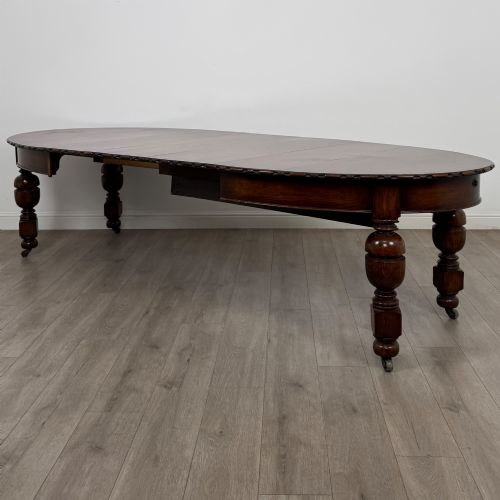
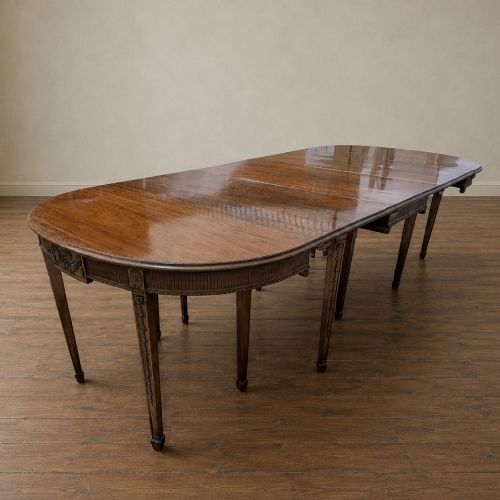
- A dining table whose end sections form a semi-circle resembling the letter D when separated from the central leaves. When pushed together without leaves, the ends create a smaller circular or oval table.
- Draw-leaf
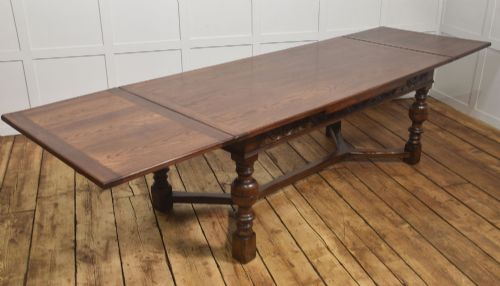
- A table style where auxiliary leaves store directly beneath the main surface and pull out from each end to extend the length. This mechanism appears frequently in oak dining tables from the early twentieth century.
- Triple pillar
- A dining table base comprising three separate pedestal columns placed in a line down the centre to support lengthy tops. This configuration provides necessary legroom and structural stability for tables seating twelve to sixteen people.
Extendable Banquet Table: Frequently Asked Questions
How many people do these tables seat?
These large dining tables typically seat between ten and twenty-four guests depending on the number of inserted leaves. Lengths often range from eight to fifteen feet.
Larger configurations utilise three or four pedestals to distribute weight evenly and accommodate extra leaves without sagging in the middle.
How do the extension mechanisms work?
Many nineteenth-century examples use a mechanical wind-out screw system operated with a removable crank handle. Turning the handle drives the pedestals apart to create a gap for the leaves.
Other tables rely on simple drop-in leaves supported by wooden runners or draw-leaf configurations where panels slide out from beneath the main top.
How do I care for a mahogany top?
Polished hardwood surfaces require regular dusting with a soft, dry cloth and occasional feeding with traditional beeswax to preserve the sheen. Avoid placing hot dishes or wet glasses directly onto the polish.
Direct sunlight can fade flame mahogany over time, so positioning the table away from intense windows helps maintain the rich colour of the timber.
How can I tell a Regency table from a Victorian one?
Regency tables dating from the early nineteenth century generally display cleaner classical lines, rosewood or mahogany veneers, and brass-inlaid pedestals. Cabinet makers of this era favoured restraint and architectural proportion.
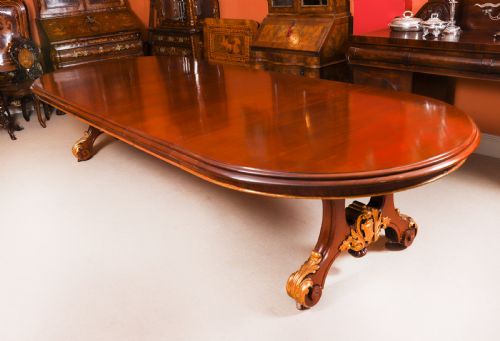
Victorian tables from around 1850 onwards often feature heavier carved decoration, such as claw and ball feet or robust cabriole legs, alongside complex mechanical winding systems.