





Expressionist Nude Painting
Expressionist nude painting captures the human form through intense colour and bold brushwork, offering buyers a powerful emotional impact.
Expressionist Nude Painting
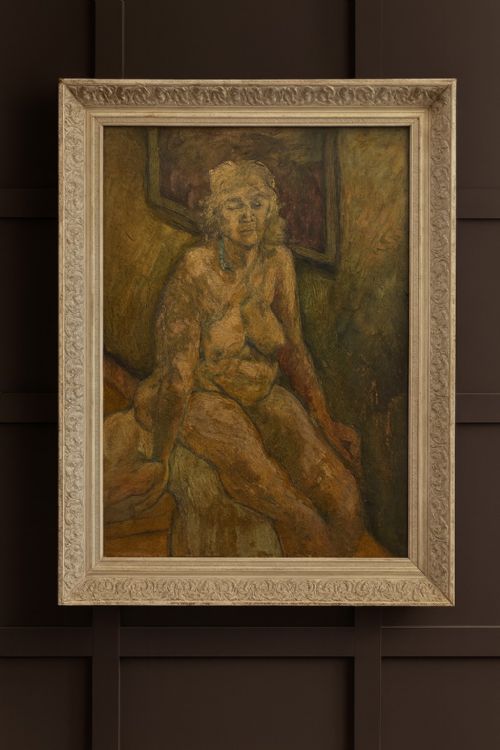
An expressionist nude painting focuses on the human figure through distorted forms and vigorous paint application, steering away from strict academic realism. When exploring expressionist nude painting, buyers frequently encounter mid-twentieth-century works produced across Britain and France during the 1920s, 1930s, 1950s, and 1960s.
The subjects appear primarily as seated, standing, or reclining female figures, rendered by artists associated with movements such as Fauvism, Cubism, and Mid-Century Modernism. These pieces range from intimate paper studies to large canvas works framed in wood or gilt plaster.
How they were made
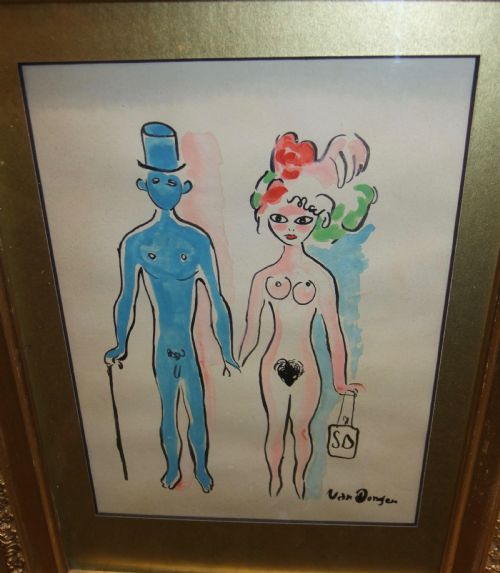
Artists apply oil paint directly onto canvas, board, or paper, often building thick impasto layers that emphasise physical texture and gestural movement. Some works employ watercolour on paper, capturing fluid forms with rapid brushstrokes.
Supports include wooden stretchers and boards, occasionally finished with framed gilt plaster mouldings that complement the vivid palettes of the mid-century compositions.
One recorded mid-century study captures a feline companion sharing the sofa with a reclining nude.
What varies in quality
The strength of the composition and the confidence of the brushwork distinguish the finest works from routine studio exercises. A master hand uses distortion purposefully to heighten emotional resonance rather than relying on conventional proportion.
The integrity of the medium also plays a role, with stable oil layers on canvas or board preserving the vibrancy of the pigment better than compromised paper supports.
Tony Giles·Gaetan Dumas·Peter Jackson·Jean Hippolyte Marchand·Pinchus Krémègne·Yetta Kane·Raymond Arthur Roadnight·Kees van Dongen
The Expressionist Nude Painting Glossary
- Impasto
- Paint applied thickly to a canvas or board, standing out in relief from the surface so that the marks of the brush or palette knife remain visible. This technique adds tactile depth to expressionist works.
- Fauvism
- An early twentieth-century style characterised by strong colours and fierce brushwork over realistic values. Painters working in this manner prioritize emotional expression over literal representation.
- Chiaroscuro
- The use of strong contrasts between light and dark to give a sense of volume to three-dimensional objects and figures. It heightens the dramatic atmosphere within a figurative composition.
- Avant-garde
- New and experimental ideas in art, pushing the boundaries of traditional forms. These pieces often challenge established academic standards of the period.
Expressionist Nude Painting: Frequently Asked Questions
What defines an expressionist nude painting?
These works utilise exaggerated forms, expressive brushwork, and non-naturalistic colour palettes to convey emotional intensity rather than photographic accuracy. The focus rests entirely on the human figure.
They capture movement, mood, and psychological depth through varied mediums like oil on canvas, paper, or board.
Where were these paintings produced?
The available pieces originate primarily from British and French artists working through the early and mid-twentieth century. Studios in these regions generated diverse interpretations of the human form.
Creators engaged with local modernist groups, incorporating avant-garde techniques into traditional portraiture.
How should I frame an oil on paper piece?
Works on paper require conservation-grade mounting behind glass to protect the delicate medium from atmospheric damage and physical wear. Acid-free materials prevent discoloration over time.
Oil on canvas pieces typically sit within wooden or gilt plaster frames that support the structural edges of the stretcher.
How do I distinguish between 1920s and 1950s styles?
Pieces from the 1920s often reflect early modernist experiments like cubism and fauvism, featuring sharper geometric reductions or vivid, untamed colour choices. Mid-century works from the 1950s tend towards looser, more gestural figurative abstraction.
Examining the canvas texture, framing materials, and recorded artist dates helps clarify the period of creation.