


Etruscan Revival Pendant
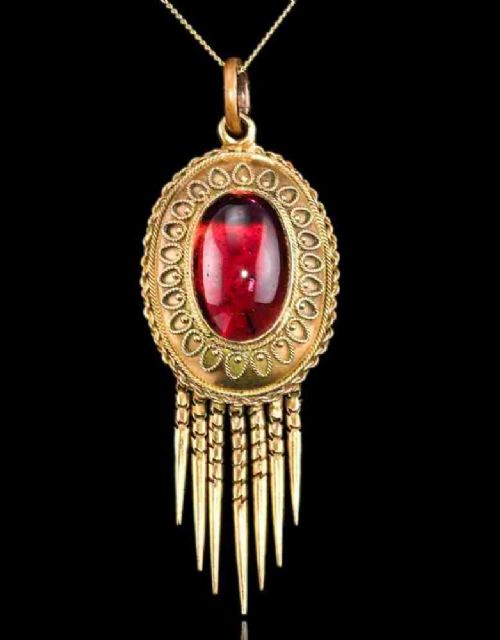
An etruscan revival pendant brings classical archaeological motifs into jewellery, offering intricate granulation and goldwork that captures Victorian historicism.
Etruscan Revival Pendant
When you search for an etruscan revival pendant, you encounter nineteenth-century interpretations of ancient Mediterranean goldwork. These pieces draw heavily on archaeological discoveries made during the Victorian period, translating ancient aesthetic ideals into wearable ornaments.
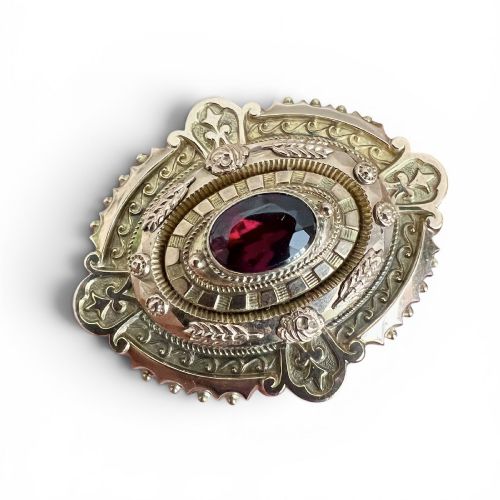
The versions most commonly met on this page belong to the Victorian era, spanning various gold purities and styles. Alongside pendants, the listings include related jewellery forms such as lockets and brooches sharing the same revivalist vocabulary.
Materials and construction
The construction relies predominantly on yellow, rose, and fifteen-carat gold shaped into classical forms. Goldsmiths utilised traditional techniques of granulation and wirework to mimic the archaeological finds inspiring the movement.
Gemstones such as garnet, turquoise, and pearl frequently accent the gold structures, occasionally accompanied by enamel work or shell cameos.
The site listings combine fifteen-carat gold, garnet, and pearl across Victorian revival designs.
Judging quality in the range
Distinctions across the range rest on the precision of the applied wirework and the delicacy of the granulation. Finer examples display meticulous attention to minute detail, whereas simpler pieces rely on broader stamped or cast elements.
The choice of materials also divides the items, with higher gold carat weights and well-matched natural gemstones marking the upper tier of production.
The Etruscan Revival Pendant Glossary
- Granulation
- A decorative technique involving small spheres of gold soldered to a metal surface in geometric or floral patterns. This method mimics ancient Mediterranean work replicated during the nineteenth century.
- Amphora
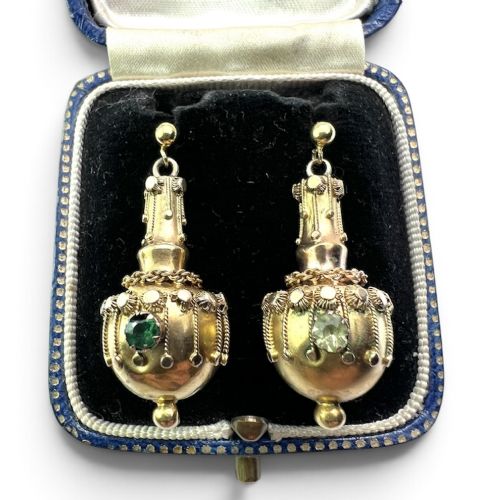
- A two-handled ancient jar shape frequently adopted as a motif in Victorian revivalist earrings and pendants. It reflects the direct influence of classical pottery forms on period jewellers.
- Foxtail
- A flexible, densely woven chain style commonly paired with Victorian pendants and tassels. The interlocking links create a smooth, tubular band of gold.
- Cabochon
- A gemstone cut with a smooth, convex domed surface rather than faceted edges. This polishing style highlights the natural colour of garnets and turquoise seen in revival pieces.
Etruscan Revival Pendant: Frequently Asked Questions
What defines an etruscan revival pendant?
An etruscan revival pendant is a nineteenth-century piece of jewellery inspired by ancient Etruscan and Greek artefacts unearthed during archaeological excavations.
These items typically feature elaborate goldwork, including fine wire filigree and tiny gold granules arranged in classical geometric patterns.
How should I wear an antique pendant?
These pendants sit well on medium-length gold chains that complement the warm tone of the historical metalwork.
Because many period pieces were designed to function as both pendants and brooches, check the reverse for integrated loops or pin fittings before styling.
What metals are used in these pendants?
The pieces utilise various purities of gold, most notably nine-carat and fifteen-carat yellow or rose gold. Some examples also incorporate gilt finishes over base metals.
The metal provides a rich backdrop for accent stones like garnets, pearls, and turquoise.
How do I care for antique gold jewellery?
Keep the piece away from harsh chemical cleaners and ultrasonic baths, which can dislodge delicate granulation or damage soft gems like turquoise and pearls.
Store the item separately in a soft pouch to prevent the intricate gold wirework from catching on other jewellery.