
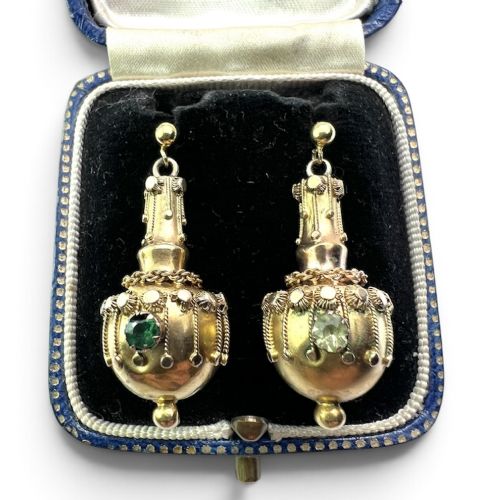
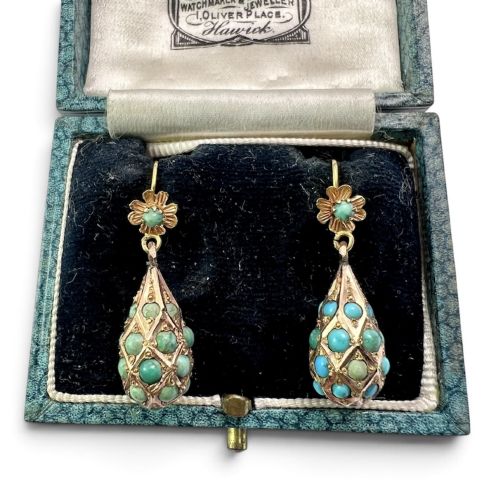


Etruscan Revival Gold Earrings
Etruscan revival gold earrings bring classical archaeological motifs to Victorian jewellery, offering collectors distinctive ornamentation inspired by ancient discoveries.
Etruscan Revival Gold Earrings
Etruscan revival gold earrings are decorative drop and dangle ornaments produced during the Victorian period, reflecting a widespread fascination with ancient Mediterranean metalwork. When searching for this phrase, a buyer meets Victorian pieces executed in 9ct or 15ct gold, alongside silver gilt and gemstone variations.
The selection ranges from amphora and torpedo drop designs to complex mosaic and tassel formations. These items frequently incorporate turquoise, garnet, shell, and onyx accents within classical Revival frameworks.
How they were made
These items were constructed primarily in yellow and rose gold, utilising 9ct and 15ct purities alongside silver gilt settings. Makers shaped metal into hollow spheres, domed bands, and wirework structures to achieve lightweight volume.
Decoration relied heavily on applied granular work and filigree wire soldered onto the gold surfaces, echoing ancient techniques. Gemstones such as turquoise, almandine garnet, and paste were flush-set or mounted in bezels to accent the metalwork.
What varies in quality
Quality in these items rests on the precision of the applied wirework and granulation, where neatness of execution separates standard production from finer output. The weight and purity of the gold, moving from nine to fifteen carats, also determine the calibre of the piece.
The integrity of the original findings, hook wires, and drop mechanisms dictates how well a pair has survived use. Superior examples retain all original stones, such as garnets or turquoise beads, without replacement components.
The Etruscan Revival Gold Earrings Glossary
- Etruscan revival
- A nineteenth-century design movement inspired by ancient Italian metalwork discoveries. It employs granulation, filigree, and classical motifs.
- Granulation
- A decorative technique involving the application of tiny spheres of gold to a metal surface in geometric patterns.
- Amphora
- A vessel shape translated into miniature form for drop earrings. It mirrors ancient Greek and Roman storage jars.
- Silver gilt
- Silver that has been coated with a thin layer of gold. This technique provided the appearance of solid gold at a lower cost.
- Torpedo
- A cylindrical or spindle-shaped earring drop popular in the Victorian era. It elongates the silhouette of the jewellery.
Etruscan Revival Gold Earrings: Frequently Asked Questions
Are these earrings comfortable to wear daily?
Victorian drop earrings vary in weight depending on their internal construction and gold purity. Many are surprisingly light due to hollow manufacturing methods.
Buyers with sensitive ears should check the wire thickness and length before wearing them for long periods.
How do I clean antique gold earrings?
Warm water and a soft cloth suffice for cleaning gold surfaces and durable gemstones like garnet. Harsh chemical dips strip patinas and damage soft stones.
Turquoise requires particular care because moisture alters its colour over time.
Can I convert these hooks for modern piercings?
Most Victorian earrings feature hook wires designed for older piercing placements or smaller lobes. Jewellers can replace or adjust wires carefully to fit modern requirements.
Altering original components should be weighed against preserving the historical integrity of the piece.
How do I date an Etruscan revival pair?
Dating relies on the style of the work, the gold hallmark standards, and the type of fastening used. Victorian examples generally align with mid to late nineteenth-century archaeological revivals.
Comparative analysis with dated archive pieces helps narrow the production window.