
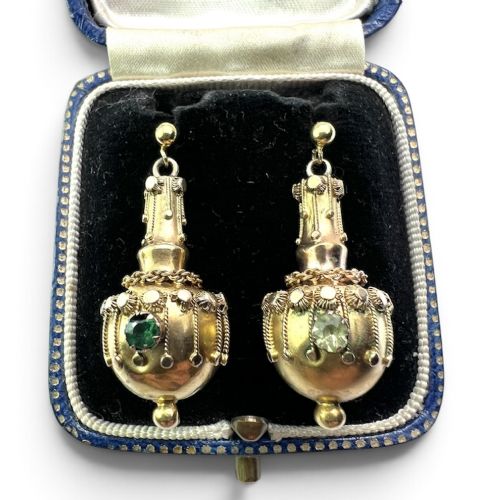
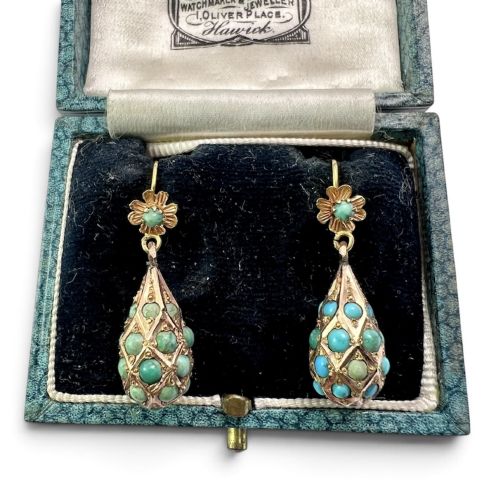


Etruscan Revival Earrings
These etruscan revival earrings bring classical archaeological style to Victorian jewellery through meticulous granulation and goldwork.
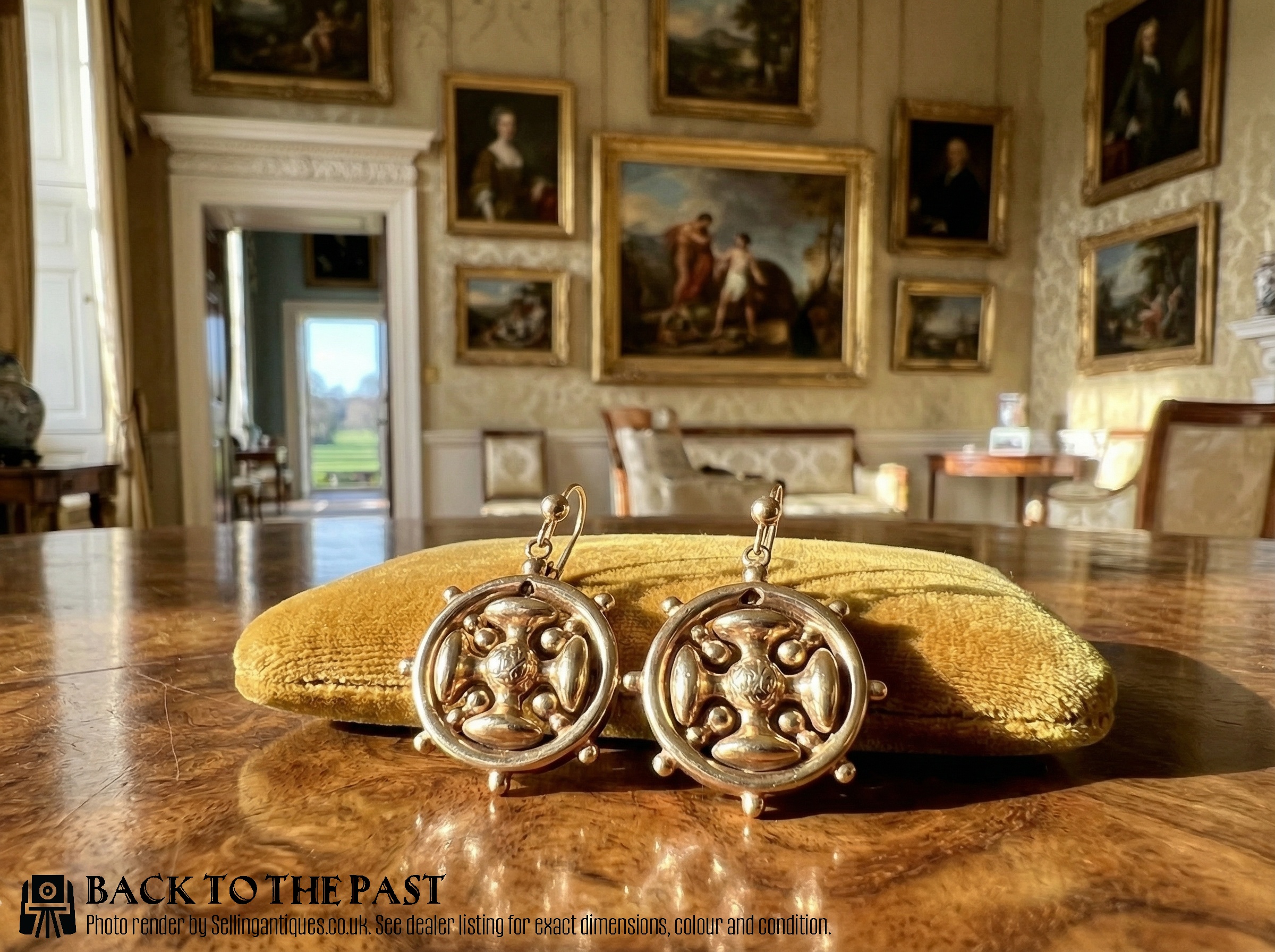
Etruscan Revival Earrings
Etruscan revival earrings are quintessential Victorian ornaments inspired by nineteenth-century archaeological discoveries in Italy. When you search for etruscan revival earrings, you encounter items predominantly created during the Victorian period alongside occasional Edwardian examples.
Victorian makers also produced variations incorporating silver gilt, paste, and shell cameos within the same classical vocabulary. The surviving examples demonstrate how deeply nineteenth-century jewellers engaged with ancient goldsmithing traditions.

Materials and technique
Gold forms the fundamental medium of these pieces, utilising nine carat, fifteen carat, and higher purities of yellow and rose gold. Workshops applied wirework and granulation to solder microscopic spheres of gold onto surfaces in intricate geometric patterns.
Gemstones such as almandine garnets, turquoise, and banded agate are frequently bezel set into the gold structures. Silver gilt and paste materials appear alongside shell cameos to provide alternative colour and texture within the designs.
Etruscan Revival Earrings Retail Price Guide 2026
Typical asking prices for etruscan revival earrings among the pieces listed under this phrase on Sellingantiques today, from the lower quarter to the upper quarter. They describe what is for sale here now, not the wider market.
Listings for etruscan revival earrings span the Victorian and Edwardian periods, employing nine carat and fifteen carat gold alongside turquoise, garnet, and shell.
The spectrum of quality
Quality in these earrings rests upon the precision and scale of the goldwork rather than the sheer weight of the materials. Granulation work executed with microscopic spheres welded cleanly to the base metal represents superior craftsmanship.
Design complexity and stone selection further separate standard production from exceptional pieces. Earrings incorporating matched natural garnets or turquoise within elaborate drop configurations sit at the upper end of the range.

The Etruscan Revival Earrings Glossary
- Granulation
- A decorative technique involving the application of tiny spheres of gold soldered to a metal surface in geometric patterns. This method mimics ancient Etruscan artefacts discovered during nineteenth-century excavations.
- Amphora
- A two-handled ancient jar shape frequently adopted for the drop portion of Victorian earrings. These miniature vessels reflect the classical archaeological influence of the era.
- Bezel setting
- A method of securing a gemstone by surrounding it with a collar of metal that folds over the stone edge. It provides a secure and smooth border typical of archaeological revival jewellery.
- Silver gilt
- Silver that has been coated with a thin layer of gold to give the appearance of solid gold. This technique allowed makers to produce impressive scale at a more accessible cost.
- Torpedos
- An elongated cylindrical drop shape tapering at both ends, popular in nineteenth-century earring design. These forms often incorporate detailed wirework and granulation.
Etruscan Revival Earrings: Frequently Asked Questions
Are these earrings comfortable for daily wear?
Drop earrings from this period often carry noticeable weight due to solid gold construction and gemstone settings. Many modern wearers reserve them for special occasions rather than continuous daily use.
Secure hook or wire fastenings help balance the dangle, though checking the integrity of the original findings remains sensible before extended wear.
How do I identify Etruscan revival style?
Look for distinctive goldwork techniques including granulation, filigree, and wire twist patterns applied to archaeological shapes like amphorae or crescents. The aesthetic deliberately echoes ancient Italian artefacts unearthed during Victorian times.
Colouration typically relies on high-karat yellow gold or rose gold combined with garnet, turquoise, or mosaic elements.
What metals were commonly used?
Victorian makers utilised various gold purities, most frequently nine carat and fifteen carat yellow or rose gold. Silver gilt also appears on specific pieces to achieve distinct visual effects.
Testing often reveals unmarked gold, which was standard practice for much of the nineteenth century before formal assay legislation tightened.
Can I wear them with modern jewellery?
The warm tones of nineteenth-century gold blend easily with contemporary yellow gold pieces. The distinct archaeological motifs provide a striking contrast against minimalist modern designs.
Pairing drop earrings with simpler necklaces allows the classical detailing to remain the focal point of an outfit.