


Etruscan Gold Drop Earrings
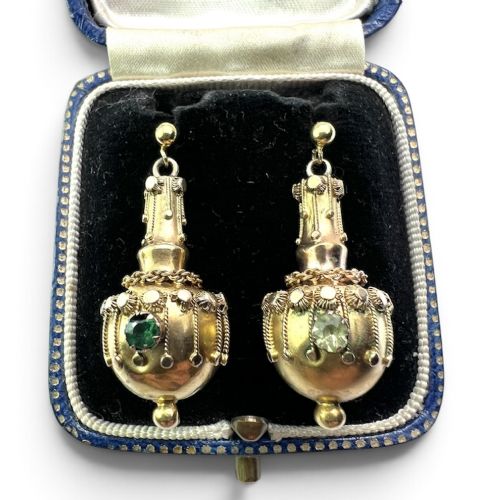
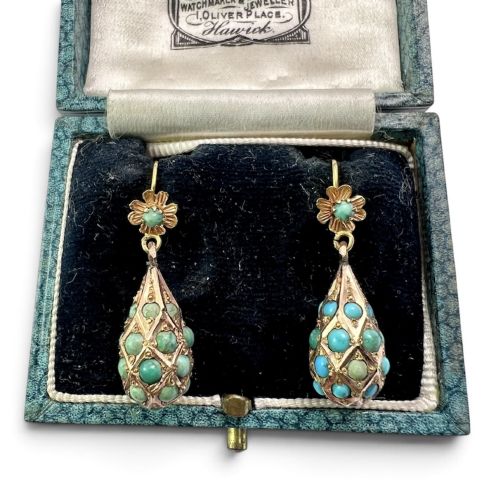
These etruscan gold drop earrings bring nineteenth-century archaeological revival style to the ear with intricate wirework and granulation.
Etruscan Gold Drop Earrings
Etruscan gold drop earrings are nineteenth-century jewels inspired by ancient Mediterranean finds, capturing the nineteenth-century fascination with classical antiquity. Most examples belong to the Victorian period, appearing in revival and classical revival styles that emulate ancient goldsmithing techniques. Buyers encounter drop forms, dangling teardrops, amphora shapes, and ornate tassel designs suspended from hooks or wires.
The materials span nine carat and fifteen carat yellow and rose gold, often accented with turquoise, garnets, paste, banded agate, cameos, or shell. Some pieces incorporate silver gilt settings alongside gold components, while others form part of matching jewellery sets with brooches. These earrings reflect a distinct era when archaeological discoveries in Italy heavily influenced British jewellery design.
How they were made
Goldsmiths constructed these earrings using hollow gold elements, stamped components, and applied wirework to achieve dimension without excessive weight. The characteristic surface texture relies on granulation, where minute spheres of gold are soldered onto the metal base in geometric or floral patterns.
Stones such as turquoise, garnet, and banded agate are securely bezel-set into gold mounts, while tassels employ fine foxtail chains. Metalsmiths combined nine carat and fifteen carat gold alloys, occasionally finishing silver elements with a layer of gold gilt.
Listings combine nine carat and fifteen carat gold with turquoise, garnets, banded agate, and shell across Victorian revival styles.
What varies in quality
The distinction between standard production and superior work rests on the precision of the granulation and the crispness of the wirework. Finer examples display immaculate soldering without excess residue, alongside heavier gold content such as fifteen carat variants.
Design complexity also separates pieces, with elaborate amphora shapes, articulated tassels, and matched gemstone arrangements demonstrating greater craftsmanship than simpler stamped circles or plain drops.
The Etruscan Gold Drop Earrings Glossary
- Granulation
- The technique of soldering tiny spherical grains of gold onto a metal surface to form decorative patterns. This method mimics ancient Etruscan ornamentation revived by nineteenth-century jewellers.
- Etruscan Revival
- A nineteenth-century design movement inspired by excavations of ancient Etruscan tombs in Italy. Jewels in this style feature matte gold finishes, wirework, and classical motifs.
- Foxtail chain
- A flexible, square-section chain woven from curved links, frequently utilised in Victorian tassels and drops. It provides fluid movement and substantial texture.
- Amphora
- A two-handled ancient jar shape translated by Victorian makers into miniature gold earring pendants. These sculptural drops reflect the period's obsession with classical ceramics.
- Silver gilt
- Sterling silver coated with a thin layer of gold. This combination allowed makers to achieve a warm gold appearance while utilising alternative base metals.
Etruscan Gold Drop Earrings: Frequently Asked Questions
Are all these earrings Victorian?
Most examples originate from the Victorian period, aligning with the height of the archaeological revival movement. However, archival records show occasional twentieth-century revival pieces hallmarked in later decades.
Buyers should examine the construction methods and gold purity marks to understand the exact chronological context of each specific pair.
How do I care for antique gold earrings?
Clean these pieces gently with a soft dry cloth to protect fragile granulation and delicate applied wirework. Avoid chemical dips, ultrasonic cleaners, and harsh scrubbing that can dislodge tiny gold spheres or damage softer set stones like turquoise.
Store them separately in a lined box to prevent friction against other jewellery items in your collection.
What is the difference between 9ct and 15ct gold here?
Fifteen carat gold contains a higher proportion of pure gold than nine carat gold, resulting in a richer, deeper yellow hue. Makers utilised both purities during the nineteenth century depending on the desired weight and cost of the finished jewel.
Both standards appear frequently across revival drop earrings and tassel designs.
Can I wear these antique earrings daily?
Antique drop earrings require careful handling due to their delicate construction, hollow components, and nineteenth-century fastenings. While sturdy enough for occasional evening wear or gentle daytime use, they benefit from being put on after styling and removed before strenuous activities.
Checking the security of the hooks and settings periodically ensures safe wear over time.