


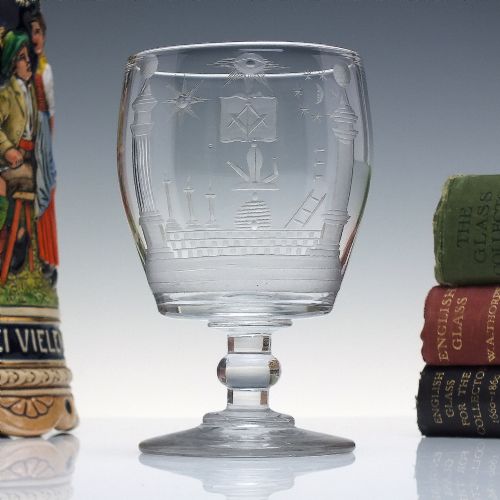
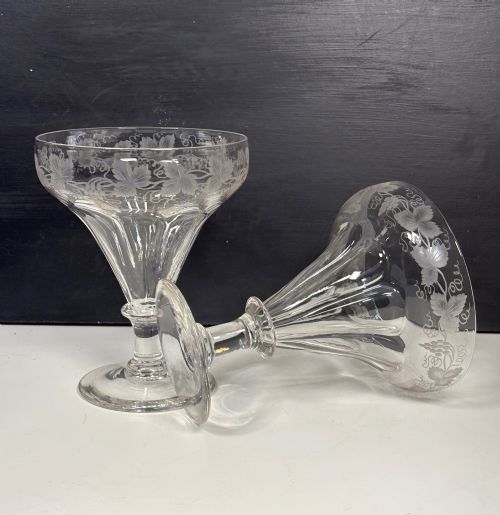


Etched Glass Rummers
These etched glass rummers are sturdy drinking vessels carrying surface decoration that reward careful handling and daily use.
Etched Glass Rummers
When you search for etched glass rummers, you find robust drinking vessels intended for hearty toasts, punch or wine rather than delicate sipping. The forms on this page span the Georgian and Victorian eras, alongside related pieces from the eighteenth and nineteenth centuries.
You meet Georgian specimens featuring square bases or air twists alongside large Victorian examples, cranberry glass, and amber wine roemers from Bohemia. Most pieces take the shape of sturdy goblets, while occasional gin glasses or pairs of matched vessels appear among the listings.
English and Bohemian origins dominate the selection, showing how different regional furnaces shaped these drinking glasses over generations. Collectors find both naive local engraving and crisp Masonic motifs across the available inventory.
How they were made
Glassmakers utilised lead glass, flint glass and lead crystal to achieve the heavy weight and ringing clarity characteristic of better drinking vessels. Hand-blown manufacturing methods left subtle irregularities in the metal, including tiny bubbles and characteristic pontil marks on the undersides.
Decoration relied on engraving and acid etching to cut designs into the surface, depicting hunting scenes, Masonic symbols and foliate bands. Workmen shaped these robust forms while hot, attaching square or circular feet to thick stems.
Etched Glass Rummers Retail Price Guide 2026
Typical asking prices for etched glass rummers among the pieces listed under this phrase on Sellingantiques today, from the lower quarter to the upper quarter. They describe what is for sale here now, not the wider market.
The site listings feature clear glass, lead crystal and cranberry glass across Georgian and Victorian periods.
What varies in quality
The refinement of the surface decoration separates standard examples from exceptional pieces, particularly where hand engraving displays confident lines rather than shallow scratching. Clarity and weight in the metal also distinguish high-grade lead crystal from simpler glass.
Proportion and foot stability dictate the overall balance of each goblet, with square-based Georgian specimens demanding precise alignment during manufacture. Matched pairs command greater attention than solitary vessels due to the difficulty of surviving together.
The Etched Glass Rummers Glossary
- Rummer
- A large, sturdy drinking glass used for wine, ale or punch during the eighteenth and nineteenth centuries. These vessels usually feature a short stem and a capacious bowl.
- Lead Crystal
- Heavy, brilliant glass containing lead oxide that increases the refractive index and weight. This material allows for sharper wheel engraving.
- Air Twist
- An optical effect inside the stem of a drinking glass created by drawing out trapped air bubbles during the blowing process. It appears as a spiral thread of tiny bubbles.
- Pontil Mark
- A rough scar left on the base of a hand-blown glass vessel where the holding rod was snapped off after shaping. Skilled makers often ground these down smooth.
- Roemer
- A continental European large drinking glass, typically green or amber, featuring a ribbed or studded stem. Bohemian examples often carry engraved decoration.
Etched Glass Rummers: Frequently Asked Questions
What were rummers used for?
These large vessels served for heavy tavern wines, spirits and mixed punches rather than delicate modern pours. Their robust build suited the rowdy toasts and gatherings of the Georgian and Victorian periods.
People kept them on sideboard trays or in cupboards ready for evening company. Their generous capacity made them versatile for various household drinks.
How do I date an old rummer?
Form and manufacturing marks offer the clearest clues to age, with Georgian pieces often showing square bases and pontil scars. Victorian examples tend to be heavier and frequently display mechanical etching or cranberry hues.
Style of engraving also helps distinguish periods, as eighteenth-century work often appears more naive and freehand. Comparing the weight of the metal provides further guidance on the decade of production.
Are these glasses safe to use?
Most antique drinking vessels remain structurally sound for occasional modern use if handled with sensible care. Hand washing in lukewarm water preserves the fragile surface decoration and prevents thermal shock.
Avoid placing them in dishwashers or exposing them to sudden temperature shifts. Careful storage protects the delicate rims from chips.
What is the difference between etched and engraved?
Engraved glass is cut physically using a rotating wheel or diamond point, creating deep grooves with sharp edges. Etched decoration relies on acid to bite patterns into the surface, resulting in frosted lines.
Both techniques produced the decorative scenes found on nineteenth-century drinking vessels. Wheel engraving generally leaves a brighter, more tactile finish than chemical etching.