

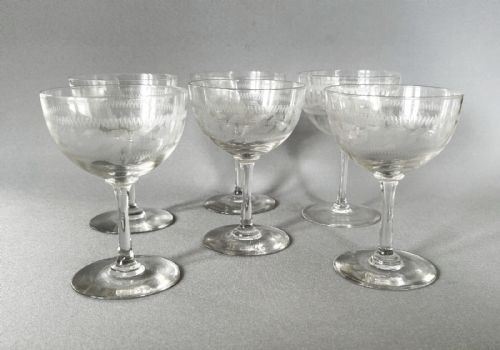


Etched Glass Champagne
These etched glass champagne pieces bring genuine period character to a celebration, offering the tactile weight and crisp cutting that modern glassware lacks.
Etched Glass Champagne
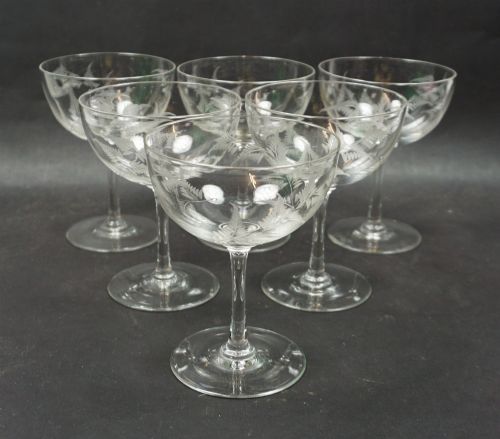
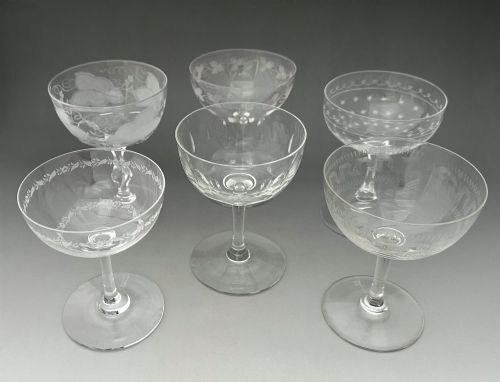
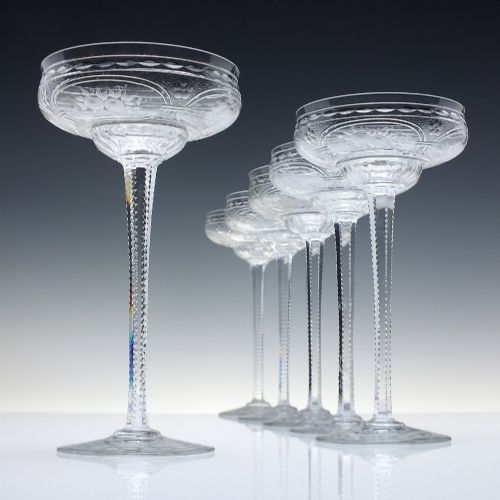
When you search for etched glass champagne, you are looking at celebratory glassware shaped primarily as shallow coupes or tall stems, designed for sparkling wines. These vessels survive from periods spanning the Victorian era through the 1930s, reflecting changing social rituals of dining and entertainment.
The pieces you are most likely to meet on this page include sets of six or sixteen drinking glasses alongside larger serving vessels like coolers and ice buckets. They encompass British, French, and Scandinavian origins, showcasing patterns from classical Greek keys to organic Art Nouveau vines.
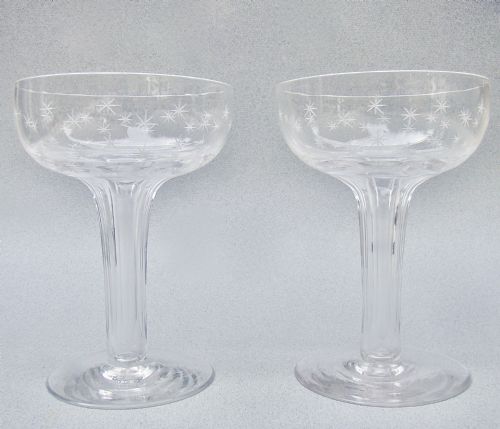
Forms range from hollow-stemmed drinking glasses to heavy crystal coolers mounted in gilt bronze or silver plate. Each object demonstrates the domestic and social ambitions of its period, whether through coloured crystal or clear lead glass.
How they were made
The makers of these objects utilised clear or coloured lead glass, shaping them into bowls and stems before applying surface decoration. Techniques combined wheel-cutting, acid-etching, and engraving to achieve motifs such as fruiting vines and geometric borders.
Metal mounts in gilt bronze and silver plate were frequently added to cooling vessels, secured to heavy glass bodies to provide durability and decorative contrast. Coloured glass variants, including ruby and amber hues, relied on specialised chemical additions during the molten stage before undergoing surface engraving.
Etched Glass Champagne Retail Price Guide 2026
Typical asking prices for etched glass champagne among the pieces listed under this phrase on Sellingantiques today, from the lower quarter to the upper quarter. They describe what is for sale here now, not the wider market.
Listings feature periods from the Victorian era through the 1930s, utilising clear glass, lead crystal, ruby glass, and amber glass.
What varies in quality
Quality in these pieces is dictated by the crispness of the wheel-cut or etched detail and the clarity of the underlying metal or lead crystal. Finer examples display deep, sharp engraving lines that catch the light, whereas lesser pieces show shallow, blurred surface marks.
The integrity of matched sets and the weight of the glass further separate the ordinary from the exceptional. Heavy, resonant lead crystal and well-preserved metal mounts indicate superior craftsmanship and better survival through decades of use.
Baccarat·Riihimaki·Adelbert Niemeyer
The Etched Glass Champagne Glossary
- Coupe
- A broad, shallow-bowled glass traditionally used for champagne, offering a wide surface area for the release of bubbles. These forms dominate Victorian and Edwardian dining tables.
- Lead Crystal
- Glass containing metallic lead oxide, which increases weight, brilliance, and refractive index. This material allows for deeper, sharper cutting and engraving.
- Wheel-cutting
- A technique where a glass vessel is held against rotating abrasive wheels of stone, copper, or wood to carve deep decorative patterns into the surface.
- Jugendstil
- The continental European counterpart to Art Nouveau, prevalent around the turn of the twentieth century. It emphasises stylised organic lines and natural motifs.
- Gilt Bronze
- Bronze that has been treated with a fine layer of gold or gold-coloured alloy. It appears frequently as decorative mounts on nineteenth-century coolers.
Etched Glass Champagne: Frequently Asked Questions
How do I clean vintage champagne glasses?
Wash these pieces by hand in warm soapy water using a gentle cloth, avoiding abrasive scourers that can scratch the delicate surface decoration.
Dry them immediately with a lint-free linen cloth to prevent water spots from forming on the lead crystal or etched details.
Can I use these glasses for modern sparkling wine?
You can use these coupes and tall glasses for any sparkling wine, though the shallow coupe bowl will allow the effervescence to dissipate faster than a narrow flute.
This wider bowl design actually mirrors the historical manner in which nineteenth-century drinkers enjoyed their champagne.
How do I date an etched champagne glass?
Dating relies on examining the optical properties of the glass, the weight of the piece, and the specific motifs used in the etching. Victorian and Edwardian examples often feature dense botanical or geometric patterns cut into heavy lead crystal.
Maker signatures or registration marks, when present on the foot or base, provide a more precise point of origin.
Were ice buckets used alongside these glasses?
Large glass and metal coolers or ice buckets formed an essential part of period dining services, keeping bottles chilled at the table. They match the aesthetic of the drinking vessels through coordinated cut or etched glass bodies.
These pieces were engineered to handle heavy ice and frequent handling during large gatherings.