
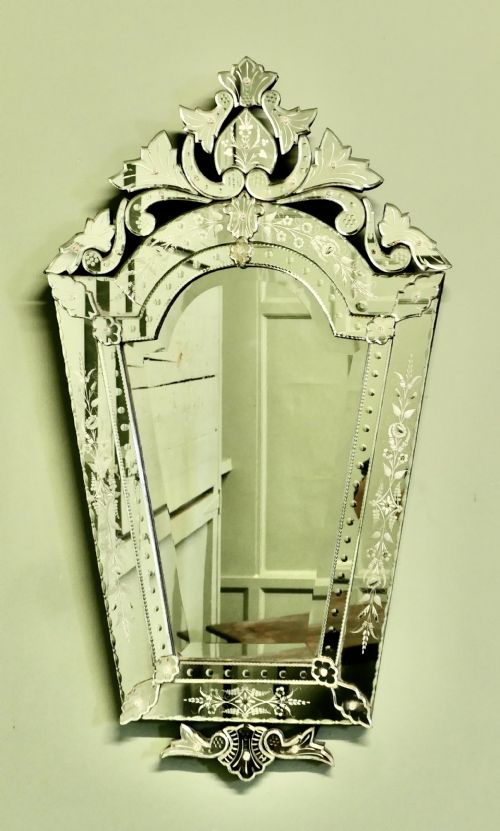
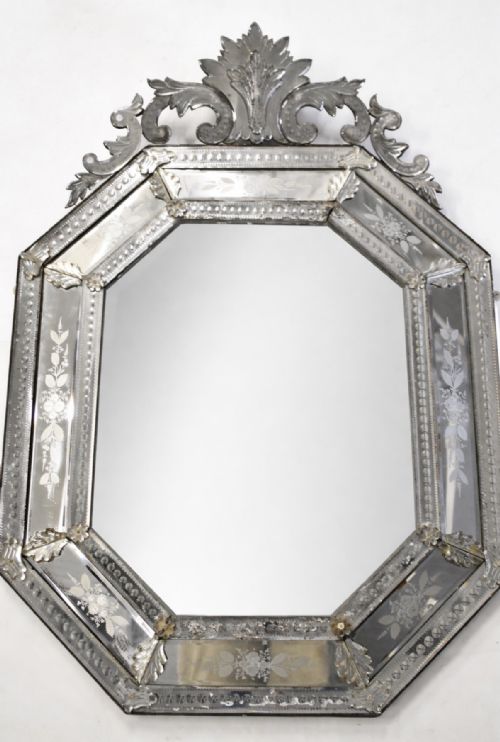


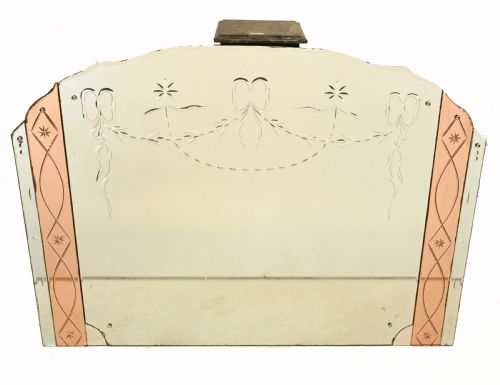
Etched Border Mirror
An etched border mirror brings layered light and classical detail into a room, spanning Venetian cushion designs to geometric Art Deco wall pieces.
Etched Border Mirror
An etched border mirror is a decorative looking glass defined by surface engraving along its outer edges, often taking the form of wall mirrors or overmantel pieces. When searching for an etched border mirror, buyers encounter a variety of periods ranging from the late nineteenth century through the Art Deco era and into the mid-twentieth century.
The dominant forms on this page include grand Venetian cushion mirrors alongside English and continental wall mirrors featuring peach coloured glass or embossed glass details. These objects serve both practical reflection and decorative framing, utilising decorative glass borders to catch and refract light across an interior space.
How they were made
Makers constructed these pieces using glass, mirrored glass, and silvered glass, frequently set into wooden frameworks or mounted as all-glass wall mirrors. Decorative borders were achieved through cutting and etching techniques directly into the glass surface, sometimes incorporating coloured elements like ruby red or peach tones.
Heavier examples from the nineteenth century feature carved wood painted shaped tops, while Art Deco variants rely on clean glass segments and embossed glass panels. The integration of metal elements and silvered glass backing gives these mirrors their reflective depth and structural longevity.
Listings span from the nineteenth century through the Edwardian period and into 1960s production, using glass, metal, and wood.
What varies in quality
Quality in an etched border mirror rests upon the crispness of the glass engraving and the depth of the cushion or bevelled profile. Finer examples display meticulous hand-cut detailing along the borders that catches light cleanly without distortion in the central plate.
The choice of materials also dictates standing, with specialist coloured glass plates and substantial carved wood frames holding greater presence than simpler later forms. Preservation of the original silvering and intact glass sections distinguishes superior examples from standard production.
The Etched Border Mirror Glossary
- Etched border
- A decorative glass edge decorated with acid or abrasive tools to create opaque patterns or lines. This technique frames the central reflective plate with ornamental detail.
- Cushion mirror
- A mirror style where the outer border panels are angled outward towards the wall like a pillow. This creates a multidirectional reflection of interior light.
- Overmantel mirror
- A large horizontal looking glass designed specifically to hang above a fireplace mantel. These pieces often anchor the decorative scale of a reception room.
- Silvered glass
- Glass coated on the rear surface with a reflective metallic compound to create a mirror. The integrity of this backing determines the clarity of the reflection.
- Venetian style
- An ornamental design tradition originating in Italy characterised by elaborate cut glass work and floral motifs. These pieces often lack a traditional wooden frame in favour of glass elements.
Etched Border Mirror: Frequently Asked Questions
Where should I hang an etched border mirror?
These mirrors work best on prominent living room walls or above mantelpieces where they can capture and multiply natural light from windows.
Their decorative borders function as artwork, making them suitable as standalone focal points rather than cramped utility pieces.
How do I clean an etched glass border?
Use a soft microfibre cloth and a mild glass cleaner sprayed onto the cloth rather than directly onto the mirror surface.
Take care around the engraved edges to prevent moisture from seeping behind aged silvered glass backings.
Are these mirrors heavy to hang?
Many examples incorporate substantial glass plates and wooden backing frames that require secure wall anchors.
It is essential to locate wall studs or use appropriate heavy-duty fixings rated for the weight of the specific mirror.
How do I tell Art Deco from Venetian styles?
Art Deco mirrors typically feature geometric lines, embossed textures, and coloured glass like peach tones.
Venetian mirrors rely on curved cushion profiles, floral engraving, and modular glass border sections.