



Equestrian Statue on Marble Base
An equestrian statue on marble base brings historical pageantry into a room, marrying heavy stone plinths with detailed metal casting.
Equestrian Statue on Marble Base
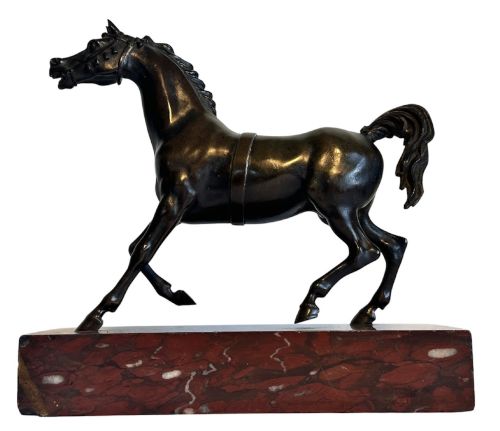
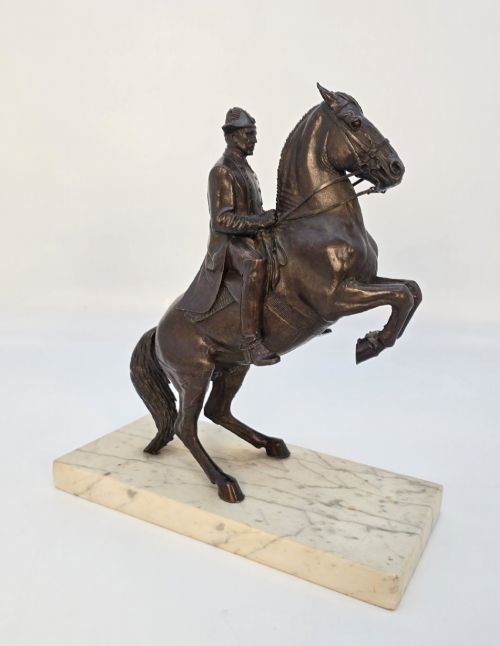
An equestrian statue on marble base depicts a rider and horse mounted upon solid stone plinths, originating across the nineteenth and twentieth centuries. These sculptures capture historical figures, mythological riders, or animal studies cast in metal and anchored by heavy mineral foundations.
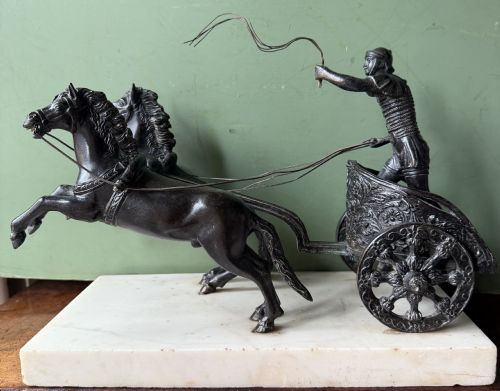
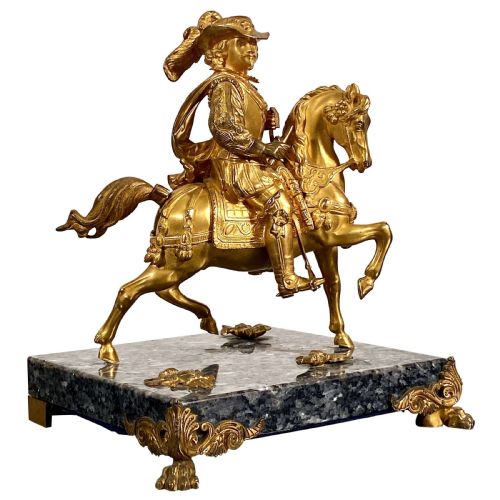
The versions met most frequently on this page span French Empire, Animalier, Academic Realism, and Grand Tour styles. Collectors encounter subjects ranging from classical charioteers and Napoleon to jockeys and stallions.
Object types on offer comprise sculptures, statues, and statuettes produced in European workshops. Each piece balances the dynamic movement of the animal with the stationary weight of the marble support.
Materials and Technique
Foundries utilised bronze, gilt bronze, ormolu, and patinated or gilded bronze to cast the figures. Molten metal poured into moulds captured musculature, reins, and garments before undergoing surface finishing.
The resulting metal figures are firmly mounted upon bases fashioned from white or green marble. These plinths provide structural stability and a clean architectural contrast to the dark or gilded metal above.
Equestrian Statue on Marble Base Retail Price Guide 2026
Typical asking prices for equestrian statue on marble base among the pieces listed under this phrase on Sellingantiques today, from the lower quarter to the upper quarter. They describe what is for sale here now, not the wider market.
Among the riders frozen in bronze is a jockey girl striding confidently into the twentieth century alongside classical emperors.
Judging Quality
The choice and preparation of the marble base also define the tier of the piece. Dense, well-polished plinths that complement the proportions of the bronze without awkward gaps demonstrate superior craftsmanship.
Franz Bergman·Bruno Zach·Xavier Raphanel
The Equestrian Statue on Marble Base Glossary
- Ormolu
- Gilded bronze produced by applying a mercury-gold amalgam to metal. This technique creates a rich, lasting golden surface common in decorative nineteenth-century work.
- Patinated bronze
- Metal treated with chemical solutions to produce a specific surface colour or aged tone. This process highlights sculptural details by creating contrast in recesses.
- Grand Tour
- Souvenir pieces acquired by travellers touring European cultural centres during the nineteenth century. These sculptures often reproduced famous public monuments in miniature scale.
- Animalier
- A nineteenth-century artistic focus on the realistic depiction of animals. Sculptors working in this style studied anatomical accuracy through direct observation.
- Plinth
- The heavy base block upon which the statue stands. It elevates the sculpture and anchors the composition visually.
Equestrian Statue on Marble Base: Frequently Asked Questions
How do I clean bronze figures?
Dust the metal gently with a soft, dry cloth to prevent particulate buildup on the surface. Avoid using chemical polishes that can strip original patination or damage applied gilding.
For the marble base, wipe with a damp cloth and dry immediately. Keep moisture away from any exposed joints where the metal meets the stone.
Where should I display these statues?
Place the sculpture on a sturdy surface capable of supporting considerable weight, as the combined bronze and marble make these pieces remarkably heavy. Position them away from direct sunlight and moisture sources to protect the metal finish and stone.
Sideboards, desks, and dedicated display tables offer stable platforms that allow viewing from multiple angles.
How do I identify Grand Tour pieces?
Grand Tour pieces frequently replicate well-known public monuments or classical antiquities encountered by nineteenth-century travellers in Italy and France. Their scale is usually reduced for portability, serving as domestic ornaments.
These works often exhibit patinas intended to evoke classical antiquity and were sold as high-end souvenirs.
What is the difference between bronze and ormolu?
Bronze is an alloy of copper and tin used directly for casting the sculptural form. Its natural colour can be altered through chemical patination to various shades of brown or green.
Ormolu specifically refers to bronze that has been gilded with a gold-mercury mixture, yielding a bright yellow metallic lustre characteristic of decorative French bronzes.