


Equestrian Military Wall Art
Equestrian military wall art brings together the charge of cavalry and the portraiture of trusted chargers across centuries of oil and paper.
Equestrian Military Wall Art
Equestrian military wall art covers centuries of cavalry scenes, skirmishes, and mounted officer portraits rendered in oil, watercolour, and pen and ink. Buyers seeking this subject meet works spanning from the seventeenth century through to the mid-twentieth century.
The material forms on this page range from framed oil paintings on canvas and wood panels to porcelain wall plaques and preparatory ink sketches. Portraits of named horses and officers sit alongside dramatic depictions of civil war and battlefield skirmishes.
Origins stretch across English, Dutch, Flemish, and Italian schools, showing diverse regional approaches to horses and military subjects. Smaller watercolours and porcelain plaques offer alternative domestic formats to large seventeenth-century master canvases.
Materials and methods
Canvases stretched over wooden frames carry layered oil paints that build the depth of horses, uniforms, and turbulent battle smoke. Gilt and giltwood frames enclose these works, adding traditional decorative borders that complement the period aesthetic.
Paper supports hold delicate pen and ink drawings as well as watercolour sketches, capturing rapid movement in fluid washes. Porcelain serves as the rigid base for specialised wall plaques fired with enduring surface decoration.
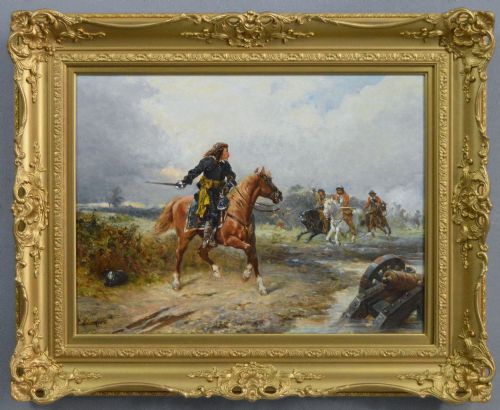
One Victorian canvas captures a dramatic moment of a Royalist pursued by Roundheads, proving horses had strong political opinions too.
Evaluating the standard
The anatomy of the horse and the accurate rendering of military uniforms dictate the strength of a composition. Weaker pieces struggle with perspective in complex skirmish scenes, whereas superior hands capture the precise tension of a charger in motion.
Depth of tone in oil and clarity of line in ink distinguish workshop output from master works. The integration of original frames and the stability of the canvas or panel further shape the standing of each piece.
Edith Alice Simkins·Jean Sobieski·Gilbert Scott Wright·Philips Wouwerman·William Edward Millner·Harry Ashby
The Equestrian Military Wall Art Glossary
- Cavalry skirmish
- A swift engagement between mounted troops, frequently chosen by artists to display dynamic equine movement and military action. These scenes often feature billowing smoke and clustered riders.
- Charger
- A strong horse ridden by a knight or cavalry officer into battle. Such animals are rendered with powerful shoulders and attentive posture.
- Giltwood
- Wood carved and coated with gold leaf or a gold-coloured metallic finish. It provides ornate framing for traditional oil paintings.
- Oil on canvas
- Pigments bound with drying oils applied to a woven fabric stretched across a wooden support. This method allows for rich blending and deep surface textures.
- Wall plaque
- A flat decorative object designed for hanging directly on a wall. These items utilise materials such as porcelain rather than stretched canvas.
Equestrian Military Wall Art: Frequently Asked Questions
How do I date a cavalry painting?
Examine the cut of the military uniforms and the tack on the horses against known historical periods. Stylistic cues in the framing and the preparation of the canvas also offer reliable clues.
Brushwork and pigment analysis further assist in confirming whether a work originates from the seventeenth century or later Victorian revivals.
Where should I hang these artworks?
These pieces suit libraries, studies, and hallways where traditional wood furniture and darker tones complement the subject matter. Keep them away from direct sunlight to protect vulnerable watercolours and oil pigments.
Ensure the wall fixings match the weight of larger framed canvases and heavy giltwood borders.
What is the difference between an oil and a watercolour?
Oils use slow-drying pigments suspended in medium that allow for rich layering and deep colour saturation on canvas or wood. Watercolours employ water-soluble pigments on paper, creating lighter, more translucent results.
Sketches in watercolour often served as preparatory studies rather than finished exhibition pieces.
How do I care for antique canvas art?
Dust surfaces gently with a soft, dry brush and avoid applying liquid cleaners to the paint or the gilt frame. Maintain stable room humidity to prevent the wood stretcher and canvas from warping.
Professional conservators should handle any structural repairs to tears or flaking paint.