


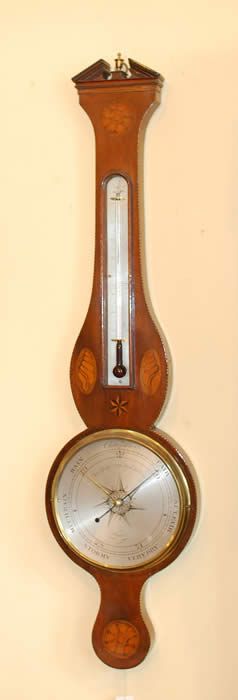

English Wheel Barometer
An english wheel barometer measures atmospheric pressure with a dial movement housed in a distinctive case, offering both functional utility and classic wall decoration.
English Wheel Barometer
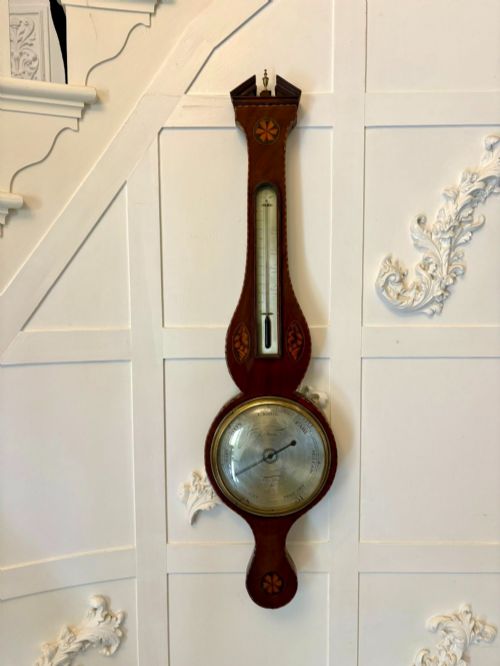
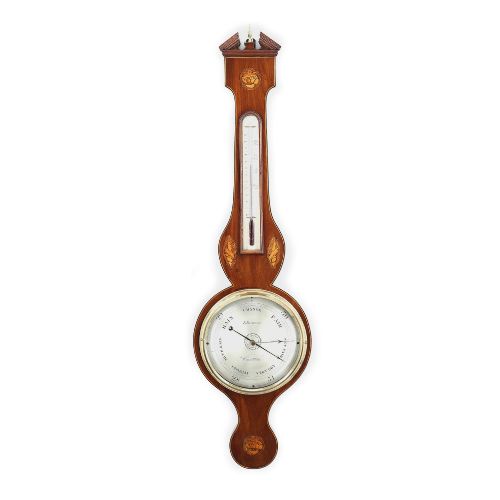
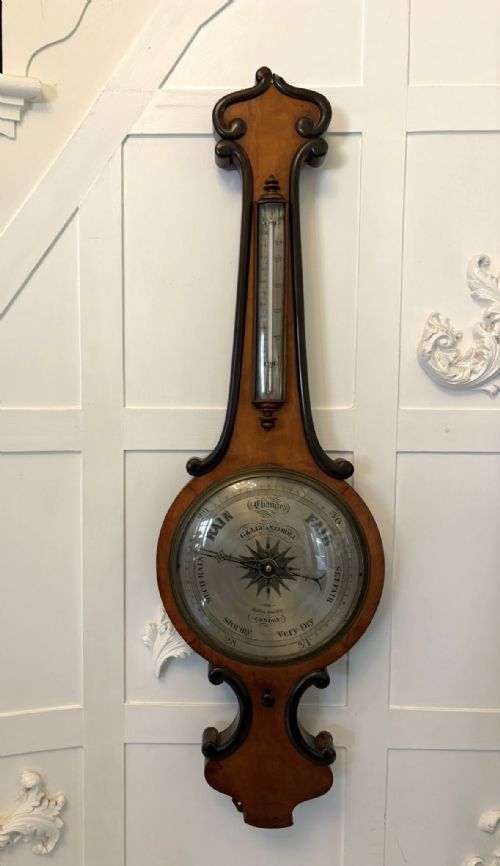
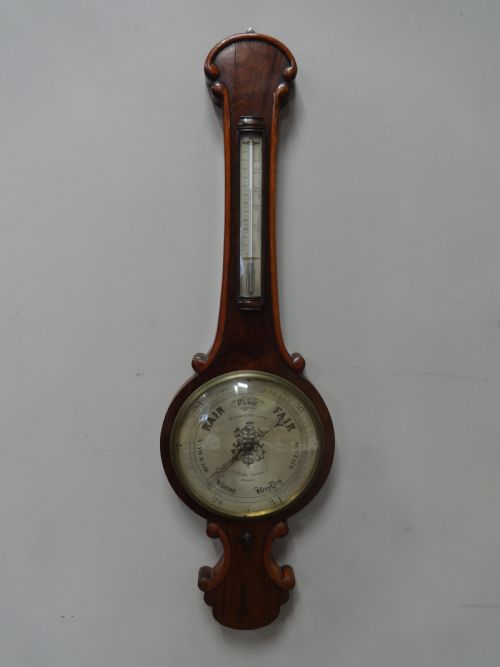
The english wheel barometer combines a mercury tube mechanism with a round dial face, housed in a wooden wall case designed to display weather changes clearly.
You are most likely to encounter mahogany cases featuring curved or onion tops, alongside examples incorporating boxwood inlay or shell motifs from the Georgian and Victorian periods.
Makers working across provincial towns and London produced these wall instruments, ranging from simple domestic pieces to complex combinations including clock movements.
Materials and Construction
Casework relies principally on dense hardwoods such as mahogany and walnut, frequently shaped with curved pediments and finished with boxwood stringing.
Dial faces utilise silvered metal paired with protective glass covers, while internal mercurial systems require precise glass tube shaping to register pressure shifts accurately.
English Wheel Barometer Retail Price Guide 2026
Typical asking prices for english wheel barometer among the pieces listed under this phrase on Sellingantiques today, from the lower quarter to the upper quarter. They describe what is for sale here now, not the wider market.
The listings span the Georgian and Victorian eras, dominated by mahogany and walnut cases fitted with silvered metal dials.
Quality and Craftsmanship
Superior examples display crisp cabinetwork with fine boxwood inlay, well-proportioned onion top or pediment shaping, and clean silvered metal dials signed by accomplished makers.
Lower tiers often show plain casework lacking decorative stringing, simpler dial execution, or replacement components that diminish the visual harmony of the instrument.
B. Besozzi of Weymouth·G & L Guanziroli London·Prada of High Wycombe·Molton of Norwich·Luisetti of London·W.E. Pain of Cambridge·Hayward of Ashford·Bianchi Ipswich·Joseph Somalvico & Co·Dominic Gatty·Russell of Liverpool·L. Malacrida·George Dollond of London
The English Wheel Barometer Glossary
- Wheel barometer
- An instrument that translates vertical mercury movement into a rotating pointer on a circular dial via a pulley and float system. This layout allowed makers to incorporate hygrometers and thermometers into the main board.
- Silvered metal
- A brass or copper dial plate treated to achieve a bright, reflective silver finish. Graduations and maker signatures are typically engraved into this surface.
- Fusee movement
- A mechanism utilising a conical pulley and chain to ensure even power delivery to a clock dial. Found in combined clock and barometer pieces.
- Onion top
- A rounded, bulbous pediment crowning the wooden case. This silhouette is particularly characteristic of Victorian wall barometers.
- Boxwood inlay
- Contrasting pale wood inserted into dark mahogany cases to form geometric lines or floral motifs. It defines the decorative edge of better quality frames.
English Wheel Barometer: Frequently Asked Questions
How do I read an english wheel barometer?
Read the main circular dial where the needle points to weather descriptions like 'Stormy', 'Change', or 'Fair'. A subsidiary hand is often set by hand to track the movement's position relative to the current reading.
Changes in pressure push the hidden mercury column, turning the central spindle. Tapping the glass gently helps settle the needle before taking a reading.
Where should I hang a wheel barometer?
Hang the instrument on an interior wall away from direct sunlight, radiators, or excessive drafts to protect the wooden case and the internal mercury mechanism from extreme temperature swings.
Ensure the wall anchor is secure, as these mahogany and walnut cases carry significant weight from the glass and metal components.
How do I distinguish Georgian from Victorian barometers?
Georgian examples often lean towards refined mahogany construction with delicate shell inlay and restrained architectural pediments. They reflect the classical proportions popular in the late eighteenth and early nineteenth centuries.
Victorian pieces frequently introduce heavier proportions, rosewood usage, and distinctive case shapes like the onion top, showing a shift toward bolder domestic decoration.
What is a combined clock and barometer?
Some wall instruments integrate a working clock movement alongside the barometer dial within a single wooden case. These dual-purpose pieces served as functional household clocks while recording atmospheric shifts.
They require careful winding of the clock train while leaving the mercurial barometer system to operate independently via internal floats.