




English Wall Barometer
An English wall barometer measures atmospheric pressure while anchoring a room with polished timber and silvered dials.
English Wall Barometer
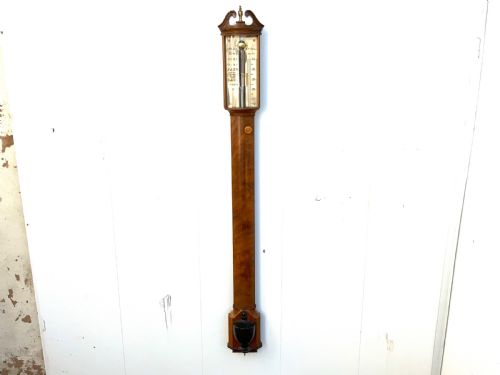
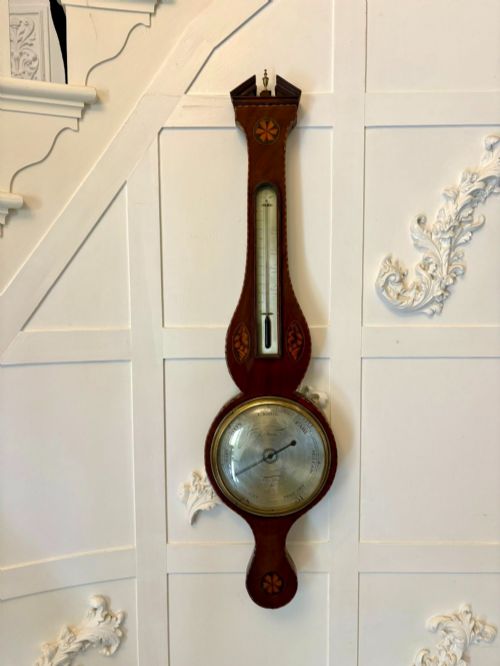
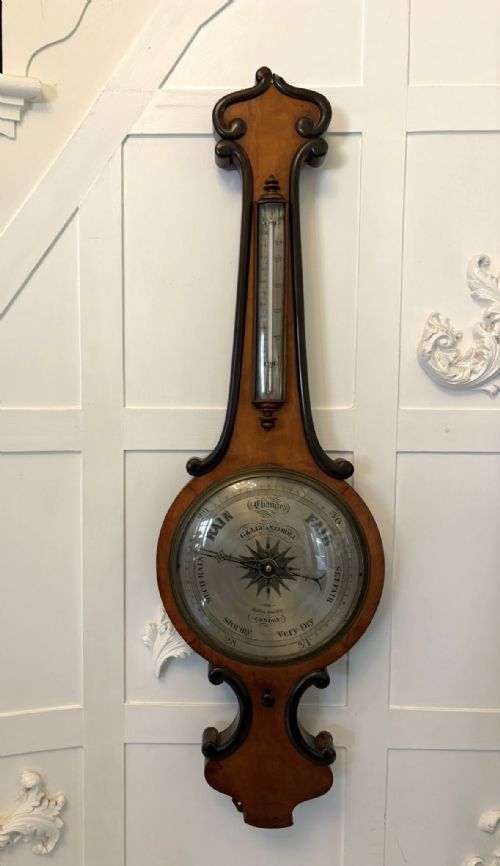
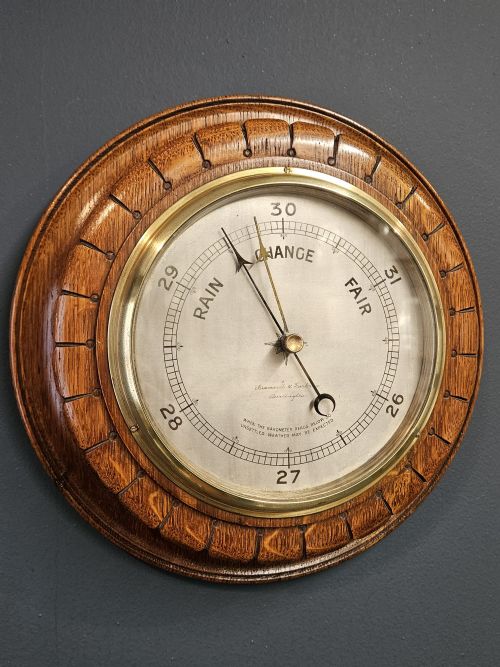
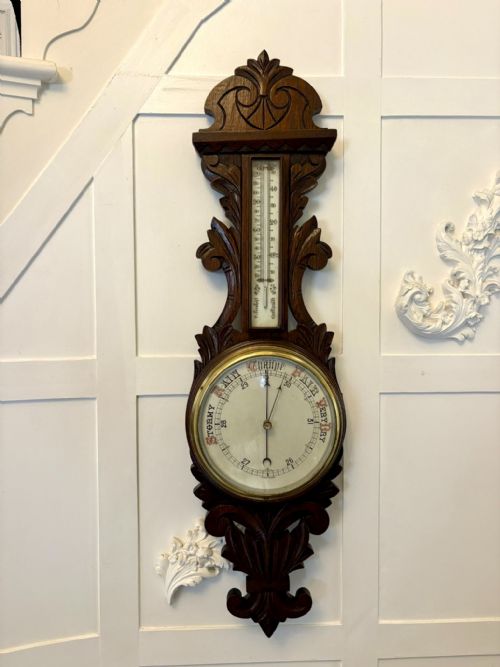
An English wall barometer appears most frequently on this page as a banjo or wheel barometer, alongside stick barometers housed in tall wooden cases designed to hang plumb against a wall. These instruments date from the Georgian, Regency, and Victorian periods, reflecting the shifting domestic tastes and scientific instrumentation of those eras.
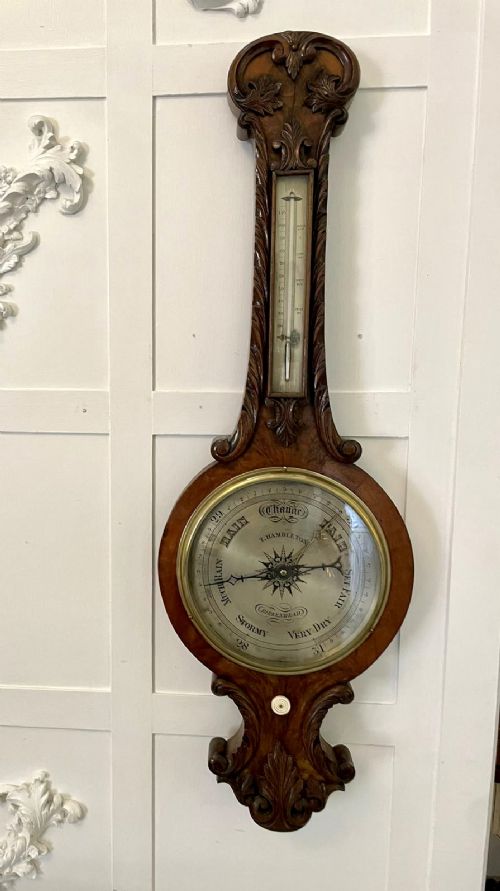
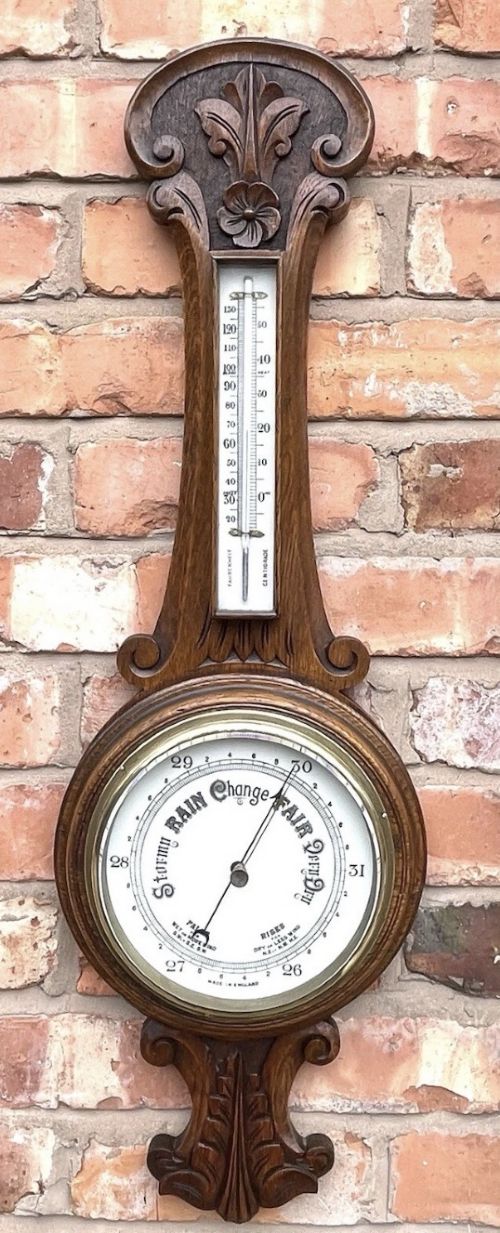
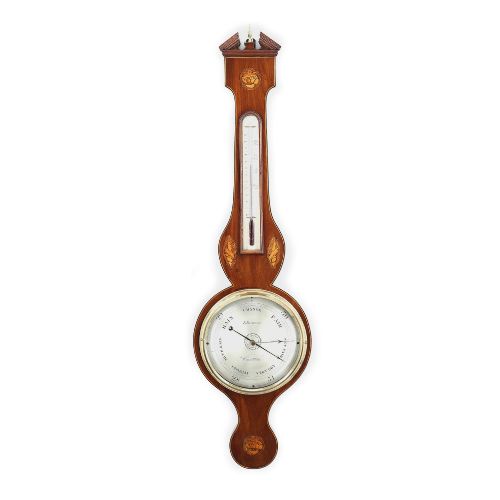
Makers housed these mechanisms in cases shaped to suit the interior architecture of the period, ranging from slender rosewood sticks to generously proportioned mahogany frames adorned with shell inlay or carved oak foliage.
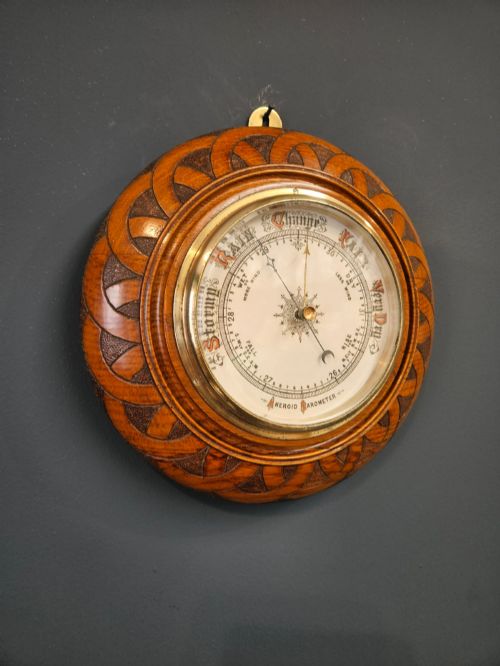
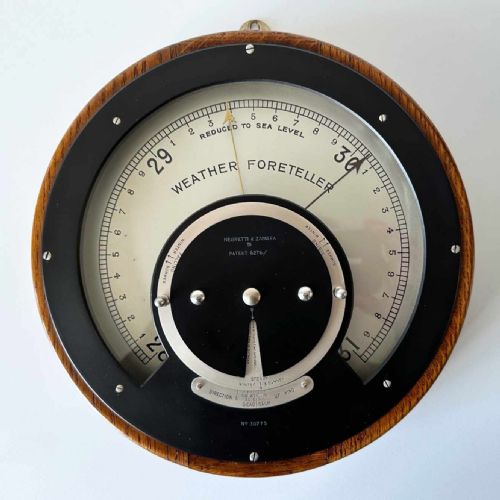
Alongside standard domestic weather glasses, the selection includes marine stick barometers and specialised aneroid models incorporating thermometers or clock movements, originating from workshops across London and provincial English towns.
Materials and Construction
Cabinetmakers constructed the cases using dense hardwoods such as mahogany, walnut, oak, and rosewood, frequently employing veneers or adding boxwood and shell inlays to decorate the principal surfaces.
Mechanisms relied on mercury columns in glass tubes for stick barometers, or metal vacuum chambers linked to mechanical linkages for later aneroid models, paired with engraved silvered metal dials to display atmospheric readings.
The selection spans the eighteenth, nineteenth, and early twentieth centuries, encompassing domestic and marine instruments.
Evaluating Execution
Quality rests in the crispness of the timber carving, the depth of the cabinetmaker's grain selection, and the finesse of the engraving on the silvered brass dial.
Signed instruments by established makers or provincial opticians demonstrate superior mechanical precision and case joinery compared to unmarked examples produced for the volume market.
B. Besozzi of Weymouth·Short & Mason London·G & L Guanziroli London·Negretti & Zambra·Bramwell & Harbron·W Watson & Sons·Prada of High Wycombe·Molton of Norwich·Luisetti of London·Blake & Son·W.E. Pain of Cambridge·Sandrino of Liverpool·Hayward of Ashford·Gilbert London·Bianchi Ipswich·James Gatty London·Charles Aiano London·Gowland London·Joseph Somalvico & Co·A Pinchetti & Co London
The English Wall Barometer Glossary
- Aneroid barometer
- A barometer that measures atmospheric pressure using a flexible metal vacuum capsule rather than liquid mercury. These instruments gained popularity during the Victorian era for domestic interiors.
- Stick barometer
- A tall, narrow instrument enclosing an exposed glass tube filled with mercury to measure barometric pressure directly. This form represents the traditional design favoured by eighteenth-century instrument makers.
- Wheel barometer
- A domestic weather glass where changes in mercury level float a weight attached to a thread, turning a pulley and pointer around a circular dial. Also known as a banjo barometer due to its distinctive case silhouette.
- Silvered metal
- A brass dial plate treated with a silver composition and engraved with weather scales and maker details. The resulting matte finish provides high contrast against the dark markings.
- Fusee movement
- A conical pulley mechanism used in combined clock and barometer pieces to maintain even driving force as the mainspring unwinds. This mechanical addition signals higher complexity.
English Wall Barometer: Frequently Asked Questions
How do I hang a wall barometer safely?
Secure a strong screw directly into a wall stud or use an appropriate heavy-duty wall anchor capable of supporting the weight of the timber case. Hang the instrument upright by its brass ring or bracket so the mechanism remains vertical and free to register pressure accurately.
Ensure the location avoids direct sunlight and sudden temperature swings from radiators, which can distort the timber or affect internal thermometer readings.
What is the difference between stick and wheel barometers?
A stick barometer displays the mercury column directly within a tall, narrow wooden trunk, offering a direct visual reading of barometric height. A wheel barometer converts that same vertical fluid movement into rotary motion using a pulley, driving a needle around a large circular dial.
Wheel barometers often incorporate additional instruments like spirit thermometers or hygrometers on the faceplate, providing a more comprehensive weather station for the parlour.
How do aneroid barometers work without liquid?
An aneroid mechanism utilises a sealed, corrugated metal box that expands or contracts as atmospheric pressure changes. Internal springs and levers translate these microscopic movements into the rotation of the pointer across the dial face.
This design eliminated the fragile mercury tubes of earlier models, allowing makers to produce compact, portable weather instruments for domestic use.
How can I date an English wall barometer?
Examine the case style, wood selection, and dial layout to establish the period of manufacture. Georgian examples often feature understated mahogany stick cases or simple damp-resistant cistern covers, while Victorian models frequently showcase carved oak, walnut, or elaborate bone adjusting knobs.
Signatures engraved on the silvered dial provide a direct link to recorded opticians and instrument makers active during specific decades.