







English Victorian Pole Screen
An English Victorian pole screen offers a clever method to deflect hearth heat and protect the complexion, mounted on a slender tripod base.
English Victorian Pole Screen
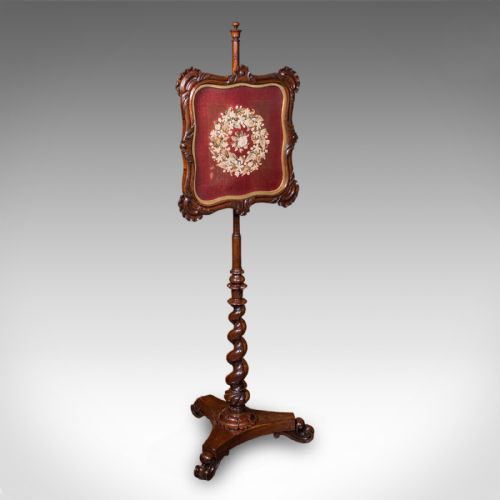
An English Victorian pole screen is a functional piece of nineteenth-century fireside furniture designed to shield a seated person from the intense radiant heat of an open coal fire. These stands feature a vertical wooden shaft fitted with a sliding panel that can be adjusted in height to suit the user.
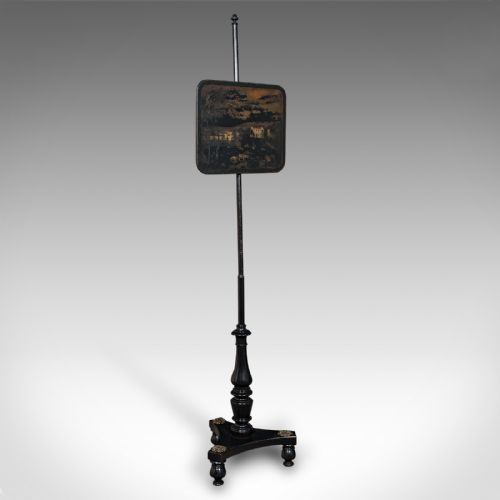
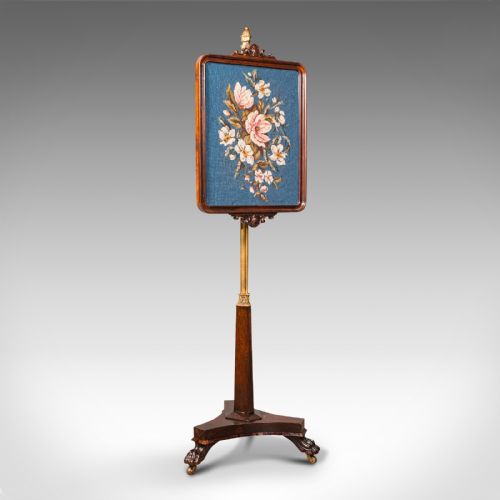
The versions most commonly met on this page span the 19th century, drawing upon earlier Regency and William IV design traditions alongside later Victorian and Aesthetic movements. They typically stand upon a tripod base supporting a central turned column that carries the embroidered or tapestry screen.
Makers utilised rich timbers such as mahogany, walnut, rosewood, and ebonised wood to form the structural supports. The panels themselves display detailed textile work, including floral tapestry and needlepoint designs framed within brass or wooden mounts.
Materials and Construction
The framework of an English Victorian pole screen relies on dense hardwoods like mahogany, walnut, and rosewood, turned on a lathe to create slender central columns and curved tripod legs. Brass mechanisms allow the panel to slide smoothly up and down the pole and secure at the desired height.
Panels are constructed from needlepoint, embroidery, or tapestry, worked in wool and silk to form floral or decorative motifs. These textile panels are held tightly within wooden or brass frames attached to sliding collars that encircle the main vertical shaft.
English Victorian Pole Screen Retail Price Guide 2026
Typical asking prices for english victorian pole screen among the pieces listed under this phrase on Sellingantiques today, from the lower quarter to the upper quarter. They describe what is for sale here now, not the wider market.
Victorian ladies utilised pole screens to keep fireplace heat from melting their wax-based cosmetics.
Quality Variations
Quality in an English Victorian pole screen often rests upon the crispness of the timber turning and the stability of the tripod base. Finer examples display carefully carved details on the legs and column, whereas simpler pieces rely on plain turned profiles.
The fineness and preservation of the needlepoint or tapestry panel significantly affect the character of the piece. Tightly worked embroidery with well-preserved coloured threads sits at the upper end of the scale compared to faded or coarsely stitched panels.
The English Victorian Pole Screen Glossary
- Pole screen
- A freestanding vertical screen with an adjustable panel designed to block radiant heat from a fireplace. It sits on a weighted base, usually with three legs.
- Needlepoint
- A form of canvas work embroidery executed with a yarn in a counted thread stitch. It forms the primary decorative panel on many fireside screens.
- Tripod base
- A three-legged support structure providing stability for tall, slender furniture. This configuration prevents the pole from tipping easily on uneven floors.
- Tapestry
- A thick textile woven or worked with decorative designs depicting scenes or floral patterns. These panels serve as the functional heat reflectors in historical rooms.
- William IV
- A transitional design style spanning the 1830s that bridges Regency elegance and heavy Victorian proportions. Pieces from this period frequently employ rosewood and mahogany.
English Victorian Pole Screen: Frequently Asked Questions
What was the purpose of an English Victorian pole screen?
An English Victorian pole screen was used to shield the face from the fierce heat of an open coal fire, which could otherwise melt heavy makeup or flush the skin uncomfortably.
By sliding the adjustable panel up or down the central pole, a person could sit close to the hearth while remaining protected from the thermal radiation.
How do you adjust the panel height?
The panel is attached to a sliding collar or brass mechanism that encircles the main vertical wooden shaft. Friction or a small thumbscrew holds the screen securely at the chosen level.
Users simply slide the panel up or down along the pole to position the embroidered screen where heat protection is required.
Where were these placed in a room?
These screens were positioned directly between the seating area and the fireplace to intercept radiant heat before it reached the occupants. They could be easily rotated and moved as needed throughout the day.
When not in use near the hearth, they often stood near walls or in corners as decorative furniture items showcasing fine needlework.
How do I tell William IV from Victorian examples?
William IV examples generally date from the 1830s and display crisper classical proportions influenced by the preceding Regency period. They frequently utilise dense rosewood or mahogany with restrained carving.
Later Victorian versions often incorporate heavier framing, walnut or ebonised timber, and design influences from the Aesthetic movement as the century progressed.