


English Townscape Watercolour
An english townscape watercolour captures the enduring charm of historic streets and market squares, offering a direct window into past urban life.
English Townscape Watercolour
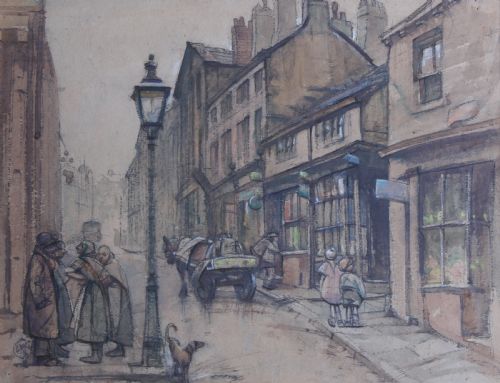
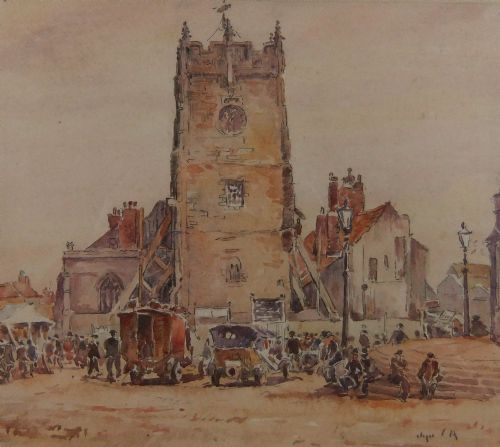
An english townscape watercolour depicts familiar urban views, architectural landmarks and busy street scenes executed on paper. These original works record historic locations ranging from northern market towns to southern inns and city walls.
The selections available here span from the late nineteenth century through the mid-twentieth century, embracing movements such as Victorian Realism, Edwardian Landscape and Mid-Century British art.
Most examples concentrate on specific named locations, offering topographical interest alongside artistic merit. Buyers encounter varied formats including finished watercolour paintings, delicate drawings and preparatory sketches.
How They Were Made
Artists relied primarily on watercolour pigment applied to paper support, frequently establishing underlying compositions with pencil or ink lines. This combination allowed painters to capture architectural detail alongside atmospheric weather effects in urban settings.
Framing materials such as wood and glass traditionally protected these delicate works from environmental damage. The combination of water-soluble pigments and paper required careful mounting to preserve the integrity of the image over decades.
The inventory spans multiple decades, moving from Victorian Realism and Edwardian styles into Modern British and Mid-Century British movements.
What Varies in Quality
The distinction between standard decorative pieces and finer works rests upon the surety of the draughtsmanship and the handling of pigment. Skilled practitioners manage transparency and light to render masonry, shadow and atmosphere with economy and precision.
Compositional strength and the evocative depiction of a specific place elevate certain works above mere topographical record. The best examples balance architectural accuracy with a distinct artistic interpretation of the street scene.
John Smith Atherton·Stanley Orchart·Angus Rands·Walter Emsley·Fred Lawson·Annie L. Lee·John J. Hamer·J.D. Walker·John Ward Knowles·A Armitage·Thomas Hearne
The English Townscape Watercolour Glossary
- Townscape
- A painting, drawing or other graphic work that depicts a city or urban scene. These works focus on buildings, streets and civic spaces rather than open rural countryside.
- Watercolour
- A painting method in which the paints are made of pigments suspended in a water-based solution. The medium is known for its luminous transparency and fluidity.
- Draughtsmanship
- The artist's ability to draw accurately and effectively. This skill underpins the structural clarity of buildings and perspective in urban views.
- Topography
- The detailed mapping and description of a particular place or locality. In art, it refers to works that faithfully record specific real-world buildings and streets.
English Townscape Watercolour: Frequently Asked Questions
How do I date an english townscape watercolour?
Dating relies heavily on artist signatures, framing clues, and architectural styles depicted within the urban scene. Clues such as horse-drawn carriages or early motor vehicles often narrow the decade.
Archival records and exhibition labels attached to the reverse also provide reliable chronological markers for these works.
Where were these watercolours typically displayed?
These works traditionally hung in domestic parlours, studies and hallway spaces of British homes. Their modest scale suited intimate residential interiors rather than grand public galleries.
Framed behind glass with wooden mouldings, they served as personal mementos of travel or familiar local landmarks.
How do I care for a watercolour painting?
Watercolours require protection from direct sunlight to prevent the fugitive pigments from fading over time. Maintaining stable indoor humidity levels prevents the paper support from buckling or developing foxing spots.
Professional framing with acid-free mount board ensures the paper remains preserved for future generations.
What defines the mid-century british style?
Mid-century works often embrace simplified forms, looser brushwork and a brighter palette compared to earlier Victorian pieces. Artists of this era interpreted traditional townscapes through a modern lens.
This stylistic shift reflects broader changes in British art following the Second World War.