

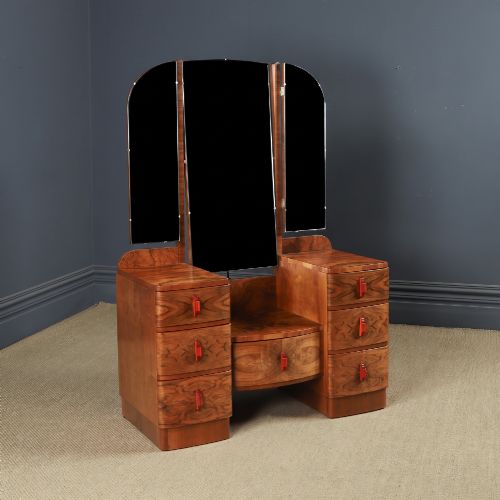


English Table Mirror
An English table mirror sits on a dressing chest or bureau to catch the morning light and frame a reflection.
English Table Mirror
Most examples found in the current selection span the Georgian, Victorian, and Edwardian eras, alongside later Art Deco iterations.
The typical form rests on a box base or small feet, often incorporating drawers for storage beneath the swivelling glass frame.
Materials and Construction
Timbers such as mahogany, walnut, rosewood, and satinwood form the primary structure of these mirrors, fashioned with fine grain and polished surfaces.
Mirror glass is held within sturdy wooden frames or mounted with brass fittings, allowing the plate to tilt smoothly on pivoting side screws.
English Table Mirror Retail Price Guide 2026
Typical asking prices for english table mirror among the pieces listed under this phrase on Sellingantiques today, from the lower quarter to the upper quarter. They describe what is for sale here now, not the wider market.
Some dressing table mirrors were designed with tiny secret drawers meant for hiding love letters from prying eyes.
Judging Quality
Quality shows in the choice of timber veneers and the crispness of the joinery around the box base and upright supports.
The clarity of the mirror plate and the weight of the brass hardware distinguish finer workshops from simpler utility pieces.
Smiths Clock Company·Heals of London
The English Table Mirror Glossary
- Box base
- A small plinth or chest fitted beneath the mirror plate, often containing one or more small drawers.
- Swivel plate
- The central glass frame mounted on pivots so the angle of reflection can be adjusted.
- Giltwood
- Timber carved and coated with gold leaf or metallic paint to create a decorative surface.
- Cheval mirror
- A freestanding full-length glass frame mounted in a floor-standing floor frame, occasionally referenced in related vanity forms.
- Toilet mirror
- The historical term for a small dressing table mirror used during grooming and toilette routines.
English Table Mirror: Frequently Asked Questions
How do I date a table mirror?
Dating relies on the construction of the drawer linings, the thickness of the glass, and the profile of the mouldings.
Earlier Georgian examples often feature hand-cut dovetails and bevelled edges, while Victorian pieces show heavier timbers and different turning on the support arms.
Where should I place a table mirror?
These pieces sit comfortably on dressing tables, chests of drawers, or sideboards in bedrooms and hallways.
They require a stable surface where the swivelling frame has enough clearance to tilt without obstruction.
Are the mirror plates original?
Many older pieces retain their original mercury or silvered glass, which often develops characteristic spots and light foxing.
Replacement glass appears in some pieces where the original silvering degraded beyond use over the centuries.
How do I care for the wood and glass?
Maintenance involves dusting the timber with a dry cloth and feeding the polish occasionally with a suitable wax.
Glass cleaner applied to a cloth rather than sprayed directly avoids seeping moisture into the wooden frame joints.