






English Serpentine Front Drawers
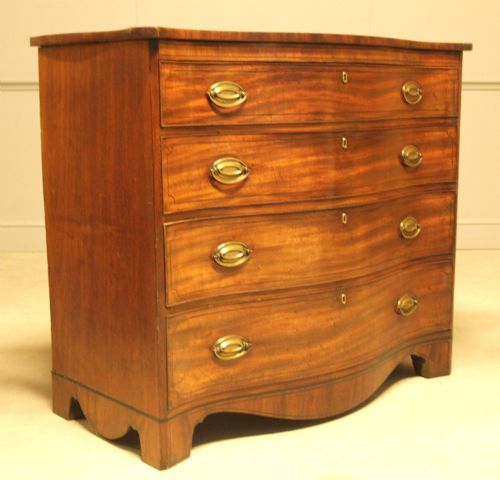
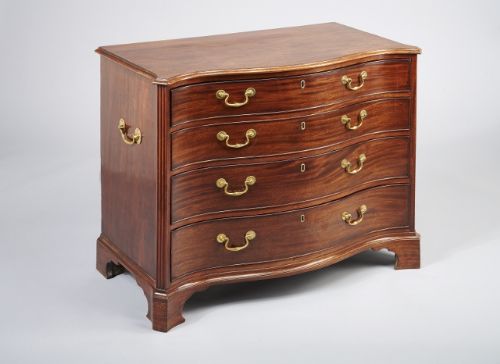
English serpentine front drawers bring the undulating curves of Georgian cabinet-making into a room, offering both sculptural presence and practical storage.
English Serpentine Front Drawers
When you search for english serpentine front drawers, you encounter a selection of case furniture defined by a gently curving front that swells outward at the centre and recedes at the sides. These pieces primarily take the form of chests of drawers, dressing chests, and commodes, originating from periods such as the Georgian era, the 18th century, and the 19th century.
The versions you are most likely to meet on this page include mahogany chests of drawers attributed to the Georgian and George III periods, alongside Edwardian interpretations and later 1920 pieces built in the George I style. Alongside standard chests, the selection extends to specialised forms such as kneehole desks, commodes in harewood and painted wood, and chests on stands.
The construction reflects traditional English cabinet-making, utilising dense timbers and fitted with brass handles. Whether you examine an 18th-century Hepplewhite period commode or a late 18th-century compact chest, the undulating outline remains the central characteristic that defines this group.
Materials and construction methods
Makers constructed these pieces predominantly using mahogany and flame mahogany, often selecting dense grain patterns to accentuate the sweeping curves of the facade. Cabinet-makers also employed harewood and satinwood for specialised commodes and dressing chests, utilising contrasting timbers to highlight the structural lines.
The assembly incorporated secondary woods and involved delicate shaping of the drawer fronts to maintain the continuous serpentine profile. Brass handles and escutcheons were fitted to the drawers, while painted wood and applied paint finishes appeared on specific decorative commodes.
Materials documented across the inventory include solid and veneered mahogany, flame mahogany, harewood, satinwood, and painted wood paired with brass hardware.
Assessing quality in serpentine furniture
Quality in these pieces rests upon the precision of the curving timber and the selection of figured veneers. Superior examples display carefully matched mahogany or flame mahogany grain that follows the exact contour of the serpentine front without distortion.
The handling of secondary details also separates standard production from finer work, including the crispness of the edge moulding, the integration of brass hardware, and the structural integrity of the carcase across periods from the 18th century onward.
The English Serpentine Front Drawers Glossary
- Serpentine front
- A furniture front characterised by a central convex curve flanked by two concave curves. This contour requires skilled cabinet-making to shape the solid wood or veneer accurately.
- Commode
- A decorative chest of drawers or cabinet, frequently associated with the 18th century and executed in fine timbers such as harewood or mahogany. These pieces often served functional roles in principal rooms.
- Flame mahogany
- A veneer cut from the branch junction of a mahogany tree, producing a distinctive flickering flame pattern. Cabinet-makers utilised this timber to create highly decorative drawer fronts.
- Kneehole desk
- A form of writing desk featuring a central recessed space for the legs, flanked by pedestals of small drawers. The evidence shows these executed with serpentine fronts.
- Hepplewhite
- A late 18th-century design style associated with lighter proportions, elegant curves, and refined cabinet work. Pieces from this period often utilised satinwood and harewood alongside mahogany.
English Serpentine Front Drawers: Frequently Asked Questions
What periods do these pieces date from?
The selection spans several centuries, with prominent representation from the Georgian era, the 18th century, and the 19th century. You will also encounter Edwardian examples and 1920 revivals built in earlier styles.
Cabinet-makers across these periods maintained the characteristic curving facade, though the choice of secondary timbers and hardware evolved over time.
How do commodes differ from standard chests?
Commodes generally denote more decorative, highly finished case furniture often associated with the 18th century. They frequently incorporated specialised woods like harewood or painted finishes.
Standard chests of drawers tended toward utilitarian storage, though the serpentine front elevated their status within Georgian interiors.
What woods were used for these drawers?
Mahogany forms the primary material for the majority of these pieces, frequently appearing as figured flame mahogany. Cabinet-makers also utilised harewood and satinwood for specific commodes.
Some variants feature painted wood and applied paint, showing a broader decorative palette alongside standard timber surfaces.
Are all serpentine chests Georgian?
Not all pieces date to the Georgian era, even though the style originated then. The listings include 19th-century interpretations, Edwardian pieces, and 1920 reproductions built in the George I style.
Examining the construction methods and secondary woods helps distinguish 18th-century originals from later revivals.