
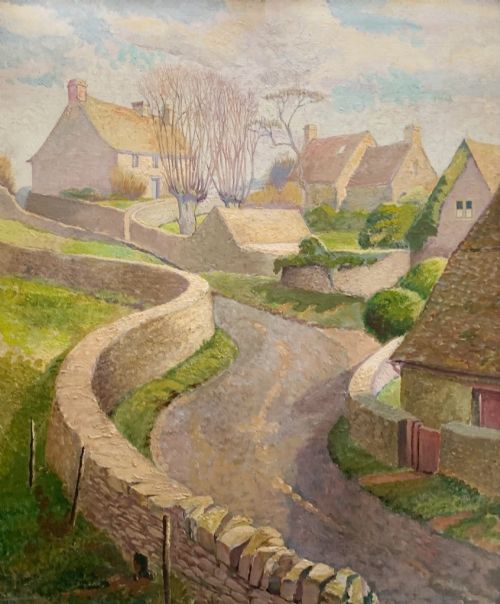



English School Impressionist Painting
These English school impressionist painting works capture changing light and rural landscapes through expressive brushwork.
English School Impressionist Painting
When you search for an english school impressionist painting, you encounter works dating from the nineteenth century through the early decades of the twentieth century. The selection on this page centres on regional landscapes, country houses, and pastoral scenes created by British artists.
Most examples you meet here take the form of landscape views set in Yorkshire and surrounding countryside. These pieces reflect the movements of British Impressionism, Post-Impressionism, and the Bloomsbury Group.
How they were made
Artists painted primarily in oil or watercolour, applying pigment directly to canvas, wood panels, or heavy paper sheets. Oil paint allows for rich, textured surfaces that build up the atmosphere of evening light or winter weather.
Watercolour works utilise fluid washes to capture open skies and rolling terrain quickly. These techniques rely on the spontaneity of the hand rather than rigid academic finish.
Materials recorded across these listings include oil paint, canvas, wood panels, watercolour, and paper.
What varies in quality
Quality rests on the confidence of the brushwork and the artist's handling of light within the scene. Stronger works convey atmosphere and topography with economy and precision.
Condition of the canvas, paper, and pigment also determines the standing of a piece. Well-preserved surfaces without heavy restoration or fading maintain the visual strength intended by the painter.
Reginald Grange Brundrit·George Graham·Arthur Tucker·Florence Hess·Herbert Royle·Frederick Mayor·Fred Stead·Ernest Higgins Rigg·Rowland Henry Hill·Owen Bowen·Fred Merriman·Fred Lawson·James William Booth
The English School Impressionist Painting Glossary
- Impressionism
- A style of painting that focuses on capturing the visual impression of a moment, especially regarding the shifting effect of light and colour.
- Watercolour
- A painting method in which the paints are made of pigments suspended in a water-based solution, typically applied to paper.
- Canvas
- A closely woven fabric used as a surface for oil painting, stretched over a wooden frame.
- Post-Impressionism
- A predominantly French art movement that developed from Impressionism, extending its limitations while retaining its use of vivid colours and thick application.
- Bloomsbury Group
- An influential group of associated English writers, intellectuals, philosophers and artists.
English School Impressionist Painting: Frequently Asked Questions
What is an English school impressionist painting?
These works are paintings created by British artists working in impressionist and post-impressionist styles during the late nineteenth and early twentieth centuries. They frequently depict rural scenes, country houses, and regional landscapes.
The grouping spans various regional art circles, including the Staithes group and the Bloomsbury Group, reflecting the wider adoption of continental techniques in Britain.
How do I choose between oil and watercolour?
Oil paintings offer textured brushwork and deep colour saturation on canvas or wood panels. They present a robust surface that often carries thick layers of pigment.
Watercolours on paper provide a lighter, more transparent finish. They suit buyers looking for delicate atmospheric effects in skies and open landscapes.
Where were these artists active?
Many of the painters represented here worked in northern England, particularly Yorkshire. Locations such as Richmond, Staithes, and Swaledale appear frequently in the titles.
Other works emerge from unnamed English school locations or specific country settings, showing a strong focus on rural topography.
How should I frame these paintings?
Period frames complement the age of these works and support their visual context. Simple moulding styles allow the brushwork and palette of the painting to remain the focus.
Watercolours require mounting behind glass to protect the paper from moisture and light damage over time.