
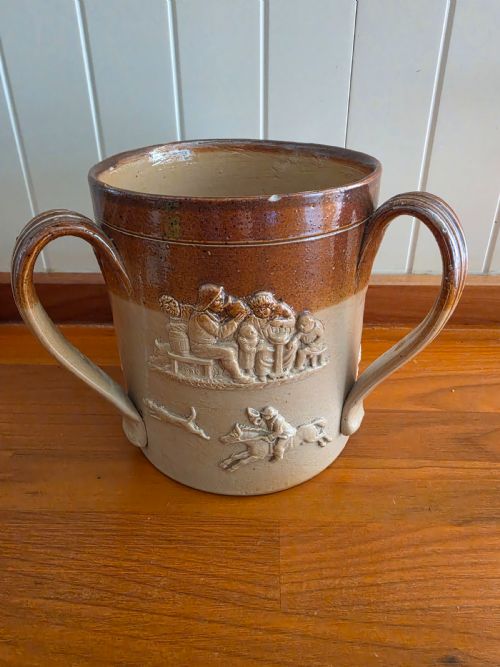


English Salt Glazed Pottery
English salt glazed pottery brings rugged texture and rich historical character to any room, offering the durability of dense stoneware alongside distinctive pitted surfaces.
English Salt Glazed Pottery
English salt glazed pottery encompasses robust utilitarian vessels and decorative pieces made from vitrified clay, most commonly seen here in the form of nineteenth-century jugs, pitchers, and tavern jars. Buyers searching for english salt glazed pottery frequently encounter Victorian Doulton Lambeth productions alongside earlier nineteenth-century and eighteenth-century examples.
The selection ranges from tall harvest jugs with sprigged ornamentation and silver mounts to puzzle jugs, salt cellars, and commemorative pieces like jubilee vessels. Surviving items demonstrate both the functional demands of domestic life and the decorative ambitions of later Victorian workshops.
Materials and technique
Potters formed these pieces using dense stoneware clay, which fired at high temperatures until the body became vitrified and impervious to liquids without requiring an internal lead glaze. Common decorative additions include applied cream-coloured sprigged reliefs and occasional sterling silver rims or plated lids.
The characteristic orange-peel texture results from throwing common salt into the kiln during the peak of the firing process, where the vaporising salt reacts with the silica in the clay body to form a glassy glaze.
Puzzle jugs challenge guests to drink without spilling by hiding secret channels inside the handle.
Judging quality
Quality in these ceramics rests on the crispness of the moulded sprigged decoration and the uniformity of the characteristic pitted salt glaze across the body. Superior examples display clean throwing lines, well-balanced proportions, and cleanly integrated metal mounts where silver hardware is present.
Attribution to named artists or esteemed workshops elevates certain pieces, distinguishing standard production vessels from exhibition-grade work created by skilled hands.
Doulton Lambeth·Emma Shute·Royal Doulton·Mortlake·C and A Painter·Moorcroft·I C Hoffmann
The English Salt Glazed Pottery Glossary
- Stoneware
- A heavy, dense ceramic fired at high temperatures until the clay body vitrifies and becomes completely non-porous. It provides the durable foundation for nearly all pieces found in this category.
- Salt glaze
- A surface finish created by introducing common salt into the kiln at maximum heat, producing a characteristic textured sheen resembling an orange peel. This chemical reaction fuses directly with the clay body.
- Sprigged
- A method of decoration where separately moulded clay reliefs are applied to the damp surface of a vessel before firing. These motifs often depict hunting scenes, floral patterns, or heraldic designs.
- Tyg
- A large drinking vessel featuring multiple handles, designed to be passed around a communal table. Early nineteenth-century examples often display robust stoneware construction.
- Puzzle jug
- An interactive vessel featuring a perforated neck that prevents normal drinking, requiring the user to cover hidden holes in the hollow handle to draw liquid. These clever pieces showcase the playful side of historical ceramics.
English Salt Glazed Pottery: Frequently Asked Questions
What is salt glazed pottery?
Salt glazed pottery is stoneware fired at very high temperatures where salt is thrown into the kiln. The vaporising salt reacts with the silica in the clay to create a durable, pitted surface finish.
This technique produces a dense, non-porous vessel that resists moisture and heavy daily use without needing traditional liquid glazes.
How do I date these pieces?
Dating relies on stylistic clues, historical markers such as royal jubilees, and identifiable maker marks stamped into the stoneware base. Eighteenth-century items often show hand-painted or simpler thrown forms, while Victorian pieces lean toward elaborate ornamentation.
Examining the type of handle, applied sprigged motifs, and any metal rim mounts helps narrow down the manufacturing decade.
Were these jugs used daily?
Many of these vessels served practical roles in taverns and homes for storing ale, water, preserving food, or serving soup. Robust stoneware made them ideal for holding liquids safely over long periods.
Other items, such as puzzle jugs and exhibition pieces, served decorative or entertainment purposes rather than standard kitchen duties.
How should I display them?
Salt glazed pieces look striking on open wooden shelving or in glazed cabinets where their tactile, textured surfaces catch the light. Their earthy tones complement both rustic and traditional interiors.
Keep them away from direct heat sources and clean them gently with a soft cloth to protect the historic stoneware surface.