


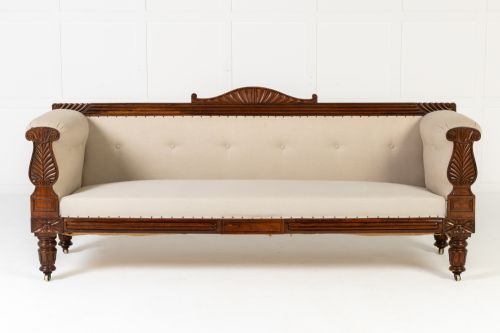


English Regency Settee
An English Regency settee brings architectural presence and seating versatility to a grand room, combining refined classical lines with substantial comfort.
English Regency Settee
An English Regency settee represents the height of classical design from the early nineteenth century, blending formal architectural restraint with comfortable domestic seating. When buyers search this phrase, they encounter robust drawing room sofas, country house settees, and occasional garden benches from the period.
The pieces appearing on this page span the broader nineteenth century alongside the strict Regency period and subsequent William IV era. Forms range from large rosewood and mahogany couches to painted and gilt show-frame settees designed for prominent display.
Origins remain firmly rooted in English cabinetmaking traditions, encompassing both urban drawing room seating and rustic country house furniture. Buyers frequently discover double-ended couches, scroll-end sofas, and button-back settees upholstered in leather, fabric, or hessian.
Materials and Construction
Cabinetmakers utilised dense exotic timbers like rosewood and mahogany for primary frames, often incorporating brass inlay to accent the wood grain. Giltwood and painted finishes provided decorative surface brilliance for formal drawing room seating.
Structural elements relied on robust joinery to support large scroll ends and carved herms, while wrought iron served for durable outdoor garden benches. Upholstery methods incorporated leather, fabric, and hessian over supportive internal webbing and springs.
English Regency Settee Retail Price Guide 2026
Typical asking prices for english regency settee among the pieces listed under this phrase on Sellingantiques today, from the lower quarter to the upper quarter. They describe what is for sale here now, not the wider market.
Listings feature woods like rosewood, mahogany, and walnut alongside giltwood and wrought iron, capturing nineteenth century and Regency periods.
Assessing Quality and Execution
Quality reveals itself through the crispness of carved wooden details, such as figurative herms, scroll arms, and applied gilt ornamentation. Superior examples display carefully matched timber veneers and intricate brass inlay that integrates seamlessly into the frame.
The integrity of the underlying structural frame dictates longevity, separating sturdy architectural seating from compromised pieces. Upholstery treatment and finish preservation further distinguish standard domestic furniture from exceptional country house pieces.
The English Regency Settee Glossary
- Regency
- A period of English design spanning roughly the early nineteenth century, characterised by classical motifs drawn from ancient Greece and Rome. This style prioritises symmetry, architectural proportion, and refined ornamentation.
- Scroll End
- A furniture arm or terminal curving outward in a continuous spiral shape. This form defines many classic couches and settees of the period.
- Giltwood
- Timber coated with a thin layer of gold leaf or gilt preparation. It creates a brilliant metallic surface typical of formal Regency and country house furniture.
- Herm
- A carved human bust or figure tapering toward the base, frequently integrated into the structural supports of seating furniture. These figures lend a classical architectural gravitas to the frame.
- Double Ended Couch
- A seating form featuring identical raised ends, allowing a user to recline comfortably from either direction. These pieces function as versatile daybeds within principal reception rooms.
English Regency Settee: Frequently Asked Questions
What defines an English Regency settee?
An English Regency settee is a formal seat dating from the early nineteenth century, characterised by classical revival motifs and architectural lines. These pieces frequently feature scroll ends, exposed timber frames, and sophisticated decorative elements.
Craftsmen utilised materials such as mahogany, rosewood, and giltwood to build these substantial pieces for drawing rooms and country houses.
How were these settees originally used?
These settees served as principal seating within formal drawing rooms, libraries, and grand reception spaces of English country houses. Their generous proportions accommodated multiple guests or allowed individuals to recline during daytime hours.
Garden benches made of wrought iron fulfilled similar functional roles outdoors, bridging domestic comfort with landscape architecture.
Where should I place one today?
A Regency settee anchors a large living room, drawing room, or wide hallway, serving as a striking focal point. Positioning the piece away from direct sunlight protects sensitive rosewood, mahogany, and leather surfaces.
Pairing the settee with complementary period furniture enhances its historical context within a modern interior.
How do I care for leather upholstery?
Leather upholstery requires regular dusting and periodic conditioning to maintain its suppleness and prevent cracking. Keeping the leather away from excessive heat sources preserves the material over decades of daily use.
Professional restoration ensures that fully restored or dyed leather retains an authentic appearance suited to antique frames.
How do I distinguish Regency from William IV?
Regency design typically displays leaner classical proportions, delicate brass inlay, and refined carving influenced by Greek and Roman models. William IV furniture, emerging slightly later in the nineteenth century, often presents heavier, more robust forms.
Comparing the scale of the frame and the weight of the carved details helps clarify the exact period of manufacture.