

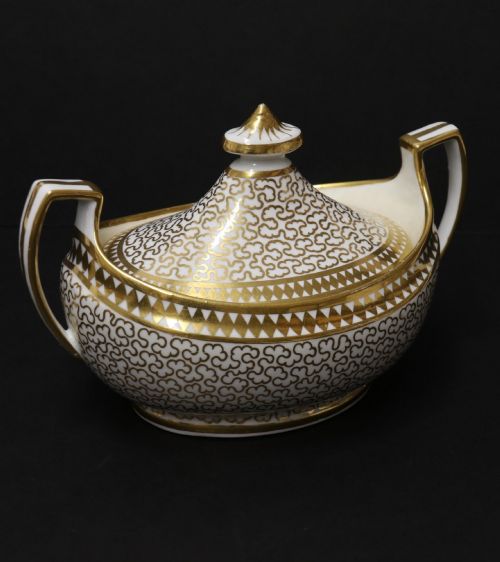


English Porcelain Sugar Basin
An english porcelain sugar basin brings the refined touch of the dining table from past centuries straight into your own home.
English Porcelain Sugar Basin
An english porcelain sugar basin is a vessel designed to hold sugar for tea service, appearing in forms such as sucriers with covers, sugar bowls, and two-handled bowls. These pieces range from Georgian and Regency creations to later 19th Century and 1920 productions.
The most common examples on this page are covered sucriers and sugar bowls originating from historic factories, often accompanied by matching cream jugs in set configurations. They span traditional British porcelain manufacture across several distinct design eras.
How they were made
Potters shaped these vessels using porcelain, bone china, soft-paste porcelain, and felspar porcelain, applying delicate techniques to achieve smooth, translucent bodies. Many examples incorporate specialised bodies developed by historic British manufactories during the late 18th and 19th centuries.
Makers finished the surfaces with hand-applied enamel painting, gold leaf, and gold gilding to create intricate patterns such as the Angouleme design and Imari palettes. Covers were thrown to fit precisely, and some forms included delicate handles fashioned directly into the porcelain body.
English Porcelain Sugar Basin Retail Price Guide 2026
Typical asking prices for english porcelain sugar basin among the pieces listed under this phrase on Sellingantiques today, from the lower quarter to the upper quarter. They describe what is for sale here now, not the wider market.
What varies in quality
Quality rests in the precision of the porcelain body and the crispness of the moulded form, where finer examples display thin, even walls and perfectly fitting covers. The sophistication of the porcelain paste itself, from early soft-paste to later felspar variants, marks the standard of production.
Hand-painted decoration creates a wide divergence in character, with skilled enamel work and generous gold gilding distinguishing superior specimens from simpler wares. The execution of specific patterns, such as detailed Imari motifs or botanical painting, elevates the artistic merit of the piece.
Chamberlains Worcester·Spode·Royal Crown Derby·Ridgway·Worcester·Royal Worcester·Flight and Barr·Coalport
The English Porcelain Sugar Basin Glossary
- Sucrier
- A covered sugar basin designed for the tea table. This term appears frequently in historic British pottery records.
- Felspar porcelain
- A durable ceramic body introduced in the 19th century that incorporated felspar to improve strength. It allowed for bright, crisp enamel decoration.
- Soft-paste porcelain
- An artificial porcelain composition fired at lower temperatures than hard-paste, common in 18th-century English manufacturing. It possesses a warm glaze texture.
- Imari
- A decorative style inspired by Japanese export wares, featuring rich iron red, cobalt blue, and gold gilding. Victorian makers adapted this palette extensively.
- Flight Period
- An era of Worcester porcelain production dating from the late 18th century under the management of Thomas Flight. Pieces from this time carry specific factory marks.
English Porcelain Sugar Basin: Frequently Asked Questions
What is a sucrier?
A sucrier is simply the traditional term for a sugar basin or bowl, usually fitted with a matching lid.
These covered vessels formed an essential part of historic tea service sets alongside teapots and cream jugs.
How old are these sugar basins?
The pieces span from the late 18th century through the Regency era and 19th Century, up to 1920 productions.
Earlier examples originate from historic periods like the Georgian era, while later pieces reflect early 20th-century artistic painting.
Did sugar basins come with covers?
Many traditional sugar basins, frequently referred to as sucriers, were created with matching fitted covers to keep the contents clean.
Open sugar bowls and two-handled variants were also produced, particularly in later 20th-century decorative sets.
How do I identify a maker?
Makers are often identified through factory marks, script signatures, or specific pattern numbers painted on the underside of the base.
Renowned English potteries such as Worcester, Spode, and Coalport each utilised distinct decorative styles and stamps.