

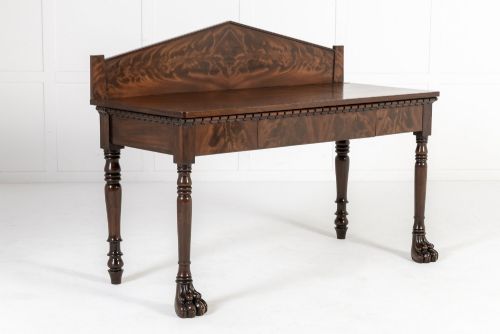


English Mahogany Server
An english mahogany server brings substantial proportion and rich timber grain to a dining room, offering both display surface and discrete storage.
English Mahogany Server
An english mahogany server spans multiple eras from the eighteenth century through the Edwardian period, encompassing sideboards, serving tables, and pedestal formats. Buyers seeking this phrase encounter formal Regency serving tables, heavy William IV buffets, and elaborate Victorian pedestal sideboards with mirrored gallery backs.
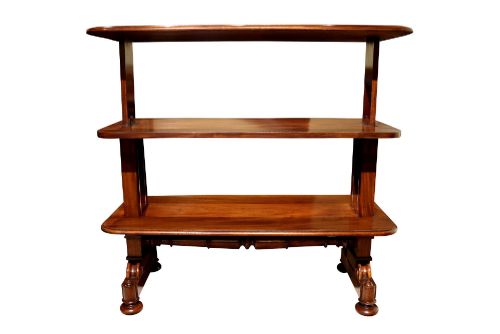
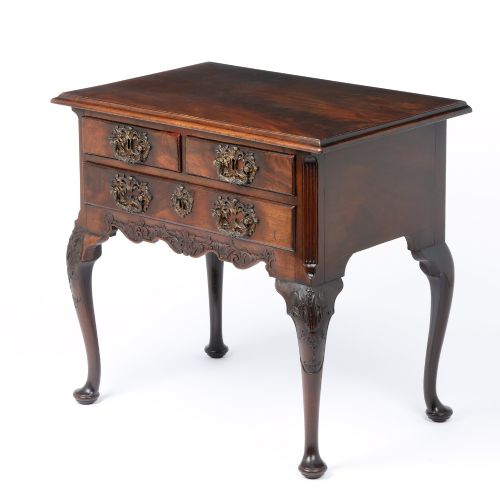
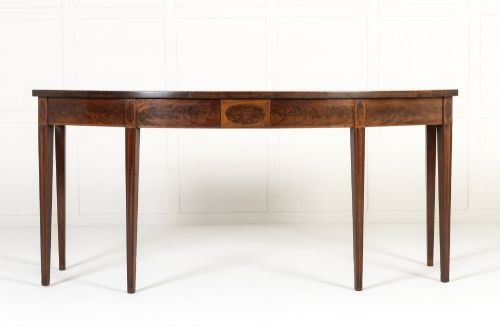
The material evidence shows these pieces originating across Georgian, Regency, and Victorian workshops, often taking the shape of lowboys, console tables, or multi-tiered dumb waiters. Serving tables and sideboards dominate the selections, serving the traditional function of holding food and tableware during dining.
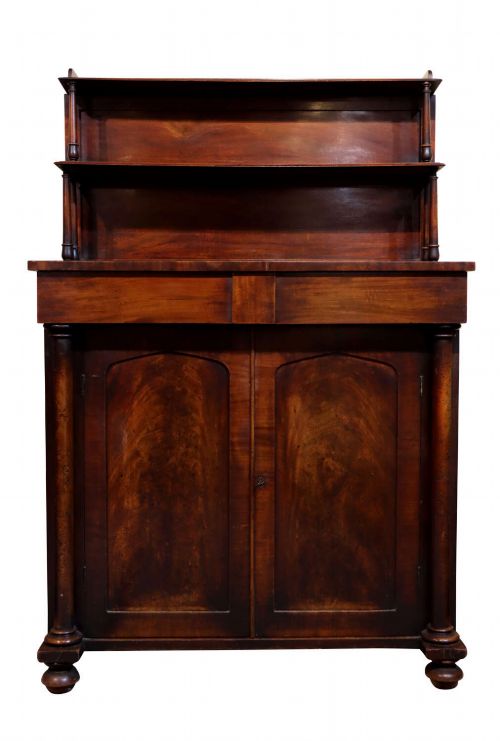
Proportions vary from slender side tables with satinwood inlay to large four-door chiffoniers built to anchor a substantial dining room. The overarching form remains rooted in practical hosting, whether through tiered shelving or deep pedestals designed for bottle storage.
Materials and Technique
Makers relied heavily upon solid mahogany and flame mahogany veneer, chosen for deep figuring and rich visual warmth. Secondary timbers such as oak appear in internal framing and drawer construction, providing robust structural support beneath the polished exterior surfaces.
Decorative elements involve careful contrasting details, utilising satinwood inlay and dark ebony lines to frame drawer fronts and panel borders. Brass fittings, handles, and occasional gallery rails add functional hardware accents to the polished timber structures.
Cabinetmakers employed hand-carved motifs alongside precise veneering techniques to create sweeping curves on bow fronts and pedestal mounts. Surface finishing relied on extensive polishing to bring out the natural chatoyancy of the flame mahogany grain.
Some Edwardian server tables double as party turntables, ensuring that passing canapés requires minimal exertion.
Assessing Quality
Quality rests significantly on the selection of the timber veneer, where book-matched flame mahogany displays dramatic symmetry across larger cabinet doors and drawer banks. Finer examples exhibit crisp hand-carved details and harmonious proportions rather than purely mechanical mass production.
Construction integrity separates the workshop standards, visible in the precision of dovetail joints on drawer boxes and the clean integration of inlay work. The depth of the timber's natural colour and the crispness of brass hardware contribute to the overall visual presence of the piece.
Oetzmann & Co.
The English Mahogany Server Glossary
- Flame mahogany
- A veneer cut from timber where the branch meets the trunk, producing a rippling, flame-like pattern across the wood. This figuring is prized for its decorative impact on primary cabinet doors.
- Dumb waiter
- A tiered piece of freestanding furniture designed to hold plates and dishes near a dining table without servant assistance. These rotate or tier upwards to maximise vertical space.
- Chiffonier
- A low sideboard cabinet, often featuring shelves or a small enclosed cupboard beneath the main surface. Victorian and William IV examples frequently incorporate mirrored backs.
- Lowboy
- A small table with drawers, originating in the Georgian period, often serving as a compact writing desk or auxiliary serving surface. They sit on slender legs with distinct kneehole spaces.
- Gallery back
- A raised framework attached to the rear surface of a sideboard or server, designed to prevent items from sliding off. These often incorporate carved wooden scrolls or small display shelves.
English Mahogany Server: Frequently Asked Questions
What is the difference between a server and a sideboard?
Servers generally provide a lighter, more open surface for presenting food and drink during meals. Sideboards often incorporate deeper cupboards, bottle drawers, and extensive storage capacities for heavy dining inventory.
Traditional servers may stand on taller legs like a side table, whereas heavy pedestal sideboards anchor themselves firmly to the floor with enclosed cabinetry.
How do I date an english mahogany server?
Dating relies on observing structural characteristics, hardware styles, and timber treatments across different eras. Georgian and Regency pieces favour cleaner classical lines and subtle inlay, while Victorian examples lean toward heavier proportions and elaborate carved details.
Internal construction methods, such as hand-cut dovetails and secondary timbers like oak, offer further clues to the manufacturing decade.
Where should I place a server in a modern home?
These pieces fit naturally in a dining room or large kitchen space, continuing their original function as a surface for serving food or displaying ceramics. They also work effectively in hallways or living rooms as console tables with built-in storage.
Ensure the depth of the cabinet matches the clearance of the room, particularly with larger pedestal models or pieces featuring gallery backs.
How do I care for antique mahogany furniture?
Maintain the timber by keeping it away from direct sunlight and sudden temperature shifts that cause the veneer to warp or dry out. Regular dusting with a soft, dry cloth preserves the polished surface without building up residue.
Apply a traditional wax polish occasionally to nourish the wood and maintain the deep lustre characteristic of period mahogany.