



English Ladder Back Chairs
These English ladder back chairs combine honest regional joinery with resilient woven seating, offering a tactile anchor for country house interiors.
English Ladder Back Chairs
English ladder back chairs appear across several distinct periods, with nineteenth-century examples and turn-of-the-century country pieces most frequently met on this page. Makers across the regions built these versatile forms as armchairs, carvers, rocking chairs, and larger sets of dining chairs for everyday domestic use.
The aesthetic draws heavily on vernacular traditions, spanning robust elm, ash, and oak constructions that reflect regional tastes from Georgian iterations up to Edwardian country workshops. Dining sets and single armchairs alike demonstrate a functional utility rooted in domestic farmhouse and kitchen environments.
Makers utilised traditional regional patterns, occasionally intersecting with formal Regency or Chippendale influences while retaining the characteristic horizontal slats that define the backrest. Buyers encounter everything from single rocking armchairs to larger sets of ten dining chairs spanning the eighteenth, nineteenth, and early twentieth centuries.
Materials and construction
Timbers like ash, elm, and oak provide the structural integrity for these frames, shaped via traditional turning and joinery techniques suited to country workshops. Selected hardwoods allow the characteristic horizontal slats and upright posts to withstand daily use while maintaining slender proportions.
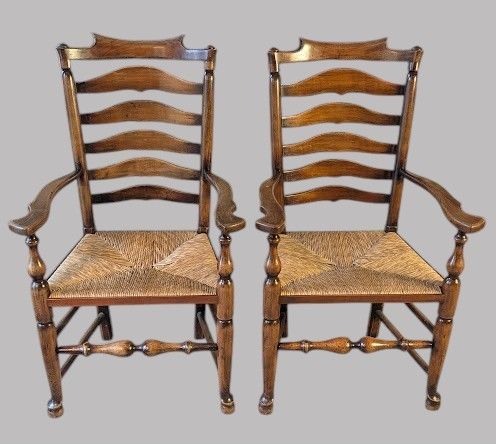
Natural rush or woven seating material fills the seat frames, providing a resilient and flexible surface that complements the wooden architecture. Selected examples incorporate brass details or contrasting woods, uniting structural timber with organic cordage.
English Ladder Back Chairs Retail Price Guide 2026
Typical asking prices for english ladder back chairs among the pieces listed under this phrase on Sellingantiques today, from the lower quarter to the upper quarter. They describe what is for sale here now, not the wider market.
One exceptional piece transforms from a library armchair into a set of steps, proving that country and town makers loved a hidden party trick.
Factors of quality
Quality rests in the integrity of the timber framing and the tightness of the rush weaving, where uniform tension across the seat indicates skilled execution. Superior examples retain their original structural timber without excessive replacement of the horizontal slats or upright posts.
The finesse of the turnery on the uprights and the harmony of proportion between the back rails and the seat separate standard vernacular pieces from masterworks. Integration of genuine period materials during restoration preserves the historical character expected by discerning buyers.
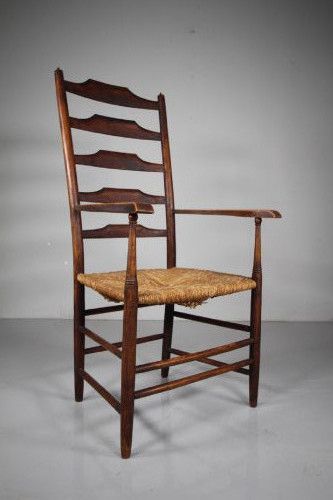
Philip Clissett
The English Ladder Back Chairs Glossary
- Ladder back
- A chair featuring a series of horizontal slats resembling a ladder between the vertical uprights of the backrest. This design dates back centuries in domestic English furniture production.
- Rush
- Dried marsh grass twisted into cords and woven tightly to form resilient chair seats. Natural rush provides a flexible and traditional seating surface.
- Carver
- An armchair, traditionally placed at the head of a dining table or used as a desk chair. These pieces often mirror the design of the matching smaller dining chairs.
- Vernacular
- Furniture made by local craftsmen following regional traditions rather than high-style metropolitan fashions. These objects prioritise practical utility and local materials.
- Spindle back
- A chair back constructed with numerous thin vertical wooden rods instead of solid horizontal planks. This construction lightens the visual weight of the frame.
English Ladder Back Chairs: Frequently Asked Questions
What periods do these chairs cover?
The inventory spans multiple eras, beginning in the eighteenth century with Georgian and Chippendale pieces, moving through Regency and Victorian periods, and extending to Edwardian items around nineteen hundred.
This broad chronological range allows buyers to select pieces that align with specific historical interiors, from early vernacular oak to later ash and elm variations.
How do I use them in a dining room?
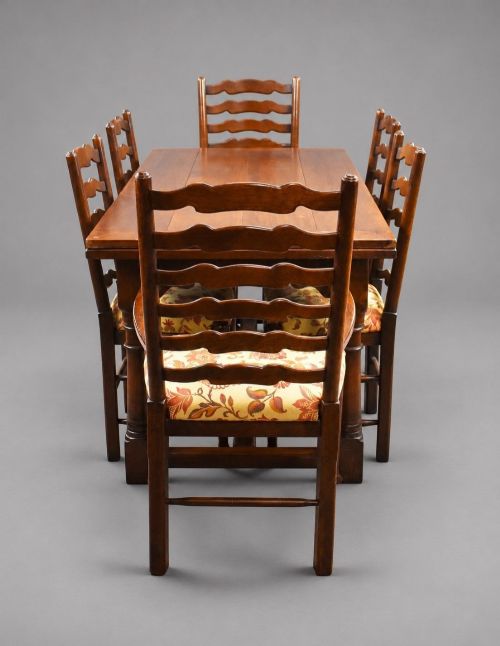
Dining chairs and carvers fit naturally around large wooden tables, offering sturdy seating for daily meals or formal gatherings. Sets of multiple chairs provide a cohesive aesthetic while single armchairs serve as end chairs.
The organic textures of rush and timber complement rustic and traditional interior schemes alike.
Are rocking chairs available in this style?
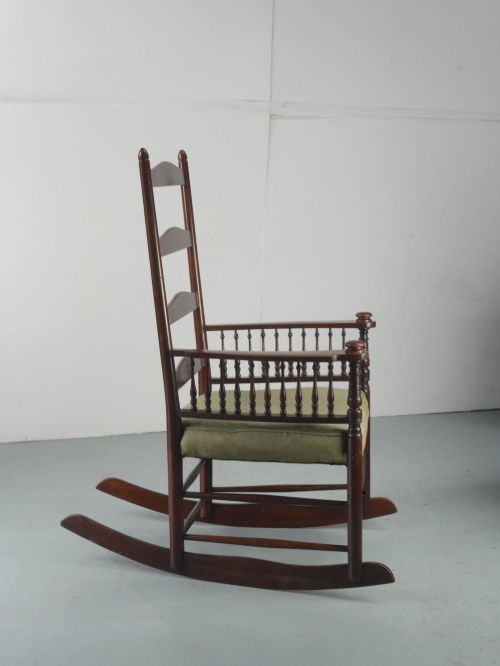
Rocking chair variants appear among the nineteenth-century listings, offering the same horizontal slat backrest mounted upon curved wooden rockers. These domestic pieces were built for comfort in farmhouses and parlours.
They combine the traditional turned frame with a deeper seat incline designed for relaxation.
What timbers were used for the frames?
Craftsmen relied on domestic hardwoods including ash, elm, oak, and mahogany to construct durable frames. These woods were often turned on lathes to shape the upright posts and decorative stretchers.
Selected pieces combine ash and elm to balance structural strength with lighter framing.