



English Georgian Card Table
An English Georgian card table offers a clever folding top that transforms a handsome pier piece into a proper gaming surface.
English Georgian Card Table
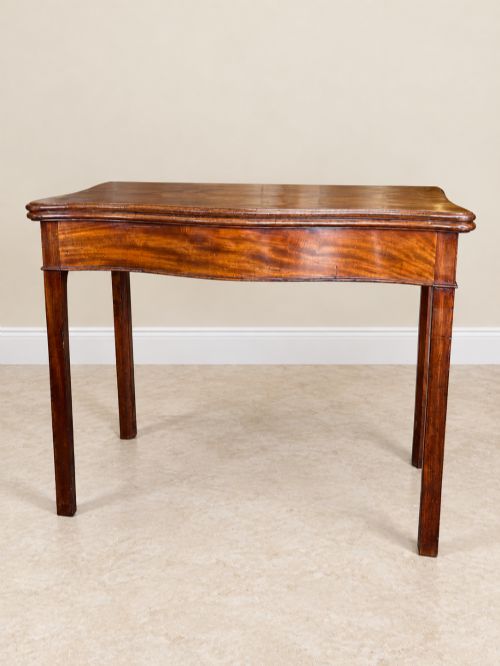
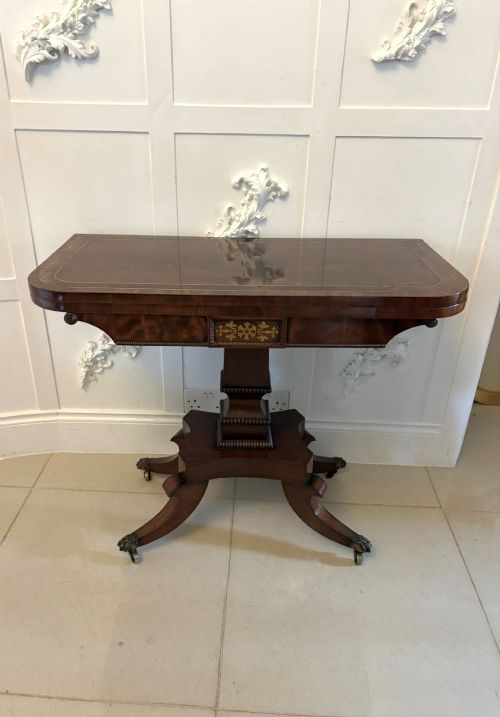
An english georgian card table is a multi-purpose folding furniture piece designed for evening entertainment in 18th and early 19th century parlours. The listings show a heavy concentration of mahogany examples alongside walnut and occasional satinwood pieces, ranging from the architectural George II period through George III demi-lune shapes to later William IV and Georgian Revival interpretations.
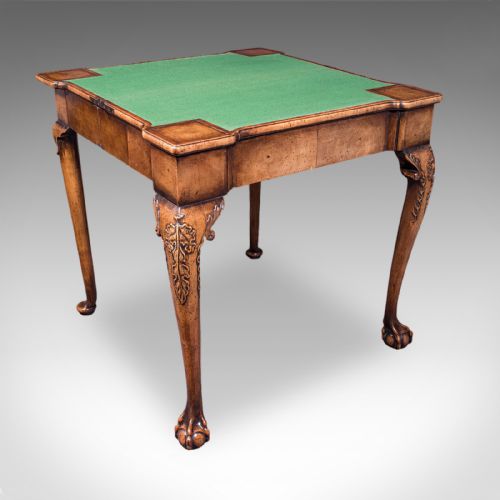
Buyers will most frequently encounter rectangular fold-over tops and semi-circular demi-lune formats that double as tea or side tables when closed. These items served a vital social function in period homes, concealing a baize-lined playing surface until guests gathered for cards or supper.
Materials and construction
Cabinetmakers relied heavily on dense timber framing, constructing the primary surfaces in solid mahogany and walnut with supportive secondary pine or oak structures. Decorative emphasis relied on contrasting veneers, utilising boxwood, satinwood inlay, and brass stringing to edge the folding tops and aprons.
The mechanical action depended on robust hinge placements and swing-out rear legs that supported the heavy cantilevered top leaf when opened. Internal wells were frequently built into the frame beneath the fold to store counters, dice, and deck boxes safely out of sight.
English Georgian Card Table Retail Price Guide 2026
Typical asking prices for english georgian card table among the pieces listed under this phrase on Sellingantiques today, from the lower quarter to the upper quarter. They describe what is for sale here now, not the wider market.
The listings demonstrate a strong preference for mahogany timbers, alongside occasional walnut and satinwood inlay examples from the Georgian and Victorian eras.
Judging distinction
Quality rests upon the crispness of carved details on the knees and legs, the selection of timber grain, and the seamless alignment of the top when folded. Superior execution shows in the precision of edge inlay and the smooth, integrated movement of the pivoting support leg.
Lesser pieces often display mechanical fatigue or later timber replacements in the frieze, whereas the highest tier retains an unblemished original surface warmth and deep patination developed over centuries.
The English Georgian Card Table Glossary
- Baize
- A coarse woollen fabric, typically green, used to line the playing surface of games tables. It provided a soft texture that kept dice and cards from sliding.
- Demi-lune
- A half-moon shape popular for console and card tables in the later 18th century. These fit neatly against walls when closed.
- Fold-over
- A hinged top design that doubles the surface area when opened out. This mechanism allows a compact side table to convert instantly for dining or gaming.
- Patination
- The natural sheen and surface depth acquired by wood through age, handling, and light exposure. Good examples show a deep, rich lustre.
- Serpentine
- A curved edge design shaped like a gentle 'S', featuring a convex centre flanked by concave corners. This contour requires skilled cabinetmaking.
English Georgian Card Table: Frequently Asked Questions
What is an english georgian card table?
These are historical folding wooden tables engineered specifically for parlour games and tea service in elite households during the 18th and early 19th centuries.
They feature a hinged double top that swings open to reveal a baize-lined interior, combining decorative utility with social functionality.
How were these tables used originally?
Hosts placed them against the parlour wall as decorative console or tea tables when not hosting visitors.
When evening arrived, servants swung the top open and pulled out the rear leg support to create a stable playing area for whist, ombre, or bridge.
How do I spot a reproduction?
Look closely at the timber movement, the wear around the hinge plates, and the depth of the finish.
Authentic examples exhibit natural timber shrinkage, hand-cut joinery inside the frieze, and historical patination that modern staining struggles to replicate.
Where should I place one at home?
They suit entrance halls, living rooms, and landings particularly well when kept in the closed position against a flat wall.
Placing them near natural light also highlights the inlaid satinwood, brass stringing, and figuring of the mahogany top.
How do I care for the baize?
Keep the interior surface dry and away from direct sunlight to prevent the woollen fabric from fading or degrading over time.
Gentle brushing removes dust safely without disturbing the underlying timber frame or historic hinges.